Key Ways Online Tutors Guide Your IB Extended Essay Research and Writing
An online tutor can help you build the research, reasoning and planning skills needed for the IB Extended Essay, especially when a promising idea feels difficult to turn into a focused investigation. Useful support teaches you how to work independently rather than supplying an argument or polishing your submission. The most important decision is not simply whom to hire: it is whether the proposed help respects IB requirements, your school’s rules and your own authorship.
Check Our IB Online Tuition Classes Choose Your IB Home Tutoring for Success
What the IB Extended Essay Requires
The Extended Essay is an independent research component of the IB Diploma Programme, culminating in an academic essay of up to 4,000 words. It requires a focused investigation, appropriate evidence and a reasoned response to a research question. The challenge is not filling the word count; it is making defensible decisions about what to investigate, what evidence to use and what that evidence actually shows.
Your school-appointed supervisor remains the central source of guidance on requirements, reflection and the submission process. Use the IB Extended Essay guide for your assessment session, and ask your supervisor or Diploma Programme coordinator what outside assistance is permitted before arranging essay-specific tutoring. Requirements and assessment guidance can differ between cohorts.
Keep Tutoring Separate from Authorship
Outside tutoring must not become additional supervision or unacknowledged collaboration. Even well-intentioned suggestions can compromise independence if someone else selects the question, develops the interpretation or repeatedly improves the assessed draft. The safest starting point is general skills teaching using material that is not part of your submission.
- Useful skills teaching: explaining how to evaluate a source, distinguish correlation from causation, organise research notes or recognise an unsupported claim.
- School-dependent assistance: discussing your actual research question, outline, data or draft. Establish permission and limits first; do not assume that anything labelled “feedback” is acceptable.
- Work the tutor must not do: write or rewrite passages, supply your analysis, fabricate findings, choose conclusions or compose reflections on your behalf.
- Your responsibility: make the research decisions, write the essay and reflections, acknowledge sources, and disclose assistance as required by your school.
The same principle applies to automated writing tools. Generated wording or interpretations are not evidence of your independent thinking, and invented references can undermine an otherwise careful investigation. Keep a transparent record of your research and follow the applicable IB and school guidance.
Discover Our Classes With A Guided Centre Tour Near You📍
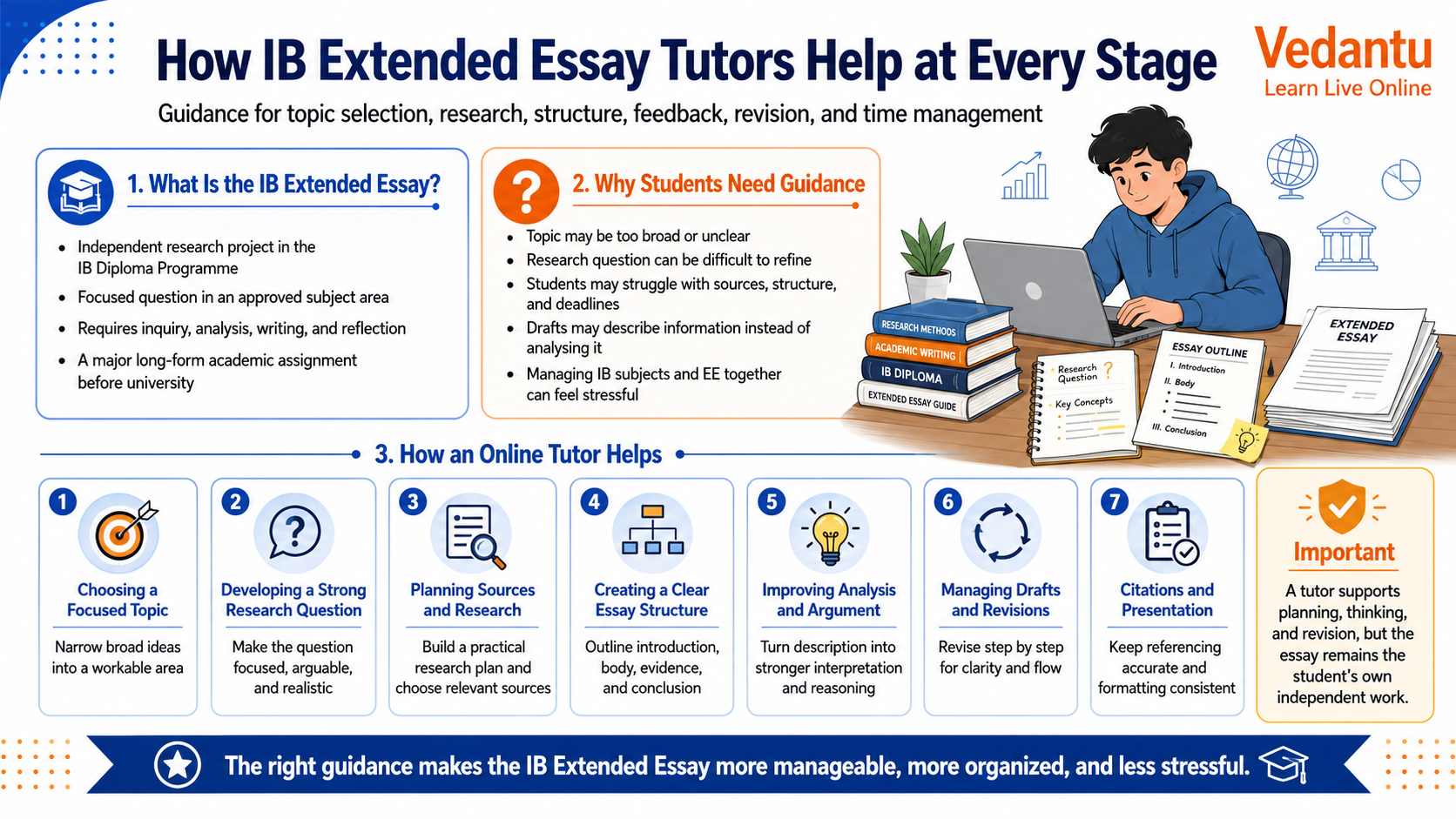
How Online Tutoring Can Support Each Stage
A productive session should leave you with a skill you can apply independently. The examples below describe skills-focused support; any discussion of your assessed work must remain within the boundaries agreed with your school.
| Stage | What a Tutor Can Teach | What You Do Independently |
|---|---|---|
| Topic exploration | How scope, evidence access and research methods affect feasibility. | Choose an area and discuss its suitability with your supervisor. |
| Question development | How to distinguish a broad topic from an investigable question. | Formulate and justify your own research question. |
| Research | Search strategies, source evaluation and accurate note-taking. | Find, read and evaluate the evidence you use. |
| Argument and structure | How claims, evidence, interpretation and limitations connect. | Construct your argument and write each section. |
| Revision | Self-review methods using unrelated practice passages. | Revise within the school’s feedback arrangements. |
| Referencing | Quotation, paraphrase and citation conventions. | Check attribution and bibliographic details throughout. |
Turn a Broad Interest into a Researchable Question
A topic such as “climate change” is an area of interest, not yet a workable investigation. Narrowing it involves identifying a specific issue, context and body of evidence. A tutor can demonstrate that narrowing process with a practice example, while you develop your own question and seek your supervisor’s guidance.
Before committing to a question, test it against four practical checks:
- Subject fit: Does the question require methods and reasoning appropriate to the chosen subject or permitted pathway?
- Evidence access: Can you obtain suitable texts, sources or data without relying on inaccessible material?
- Analytical depth: Does answering it require interpretation or evaluation, rather than a list of facts?
- Manageable scope: Can you investigate it meaningfully within the word limit, available time and school resources?
A narrower question is not automatically easier, but it usually makes depth more achievable. For experimental work or research involving people, discuss safety, ethics and feasibility with the school before collecting data.
Build Better Research and Analysis Habits
Record Why Each Source Matters
Collecting many sources is less useful than understanding a smaller set carefully. Maintain a research log with the source details, relevant page numbers, a summary in your own words, possible uses and limitations. Keep exact quotations visibly separate from your notes so that borrowed wording does not accidentally enter the essay without attribution.
Source quality depends on the subject and purpose. A historical document may be valuable precisely because it reveals a particular perspective, while a scientific claim requires attention to methods, measurements and uncertainty. A tutor with relevant subject knowledge can teach these distinctions without choosing your evidence for you.
Move Beyond Description
Description reports what a source says or what the data show. Analysis explains why that information matters, how securely it supports a claim and what alternative explanations remain. For example, “the measured value increased” reports a result; examining measurement uncertainty and whether the method supports a causal conclusion demonstrates deeper reasoning.
For each paragraph, ask: What claim am I making? Which evidence supports it? What can I reasonably infer? What limits that inference? How does this help answer the research question? Practising these questions on unrelated material can make tutoring useful without handing over the intellectual work of the essay.
Use Online Sessions to Create a Manageable Routine
Online sessions can remove commuting and make short skills lessons easier to fit around school, depending on the tutor’s availability. Their value depends on what happens between meetings: you still need protected time for reading, thinking and writing. Screen-sharing or a shared whiteboard can support demonstrations where the service offers them, but these tools are not a reason to allow someone else to edit your submission.
A sample 45-minute skills session could use five minutes to identify one difficulty, 15 minutes for a demonstration on unrelated material, 20 minutes for your practice and five minutes to agree a next step. Choose one clear outcome, such as learning to evaluate a study’s limitations, rather than trying to “fix the essay” in one sitting.
- Work backwards: put school deadlines and supervisor meetings into your calendar first.
- Set concrete milestones: use tasks such as “evaluate three relevant sources” instead of “do research”.
- Separate work types: reserve different blocks for reading, note-making, drafting and self-review.
- Leave a buffer: allow time for inaccessible sources, inconclusive findings and referencing checks.
Choose Support That Matches the Actual Difficulty
Tutoring is not necessary for every student. If your main difficulty is an unclear school requirement, ask your supervisor. If it is finding academic material, a school librarian may be more useful. If you understand the task but repeatedly struggle with a transferable skill, a targeted lesson may help more than a large tutoring package.
When considering a tutor, ask for relevant subject experience and an explanation of how they teach research skills without contributing to assessed work. Someone who teaches literary analysis may not be the right person to explain experimental uncertainty. Avoid services promising a particular grade, unlimited draft polishing or a “ready-to-submit” essay.
For an initial reading resource, Vedantu’s How Online Tutors Support IB Extended Essays can provide context for a conversation about support. A reading resource can be used independently, but unlike an individual lesson it cannot respond to your specific skill gaps. Neither replaces school supervision; if considering paid support through Vedantu or another provider, confirm subject suitability, availability and school-permitted boundaries before booking.
Summary
An online tutor is most useful when they teach skills you can apply independently: focused inquiry, source evaluation, analytical reasoning and realistic planning. Your research decisions, writing and reflections must remain your own, with school supervision guiding the assessed work. Start by identifying one difficulty and agreeing the limits of outside help with your supervisor. Vedantu’s Extended Essay reading resource offers a starting point for understanding support options, without replacing subject-specific guidance or the applicable IB requirements.
FAQs on How an Online Tutor Can Support Your IB Extended Essay
1. How can an online tutor support my IB Extended Essay?
An online tutor can guide you through every stage of your IB Extended Essay by offering personalized feedback, topic selection advice, and research guidance.
- Helps you narrow down and refine your research question
- Assists in structuring your essay according to IB criteria
- Provides support with referencing and academic honesty
- Reviews drafts and gives detailed suggestions for improvement
- Offers effective time management strategies
2. What are the benefits of working with an online IB Extended Essay tutor?
Working with an online IB Extended Essay tutor provides customized support tailored to your strengths and challenges.
- Guidance on topic selection and proposal submission
- Step-by-step support in formulating arguments
- Expert advice on research methods and credible sources
- Timely feedback to improve essay clarity and structure
3. Can an online tutor help me choose a good Extended Essay topic?
Yes, an online tutor can help you select a unique and relevant Extended Essay topic that aligns with the IB syllabus.
- Evaluates your interests and strengths
- Suggests researchable and focused topics
- Ensures your topic meets IB subject requirements
4. How does online tutoring support research for the IB Extended Essay?
Online tutors support effective research skills by teaching you how to find, evaluate, and cite reliable sources.
- Demonstrates research database use
- Guides on note-taking and information organization
- Helps in referencing and citation styles
- Prepares you for academic honesty requirements
5. Will I receive feedback on my IB Extended Essay drafts from an online tutor?
Yes, online tutors provide detailed feedback on your Extended Essay drafts, helping you strengthen arguments, structure, and clarity.
- Identifies areas for improvement
- Provides actionable suggestions
- Ensures your work meets IB assessment criteria
6. What is the role of academic honesty in the IB Extended Essay and how can a tutor help?
Academic honesty is essential in the IB Extended Essay to maintain originality and integrity. An online tutor can:
- Clarify plagiarism rules
- Teach correct citation methods
- Review your essay for proper referencing
- Help develop ethical research habits
7. How can online tutors help me stay on track with my IB Extended Essay deadlines?
Online tutors assist you in managing deadlines effectively by creating structured study plans and regular checkpoints.
- Breaks essay tasks into manageable steps
- Sets clear milestones for each section
- Monitors progress and offers reminders
8. Do online tutors offer support for organizing and structuring my Extended Essay?
Yes, online tutors guide you in organizing your Extended Essay by teaching you how to build logical arguments and maintain clear essay flow.
- Helps with outline and chapter planning
- Ensures coherent introduction, body, and conclusion
- Reviews and refines essay structure
9. Can an online IB tutor help with referencing and citations?
Absolutely, an online IB tutor will guide you through correct referencing and citation techniques as per IB guidelines.
- Explains different citation styles (MLA, APA, Chicago)
- Reviews references for accuracy and completeness
- Prevents unintentional plagiarism
10. Is online tutoring effective for all IB Extended Essay subjects?
Yes, online tutoring is effective across all IB Extended Essay subjects, as tutors are typically subject specialists.
- Offers expertise in various disciplines
- Personalizes strategies for your subject area
- Supports subject-specific research and writing standards
11. How do I select the right online IB Extended Essay tutor?
Choose an online IB Extended Essay tutor based on their subject expertise, familiarity with IB criteria, and positive student feedback.
- Check tutor qualifications and experience
- Review testimonials or success stories
- Schedule a trial session if available
12. What technical requirements are needed for online IB Extended Essay tutoring?
For effective online tutoring, you will need:
- A reliable device (computer, laptop, or tablet)
- Stable internet connection
- Access to required online platforms or video tools
- Document sharing capabilities for essay drafts