






How to Find Area and Perimeter of Joined Rectangles: Stepwise Guide for Students
Section 1: Find the Area and Perimeter
1. Calculate the area and perimeter of the shape below.
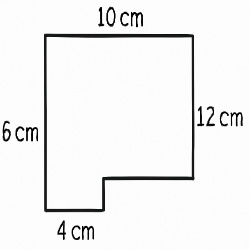
Area: __________
Perimeter: __________
2. Find the total area and perimeter of the following figure.
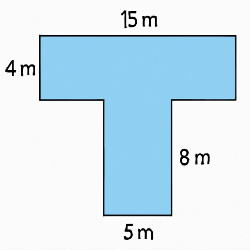
Area: __________
Perimeter: __________
3. Determine the area and perimeter of this composite rectangular shape.
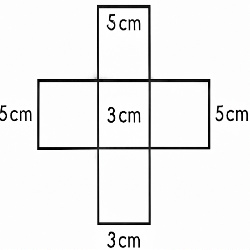
(The central square - 3 cm. And Four identical rectangles are attached to each side of the central square. Each attached rectangle has a length of 5 cm and a width of 3 cm.)
Area: __________
Perimeter: __________
4. Calculate the area and perimeter for the shape shown.
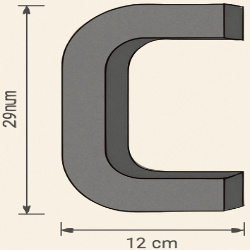
(Thickness of all parts is 4 cm)
Area: __________
Perimeter: __________
Section 2: Multiple Choice Questions (MCQs)
5. An irregular shape is formed by joining two rectangles. Rectangle A is 8 cm by 5 cm. Rectangle B is 6 cm by 4 cm. What is the maximum possible area of the combined shape?
a) 40 cm²
b) 24 cm²
c) 64 cm²
d) 26 cm²
6. Look at the L-shaped figure from Question 1. To find its area, you can split it into two smaller rectangles. Which of the following calculations is correct?
a) (10 x 12) - (4 x 6)
b) (6 x 4) + (10 x 6)
c) (10 x 6) + (4 x 6)
d) (12 x 4) + (6 x 10)
7. A rectangular park is 50 m long and 30 m wide. A rectangular swimming pool, 10 m long and 5 m wide, is built in one corner of the park. What is the perimeter of the remaining park area?
a) 150 m
b) 160 m
c) 130 m
d) 110 m
Section 3: True or False
8. To find the perimeter of any irregular rectangular shape, you must add the lengths of all its outer sides.
True / False
9. The area of an irregular shape can be found by imagining it as a larger rectangle and subtracting the missing parts.
True / False
10. If we double the length of all sides of an irregular rectangular shape, its perimeter will also double.
True / False
11. Two different irregular shapes cannot have the same area.
True / False
Section 4: Short Answer Questions
12. A classroom has an L-shape. The total length of the longest wall is 12 metres, and the total width of the widest part is 9 metres. A corner section measuring 4 metres by 5 metres is not part of the classroom. Draw a simple diagram and calculate the area of the classroom floor.
13. Explain in your own words how you would find the perimeter of a U-shaped figure if some of the side lengths are not given.
Answer Key
1. Area: 84 cm²; Perimeter: 44 cm
2. Area: 100 m²; Perimeter: 50 m
3. Area: 69 cm²; Perimeter: 52 cm
4. Area: 144 cm²; Perimeter: 64 cm
5. c) 64 cm² (Area of A = 8x5=40, Area of B = 6x4=24. Total Area = 40+24 = 64 cm²)
6. c) (10 x 6) + (4 x 6)
7. b) 160 m
8. True
9. True
10. True
11. False
12. Area = 88 m².
13. To find the perimeter, you must find the length of all outer sides. If some are missing, you can deduce them from the given lengths. For a U-shape, the sum of the three horizontal sides at the top/inside will be equal to the length of the bottom horizontal side. Similarly, the total vertical length on the left side will be equal to the total vertical length on the right side (including the inner vertical side).
How This Worksheet Helps You Learn?
This printable worksheet for Class 6 Maths helps students learn area and perimeter of irregular rectangular shapes through real-life practice questions. With activities focused on composite figures, perimeter calculation and area of joined rectangles, it reinforces understanding in a stepwise, NCERT-aligned way. Each PDF practice sheet includes labeled diagrams and varied problems for active concept reinforcement.
Usage Tips for Parents and Teachers
- Encourage your child to solve each area and perimeter worksheet independently, then review answers together.
- Use the diagrams for visual learning and ask students to explain the steps they used to solve the problems.
- Assign the worksheet for extra geometry practice or as a quick homework revision before exams.
- Let students access the practice sheet on tablets or print for hands-on work.
Explore Related Worksheets
- Class 6 Maths Worksheets – Broaden your understanding with more class 6 geometry and arithmetic topics.
- Measurement Worksheets – Strengthen unit conversion and measurement skills for area and perimeter.
- Class 8 Maths Mensuration Worksheets – Explore advanced area and perimeter worksheets for future practice.
What You Learned
On this page, you explored how to find the area and perimeter of irregular rectangular shapes with engaging class 6 maths worksheet questions. Following NCERT standards, each exercise focused on breaking composite figures into rectangles, proper measurement, and perimeter calculation. Regular reinforcement with these printable worksheets builds students’ confidence and problem-solving skills in geometry. Download the PDF practice sheet anytime for classroom or home use.
FAQs on Area and Perimeter of Irregular Rectangular Shapes – Class 6 Worksheet
1. How do you find the area of irregular rectangular shapes?
To find the area of an irregular rectangular shape, you must first divide it into smaller, regular rectangles and then add their areas together. This method involves three simple steps:
- Step 1: Split the composite figure into simple rectangles or squares using horizontal or vertical lines.
- Step 2: Calculate the area of each individual rectangle using the formula Area = Length × Breadth.
- Step 3: Add the areas of all the smaller rectangles to get the total area of the irregular shape.
2. How do you calculate the perimeter of two joined rectangles?
The perimeter of a composite figure made of two joined rectangles is calculated by adding the lengths of all its outer sides only. You must ignore the internal lines where the shapes are joined.
- First, identify all the external boundary lines of the combined shape.
- Next, add the lengths of these outer sides to find the total perimeter.
- Do not include the length of the side shared between the two rectangles.
3. What is the difference between area and perimeter for Class 6?
The main difference is that area measures the space inside a shape, while perimeter measures the distance around its boundary. For a Class 6 student, it's important to remember:
- Area: It is the total surface covered by a two-dimensional figure, measured in square units (e.g., cm², m²).
- Perimeter: It is the total length of the outline of a shape, measured in linear units (e.g., cm, m).
4. Does this Class 6 maths worksheet on area and perimeter include answers?
Yes, this Class 6 maths area and perimeter worksheet comes with a complete answer key. The provided solutions are detailed and stepwise, which helps students check their work and understand the correct method for solving each problem involving irregular rectangular shapes.
5. Is this area and perimeter worksheet for Class 6 printable?
Absolutely. This area and perimeter worksheet for Class 6 is designed as a free printable PDF. You can easily download the file and print it for convenient use at home for homework, in the classroom for practice, or for exam revision.
6. What is the best way to use this worksheet for homework or revision?
This worksheet is an excellent tool for both maths homework and revision as it reinforces key geometry concepts with varied practice problems. For homework, students can solve the questions to solidify what they learned in class. For revision, it helps identify weak spots in calculating the area and perimeter of composite figures before an exam.
7. What is a composite figure in Class 6 Maths?
A composite figure, also known as a composite shape, is a two-dimensional figure made by combining two or more simple geometric shapes. In this Class 6 worksheet, the irregular rectangular shapes are composite figures created by joining multiple rectangles together.
8. How do you find the area of a shaded region in an irregular shape?
To find the area of a shaded region, you typically subtract the area of the unshaded part from the total area of the larger shape. The process involves these steps:
- Step 1: Calculate the total area of the entire outer figure.
- Step 2: Calculate the area of the non-shaded inner part.
- Step 3: Subtract the smaller area (unshaded) from the larger area (total) to find the final shaded area.
9. What formula is used to find the area of composite rectangular figures?
There is no single, unique formula for a composite figure; instead, you use the basic rectangle formula and addition. The method involves breaking the shape down and applying the formula Area = Length × Breadth to each part, then summing the individual areas to get the total.
10. Is this worksheet aligned with the NCERT syllabus for Grade 6?
Yes, this worksheet is fully aligned with the latest NCERT syllabus for Grade 6 Maths. The questions are designed to cover key concepts of area and perimeter of irregular rectangular shapes as prescribed in the curriculum, making it a reliable resource for exam preparation.
