




How to Identify and Label Body Parts in Grade 1 Science
Section A: Fill in the Blanks
Instructions: Choose the correct word from the box to complete the sentences.
1. I use my __________ to see the beautiful rainbow.
2. I use my __________ to smell the flowers.
3. I use my __________ to hear the birds singing.
4. I use my __________ to run in the park.
5. I use my __________ to clap and write.
Section B: Match the Columns
Instructions: Match the body part in Column A with its action in Column B.
Section C: True or False
Instructions: Read the sentences and write 'True' or 'False'.
1. We have ten fingers on our hands. __________
2. We smell with our ears. __________
3. Our legs help us to walk and jump. __________
4. Our neck helps us to turn our head. __________
5. We chew food with our hair. __________
Section D: Tick the Correct Option (MCQs)
1. Which part of the body helps you to smile?
(a) Ear (b) Mouth (c) Knee
2. How many sense organs do we have?
(a) Three (b) Four (c) Five
3. We use our __________ to listen to music.
(a) Nose (b) Eyes (c) Ears
4. Which body part helps us bend our leg?
(a) Knee (b) Elbow (c) Shoulder
Section E: Unjumble the Words
Instructions: Rearrange the letters to form the name of a body part.
1. D A H E ____________________
2. S E G L ____________________
3. E S O N ____________________
4. K C E N ____________________
Section F: Short Answer Questions
1. What do you use to taste an ice cream?
Ans: _________________________________________________
2. Which body part helps you to nod your head 'yes'?
Ans: _________________________________________________
3. How many legs do you have?
Ans: _________________________________________________
Section G: Label the Body Parts
Instructions: Look at the picture and write the correct name for each part.
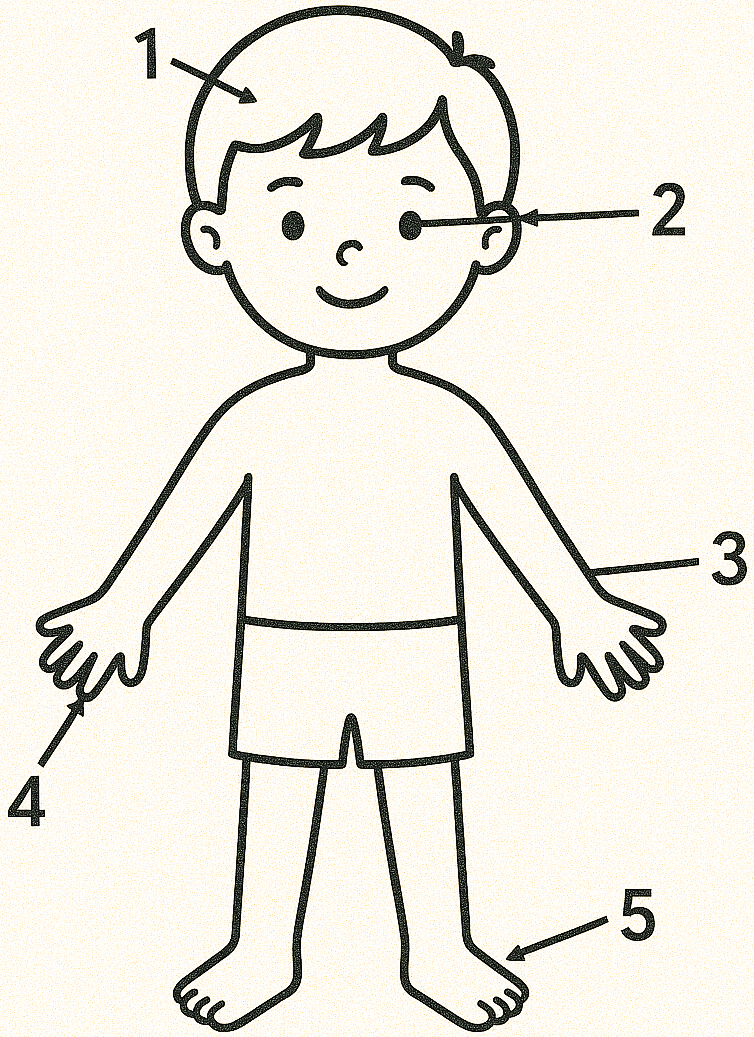
1. ____________________
2. ____________________
3. ____________________
4. ____________________
5. ____________________
Answer Key
Section A: Fill in the Blanks
eyes
nose
ears
legs
hands
Section B: Match the Columns
1 - d (To chew food)
2 - a (To taste food)
3 - b (To hold a pencil)
4 - e (To feel hot or cold)
5 - c (To kick a ball)
Section C: True or False
True
False
True
True
False
Section D: Tick the Correct Option (MCQs)
(b) Mouth
(c) Five
(c) Ears
(a) Knee
Section E: Unjumble the Words
HEAD
LEGS
NOSE
NECK
Section F: Short Answer Questions
I use my tongue.
My neck.
I have two legs.
Section G: Label the Body Parts
Hair
Eye
Arm
Fingers
Foot
Learn How Body Parts Help Every Day in Grade 1 Science
By working through this Class 1 Science worksheet on Parts Of Body, children learn how each body part helps them play, eat, and talk with friends. Students practice recognizing body parts with fun questions and pictures. This Topic builds early science basics while boosting observation skills. Parents see how their child remembers the names and uses of different body parts, which is a top search for young learners exploring human body parts.
Grow Confidence Naming Body Parts
With this worksheet, Class 1 students gain confidence as they name and point out body parts in everyday life. The Science activities use coloring and matching to make the Topic exciting. Practicing body part names is one of the best ways for children to get ready for next steps in health and science. Parents appreciate seeing their child connect classroom learning with common searches like “parts of body worksheet for kids.”
FAQs on Class 1 Science: Parts of Body Worksheet with Pictures
1. What are body parts for class 1?
The main body parts for class 1 students include common areas we use every day.
These are: head, arm, hand, leg, foot, eye, ear, nose, mouth, and fingers. Learning their names helps improve body awareness and vocabulary for young learners.
2. Which parts of your body help you for class 1?
Different body parts help us do various activities every day.
For example:
- Hands – for picking, holding, and writing.
- Legs and feet – for walking and running.
- Eyes – for seeing.
- Ears – for hearing.
- Nose – for smelling.
- Mouth – for talking and eating.
3. How to teach body parts to kids?
Teaching body parts to kids uses fun activities and worksheets:
- Use pictures and games to name and identify parts.
- Ask children to touch or point to their head, arm, foot, etc.
- Try labelling worksheets and match-the-following exercises.
- Practice with songs or rhymes about the body.
4. How can I use this worksheet at home?
You can use this printable body parts worksheet at home for easy practice and revision.
Just download and print the worksheet, then guide your child to label, match, or fill in the names of the body parts. This supports independent learning, helps reinforce concepts, and builds observation and vocabulary skills in class 1 students.
5. Does this include an answer key?
Yes, the body parts worksheet for class 1 includes an answer key.
This helps parents and teachers quickly check the answers, making learning effective and helping students correct mistakes easily during revision.
6. What is the function of body parts for class 1?
Each body part has a special function taught in class 1 science.
For example:
- Eyes help us see.
- Ears help us hear.
- Hands help us hold objects and write.
- Legs help us walk.
Learning these functions improves understanding of how our body works.
7. Is this worksheet printable?
Yes, this is a printable worksheet.
You can download the free PDF and print it at home or school for grade 1 science practice. Large fonts and clear images ensure it is easy for young students to use.
8. What age group is it best for?
The worksheet is specially designed for class 1 (age 5–7 years) students.
It uses age-appropriate images, simple instructions, and large fonts to make learning about body parts fun and engaging for young children.
9. What skills are built by this activity?
This worksheet builds several important early learning skills.
These include:
- Body awareness
- Vocabulary development
- Observation and identification
- Fine motor skills
- Concept retention through labelling and matching activities
10. Can I use this worksheet digitally on a tablet?
Yes, this body parts worksheet PDF can be used on a tablet.
Children can open it in a PDF editor app and use a stylus or finger to label, circle, or match body parts directly. This makes learning interactive and flexible, whether used on paper or digitally.
11. What are the 20 body parts name?
Here are 20 common body part names students can learn:
Head, hair, forehead, eye, eyebrow, ear, nose, cheek, mouth, chin, neck, shoulder, arm, hand, fingers, chest, stomach, leg, knee, and foot. These names are useful for class 1 science and daily body awareness exercises.
12. Can I modify or combine this with other worksheets?
Yes, you can modify or combine this worksheet with others for extra practice.
Mixing worksheets about body parts, sense organs, or family helps reinforce topics, gives students more exercises, and keeps learning interesting in Grade 1 science lessons.
