






How do you solve measurement questions in Class 3 maths?
Section A: Fill in the Blanks
1. The length of a new crayon is measured in ______________ (cm / m).
2. The weight of a watermelon is measured in ______________ (g / kg).
3. A large bottle of cold drink contains 2 ______________ (ml / L) of liquid.
4. The distance from your home to your school is measured in ______________ (m / km).
5. A small packet of chips weighs about 20 ______________ (g / kg).
6. 5 meters is equal to ______________ centimeters.
7. 3000 grams is equal to ______________ kilograms.
Section B: Multiple Choice Questions (MCQs)
1. Which of the following is the longest?
a) 2 meters
b) 200 centimeters
c) 2 kilometers
2. What would you use to measure the milk for a cake recipe?
a) A weighing scale
b) A measuring cup
c) A ruler
3. Which is heavier: a 1 kg bag of apples or a 1 kg bag of cotton?
a) The bag of apples
b) The bag of cotton
c) Both are of equal weight
4. How many milliliters are in 1 liter?
a) 10 ml
b) 100 ml
c) 1000 ml
Section C: True or False
1. A table is about 1 cm long.
2. 500 g is heavier than 1 kg.
3. A swimming pool holds water in Liters.
4. 4 m 50 cm is the same as 450 cm.
5. We measure our own weight in grams.
Section D: Match the Columns
Match the object with its most likely measurement.
Section E: Short Answer Questions
1. Riya bought 2 Liters of juice. Her brother drank 500 ml. How much juice is left in milliliters?
2. A shopkeeper has a roll of ribbon that is 10 meters long. He cuts a piece of 3 m 50 cm. How much ribbon is left on the roll?
3. Aman's school bag weighs 4 kg. His lunch box inside weighs 500 g. What is the total weight of the bag with the lunch box in grams?
4. Look at the image and answer the question.
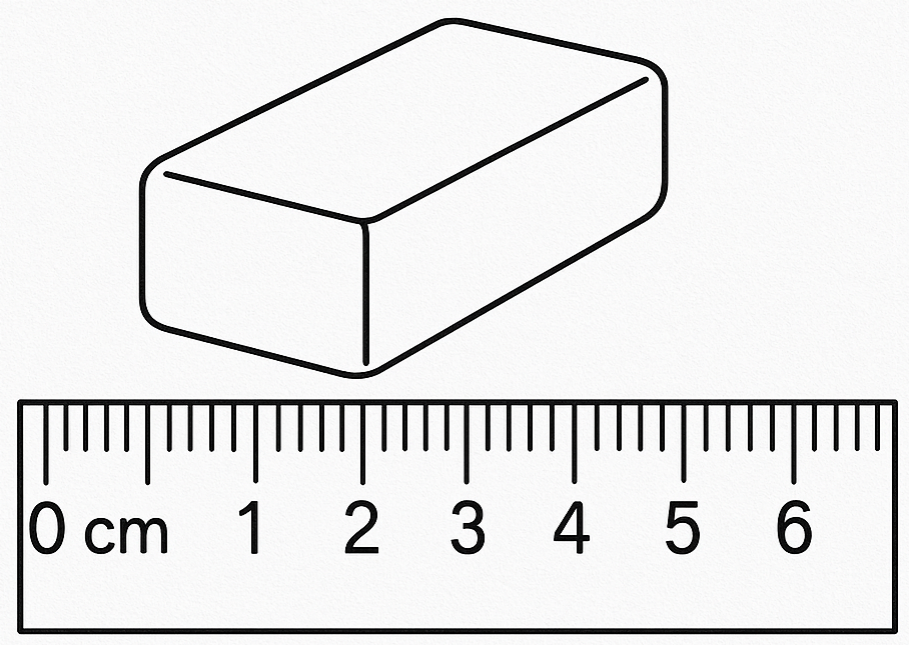
What is the length of the eraser?
5. A jug can hold 2 L of water. A glass can hold 200 ml of water. How many glasses of water can be filled from the jug?
Answer Key
Section A: Fill in the Blanks
1. cm
2. kg
3. L
4. km
5. g
6. 500
7. 3
Section B: Multiple Choice Questions (MCQs)
1. c) 2 kilometers
2. b) A measuring cup
3. c) Both are of equal weight
4. c) 1000 ml
Section C: True or False
1. False
2. False
3. True
4. True
5. False
Section D: Match the Columns
1. C
2. D
3. B
4. A
Section E: Short Answer Questions
1. 2 L = 2000 ml. So, 2000 ml - 500 ml = 1500 ml. 1500 ml of juice is left.
2. 10 m = 1000 cm. 3 m 50 cm = 350 cm. 1000 cm - 350 cm = 650 cm. So, 6 m 50 cm of ribbon is left.
3. 4 kg = 4000 g. Total weight = 4000 g + 500 g = 4500 g.
4. The length of the eraser is 5 cm.
5. 2 L = 2000 ml. Number of glasses = 2000 ml / 200 ml = 10 glasses.
Class 3 Measurement Worksheet – Fun Activities for Learning Measurement
This worksheet lets Class 3 students use measurement skills on real-life objects around them. Kids explore length and weight, turning maths into something they see and touch every day. As they work through the Class 3 Maths Measurement topic, they learn to compare and estimate—skills that help both in school and at home. Parents see their child grow confident with measurement units and simple word problems.
Benefits of Practising Measurement Worksheets for Class 3
Measurement is an important part of Class 3 Maths because students use it in everyday life while checking length, weight, capacity, and time. Regular worksheet practice helps children understand these concepts in a simple and practical way.
Key Benefits of These Worksheets:
Improves understanding of units like centimetres, metres, kilograms, and litres
Builds accuracy in measuring objects and comparing quantities
Helps students solve real-life maths problems confidently
Strengthens mental maths and calculation skills
Makes concepts easier through practical examples and visual learning
Prepares students for school tests, Olympiads, and higher-level maths topics
What Students Learn in Class 3 Measurement Worksheets
These worksheets help students practise different types of measurement concepts step by step.
Topics Covered:
Length Measurement
Weight Measurement
Capacity Measurement
Time and Calendar
Unit Conversion
Comparison of Quantities
Word Problems on Measurement
Explore More Class 3 Maths Worksheets
FAQs on Maths Measurement Worksheets for Class 3 – Length, Weight & Time
1. What is measurement for Class 3?
Measurement in Class 3 Maths means finding out how long, heavy, or old something is using standard units. In this chapter, students learn to:
- Measure length (using centimeter, meter, kilometer)
- Measure weight (using gram, kilogram)
- Measure time (using hour, minute, second)
2. Which unit is used to measure weight?
Weight is measured using:
Gram (g) for lighter objects
Kilogram (kg) for heavier objects
For example, an apple may weigh a few grams, while a school bag may weigh several kilograms.
3. Which is the smallest unit of time for Class 3?
The smallest unit of time commonly taught in Class 3 is the second.
60 seconds make 1 minute, and 60 minutes make 1 hour.
4. How do you solve length word problems?
To solve length word problems:
Read the question carefully
Identify the unit used
Add, subtract, multiply, or divide as needed
Write the final answer with the correct unit
Practising worksheets regularly helps students solve these questions faster.
5. How can I use this Class 3 maths measurement worksheet at home?
The Class 3 maths measurement worksheet is designed for home practice and revision:
- Download and print the worksheet PDF
- Attempt different question types (fill-in-the-blanks, word problems, unit conversion)
- Check answers using the provided answer key for faster learning
- Use visuals and examples for better concept understanding
6. Does this measurement worksheet include an answer key?
Yes, the worksheet includes detailed answers so students can check their work and understand mistakes easily.
7. What concepts are covered in this measurement worksheet for Class 3?
The worksheet covers key measurement concepts for Class 3, including:
- Measurement of length (cm, m, km)
- Measurement of weight (g, kg)
- Measurement of time (hour, minute, second)
- Unit conversions and word problems
8. What are the basic units of measurement for Class 3?
The basic units of measurement for Class 3 are:
- Centimeter (cm) – for small lengths
- Meter (m) – for larger lengths
- Kilogram (kg) – for heavy objects
- Gram (g) – for light objects
- Hour, minute, second – for measuring time
9. What skills are built by doing this worksheet?
These worksheets help students improve:
Calculation speed
Logical thinking
Measurement accuracy
Mental maths
Problem-solving skills
Real-life maths application
10. Can this worksheet be used for CBSE exam preparation?
Yes, this worksheet is useful for CBSE Class 3 Maths revision, school homework, practice tests, and exam preparation.
11. What is the difference between gram and kilogram?
Gram (g) is used for lighter objects, while kilogram (kg) is used for heavier objects.
Example:
Chocolate weight → grams
Rice bag weight → kilograms
1 kilogram = 1000 grams.
12. Are measurement word problems important for Class 3 students?
Yes, measurement word problems help students apply maths concepts to real-life situations. They improve understanding, logical reasoning, and calculation accuracy.
13. How can students improve measurement skills quickly?
Students can improve measurement skills by:
Practising worksheets daily
Learning units properly
Solving word problems
Revising conversions regularly
Checking answers carefully
