






How to Use Ordinal Numbers in Everyday Math for Grade 1
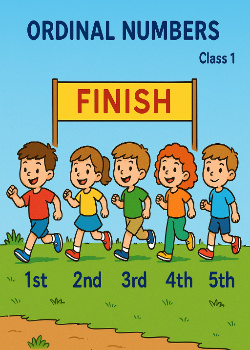
Section 1: Fill in the Blanks
1. In the list of days, Sunday is the _________ day.
2. The number 4 is represented by the ordinal word _________.
3. If you are second in a race, the person in front of you is _________.
4. In the word 'SCHOOL', the letter 'H' is in the _________ position.
5. The number that comes after ninth is _________.
Section 2: Match the Columns
Match the ordinal numbers in Column A with their correct words in Column B.
Section 3: Multiple Choice Questions (MCQs)
1. Which ordinal number comes just before tenth?
(a) Eighth (b) Ninth (c) Seventh
2. How do we write 'Second' using a number?
(a) 2nd (b) 2th (c) 2st
3. In the word 'APPLE', what is the position of the letter 'L'?
(a) Third (b) Fifth (c) Fourth
4. If you have five pencils and your favourite is the last one, which pencil is it?
✏️✏️✏️✏️✏️
(a) Fourth (b) Fifth (c) First
5. Which number represents 'Eighth'?
(a) 8 (b) 8th (c) 18th
Section 4: True or False
1. The ordinal number for 3 is 'third'.
2. The seventh position comes after the eighth position.
3. '1st' is read as 'onest'.
4. In the word 'CAT', the letter 'A' is in the second position.
5. The ordinal number for 10 is 'tenth'.
Section 5: Write the Correct Form
A) Write the ordinal word for the given number.
1. 6th: _____________
2. 4th: _____________
3. 1st: _____________
B) Write the ordinal number for the given word.
1. Tenth: _____________
2. Fifth: _____________
3. Second: _____________
Section 6: Short Answer Questions
1. A group of friends are standing in a line: Rohan, Priya, Ali, Simran, Tom. Who is standing in the third position?

2. What is the fourth letter in the word 'COMPUTER'?
3. If you read 10 pages of a book, what is the position of the page that comes just after the sixth page?
Answer Key
Section 1: Fill in the Blanks
1. first
2. fourth
3. first
4. fourth
5. tenth
Section 2: Match the Columns
1st → First
3rd → Third
5th → Fifth
7th → Seventh
9th → Ninth
Section 3: Multiple Choice Questions (MCQs)
1. (b) Ninth
2. (a) 2nd
3. (c) Fourth
4. (b) Fifth
5. (b) 8th
Section 4: True or False
1. True
2. False
3. False
4. True
5. True
Section 5: Write the Correct Form
A) Write the ordinal word:
1. Sixth
2. Fourth
3. First
B) Write the ordinal number:
1. 10th
2. 5th
3. 2nd
Section 6: Short Answer Questions
1. Ali
2. P
3. Seventh page
How This Worksheet Helps You Learn?
This Class 1 Maths Ordinal Numbers worksheet helps young learners understand and use ordinal numbers from 1st to 10th through engaging activities. The printable worksheet offers practical concept reinforcement, encouraging students to identify positions, complete number sequencing, and match numbers with objects in everyday scenarios. Designed to fit Grade 1 learning needs, this PDF practice sheet supports early numeracy, basic maths vocabulary, and builds confidence in ordering skills.
By tackling tasks like “circle the correct ordinal number” or “fill in the missing position,” children become familiar with ordering in math and daily life. The worksheet uses bold fonts, simple instructions, and age-appropriate layouts to ensure learning is fun, visual, and accessible for every student.
Usage Tips for Parents/Teachers
- Print the PDF worksheet and guide your child to complete it independently before reviewing answers together.
- Use real-life items—like toys or books—to reinforce the concept of ordering objects by position.
- Encourage coloring or matching activities for visual engagement and better recall.
- Discuss ordinal numbers in daily routines, such as lining up snacks or ranking favorite books, for practical connection.
Explore Related Worksheets
- Class 1 Maths Worksheets Chapter 9
- Class 1 Maths Worksheets Chapter 6
- Ones, Tens, Hundreds Worksheet
- Counting and Write Worksheets
- Class 1 Maths Worksheets Chapter 13
What You Learned
On this page, you explored a Class 1 Maths Ordinal Numbers worksheet designed for basic number sequencing and position practice. This downloadable PDF supports foundational maths skills by helping students recognize, use, and sequence ordinal numbers in simple, relatable ways. With clear instructions and a child-friendly approach, the worksheet is suitable both for classroom and home use, giving teachers and parents a valuable resource for reinforcing ordering concepts and early numeracy skills.
FAQs on Ordinal Numbers Worksheet for Class 1 Maths
1. What are ordinal numbers for class 1?
Ordinal numbers for Class 1 are words that tell the specific position or order of an object in a list. Instead of counting how many (like 1, 2, 3), they show which one in a sequence (like 1st, 2nd, 3rd).
Examples of ordinal numbers from 1 to 5 include:
- 1st – First
- 2nd – Second
- 3rd – Third
- 4th – Fourth
- 5th – Fifth
2. How can you teach ordinal numbers to a Class 1 student?
You can teach ordinal numbers to a Class 1 student using fun, interactive methods that connect to their daily life. This free printable worksheet is a great tool for practice.
Effective methods include:
- Using real-world examples like lining up toys and asking which one is first, second, or third.
- Engaging in ordering activities, such as arranging pictures or following steps in a recipe.
- Using practice worksheets with activities like 'circle the 4th object' or 'color the 2nd balloon'.
- Telling stories and asking about the order of events.
3. What is the difference between cardinal and ordinal numbers for Grade 1?
The main difference is that cardinal numbers tell 'how many,' while ordinal numbers tell 'in what position'.
- Cardinal Numbers (Quantity): These are standard counting numbers. For example, “There are three cats.” (Tells us the total number).
- Ordinal Numbers (Position): These show order or rank. For example, “The third cat is sleeping.” (Tells us the specific position of one cat in a row).
Our Class 1 Maths worksheets help students practice both concepts.
4. What types of activities are included in this ordinal numbers worksheet for Grade 1?
This ordinal numbers worksheet for Grade 1 includes several engaging activities designed to reinforce learning in a fun way. Students can practice their skills with different formats.
Activities include:
- Circle the correct ordinal number: Identifying an object's position in a line.
- Color by order: Following instructions like “color the fifth star.”
- Matching: Drawing lines to match objects to their ordinal position (e.g., 1st, 2nd, 3rd).
- Fill-in-the-blank: Completing sentences with the correct ordinal number word.
5. Is this ordinal numbers worksheet for Class 1 printable?
Yes, this ordinal numbers worksheet is available as a free printable PDF. Parents and teachers can easily download and print it for students to practice at home, for homework, or as a classroom activity. The format is designed to be clear and easy for young learners to use on paper.
6. What skills does this ordinal math worksheet help build?
This ordinal math worksheet helps build several crucial foundational skills for first-grade students. It goes beyond simple counting to develop deeper number sense.
Key skills include:
- Number Sequencing: Understanding the logical order of numbers.
- Positional Vocabulary: Learning and using words like first, second, last, etc.
- Spatial Awareness: Identifying the placement of objects in relation to others.
- Attention to Detail: Carefully reading instructions to identify the correct item in a series.
- Maths Vocabulary: Building a strong base for more complex mathematical concepts.
7. Can you give some examples of ordinal numbers from 1 to 10?
Yes, here are the first ten ordinal numbers, showing both the numeral and word form, which are covered in our Class 1 worksheets.
- 1st - First
- 2nd - Second
- 3rd - Third
- 4th - Fourth
- 5th - Fifth
- 6th - Sixth
- 7th - Seventh
- 8th - Eighth
- 9th - Ninth
- 10th - Tenth
8. How can I use this maths worksheet at home with my child?
This maths practice worksheet for class 1 is perfect for use at home to support your child's learning. Its simple and clear layout encourages independent work.
Here are a few ways to use it:
- Download and Print: Access the free PDF and print it out.
- Explain the Task: Briefly explain what an ordinal number is, using an example from the sheet.
- Supervise Practice: Let your child attempt the activities, offering help if needed.
- Review Together: Use the answer key to check their work and discuss any mistakes.
9. Does this free PDF worksheet include an answer key?
Yes, this free ordinal numbers worksheet PDF comes with a complete answer key. The answer key is provided to help parents and teachers quickly and accurately check the student's work, making it a reliable tool for both home and classroom use.
10. What age group is this ordinal numbers worksheet best for?
This worksheet is specifically designed for Class 1 students, who are typically 6 to 7 years old. The layout, large fonts, simple instructions, and engaging visuals are all age-appropriate to help young learners grasp the concept of ordinal numbers without feeling overwhelmed, building their early math confidence.
