






How to Count Tens and Ones Using Base 10 Blocks
Count and Write the Number
1. Count the tens and ones blocks, then write the total number in the box.
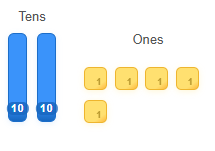
2. Count the tens and ones blocks, then write the total number in the box.
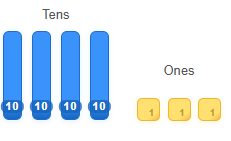
3. Count the tens and ones blocks, then write the total number in the box.
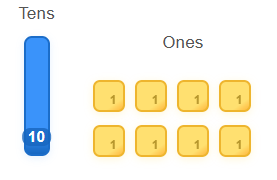
4. Count the tens and ones blocks, then write the total number in the box.
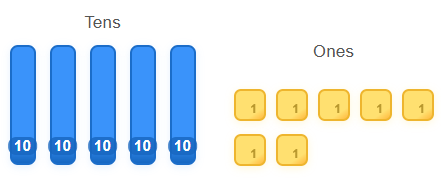
5. Count the tens and ones blocks, then write the total number in the box.
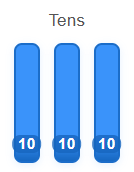
Match the Columns
6. Draw a line to match the base 10 blocks in Column A with the correct number in Column B.
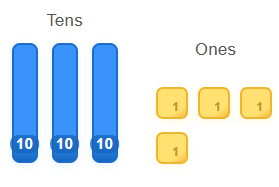
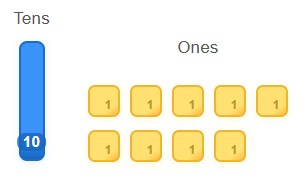
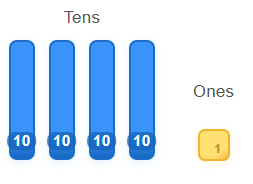
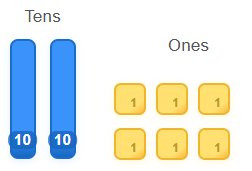
Tick the Correct Option
7. Look at the blocks and tick (✓) the correct number.
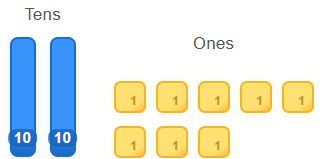
a) 18 [ ]
b) 28 [ ]
c) 82 [ ]
8. Look at the blocks and tick (✓) the correct number.
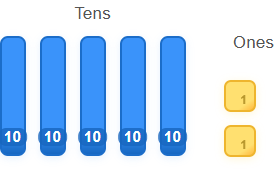
a) 52 [ ]
b) 25 [ ]
c) 50 [ ]
9. Look at the blocks and tick (✓) the correct number.
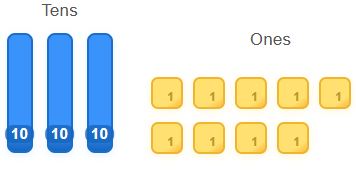
a) 93 [ ]
b) 30 [ ]
c) 39 [ ]
True or False
10. Look at the blocks and the number. Write 'True' if the number is correct and 'False' if it is not.
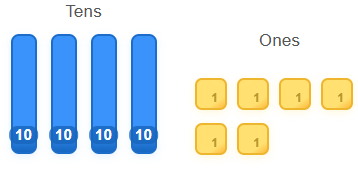
11. Look at the blocks and the number. Write 'True' if the number is correct and 'False' if it is not.
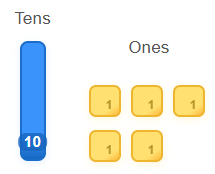
12. Look at the blocks and the number. Write 'True' if the number is correct and 'False' if it is not.
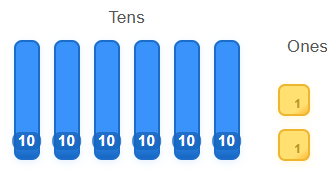
13. Look at the blocks and the number. Write 'True' if the number is correct and 'False' if it is not.
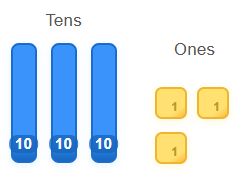
Draw the Blocks
14. Read the number and draw the correct number of tens rods ( | ) and ones cubes ( □ ).
Number: 32
15. Read the number and draw the correct number of tens rods ( | ) and ones cubes ( □ ).
Number: 15
Answer Key
Count and Write the Number
1. 25
2. 43
3. 18
4. 57
5. 30
Match the Columns
6.
1 → 34
2 → 19
3 → 41
4 → 26
Tick the Correct Option
7. b) 28
8. a) 52
9. c) 39
True or False
10. True
11. False
12. True
13. False
Draw the Blocks
14. Student should draw 3 tens rods and 2 ones cubes.
15. Student should draw 1 ten rod and 5 ones cubes.
How This Worksheet Helps You Learn?
This Class 1 Maths Counting With Base 10 Blocks worksheet provides focused practice for young learners building place value skills. Children visually count tens and ones using base 10 blocks, strengthening their fundamental number sense. With a printable worksheet format and clear structure, this PDF practice sheet supports concept reinforcement both at home and in school.
Counting with base 10 blocks helps students master recognising tens and ones, matching numbers, and understanding place value through visual activities. The worksheet encourages independent problem-solving and engages children with age-appropriate layouts, supporting primary math development in a low-pressure way.
Usage Tips for Parents and Teachers
- Guide your child to count rods (tens) and single blocks (ones) before writing answers.
- Use the worksheet as printable homework or quick revision during holidays.
- Discuss each example out loud to boost vocabulary and number confidence.
- Try colouring the base ten blocks for extra engagement and reinforcement.
Explore Related Worksheets
- Class 1 Maths Worksheets Chapter 5
- Class 1 Maths Worksheets Chapter 6
- Counting and Write Worksheets
- Ones, Tens, Hundreds Worksheet
- Class 1 Maths Worksheets
What You Learned
On this page, you explored the Class 1 Maths Counting With Base 10 Blocks worksheet. The printable worksheet develops essential place value skills by helping children count and group numbers using tens and ones blocks. With step-by-step activities and a handy PDF practice sheet, students build stronger math foundations while enjoying hands-on learning. This supportive resource ensures practice with the primary keyword—counting with base 10 blocks—remains fun, simple, and effective for all young learners.
FAQs on Counting with Base 10 Blocks for Class 1 Maths
1. How do you count with base 10 blocks?
Counting with base 10 blocks involves adding the values of the tens rods and the ones units to find the total number. This visual method is excellent for Grade 1 students learning about place value.
- First, count the number of long rods. Each rod is equal to 10.
- Next, count the number of small, single blocks. Each block is equal to 1.
- Finally, add the values together. For example, 3 rods (30) and 5 single blocks (5) represent the number 35.
2. What are tens and ones in Class 1 Maths?
In Class 1 Maths, tens and ones are the basic components of place value used to build numbers. Base 10 blocks are a popular tool to help kids visualize this concept.
- Tens: A 'ten' is a group of 10 single units. In base 10 blocks, this is shown as a long rod.
- Ones: An 'one' is a single unit. In base 10 blocks, this is shown as a small cube.
3. How do these base 10 blocks worksheets help my child?
This printable base ten worksheet helps your child build a strong foundation in early numeracy and number sense. It uses visual math practice to make abstract concepts like place value easier to understand.
- Reinforces counting skills for numbers up to 100.
- Develops a concrete understanding of tens and ones.
- Improves number recognition and representation.
- Builds confidence in solving early maths problems.
4. How can I use this worksheet at home?
This worksheet is designed for easy use at home to support your child's learning. Simply download the free maths worksheet PDF and print it out.
- Give your child a pencil or crayon.
- Guide them to count the tens rods and unit blocks in each problem.
- Encourage them to write the correct number in the space provided.
- Use the included answer key to check their work.
5. Is this worksheet printable and free?
Yes, this worksheet for Grade 1 is completely free to download and print. It is provided as a high-quality PDF file, making it easy to access for homework, revision, or classroom activities.
6. How do you draw with base 10 blocks?
Drawing with base 10 blocks is a simple way for students to represent numbers visually. A long rectangle or stick is used for tens, and a small square or circle is used for ones.
- To draw the number 23, you would draw:
- Two long rectangles to represent the tens (20).
- Three small squares to represent the ones (3).
7. What age group is this counting worksheet best for?
This counting with base 10 blocks worksheet is ideal for children in Class 1 or Grade 1. This typically corresponds to an age group of 5 to 7 years old, who are beginning to learn about place value and two-digit numbers.
8. What is the main concept taught in this worksheet?
The main concept is place value, specifically understanding tens and ones. The worksheet uses math manipulatives (base 10 blocks) to help children visually break down numbers into groups of tens and ones, which is a fundamental skill in early numeracy.
9. Does this worksheet include an answer key?
Yes, an answer key is typically included with our maths revision worksheets. This allows parents and teachers to quickly check the child's answers, provide feedback, and confirm their understanding of the topic.
10. What skills does my child develop with this activity?
This base ten activity helps your child develop several crucial early mathematical skills. Beyond basic counting, it strengthens their overall numerical skills.
- Number Sense: Understanding the value of numbers.
- Place Value: Recognizing the difference between tens and ones.
- Counting and Cardinality: Accurately counting objects.
- Fine Motor Skills: Writing numbers and drawing blocks.
