






How to Convert Centimeters and Meters Easily for Kids
Tick the Correct Option
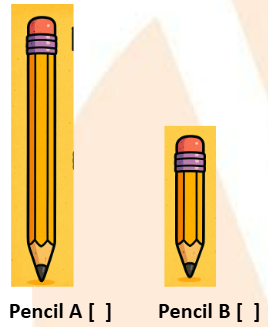
1. Tick the LONGER pencil.
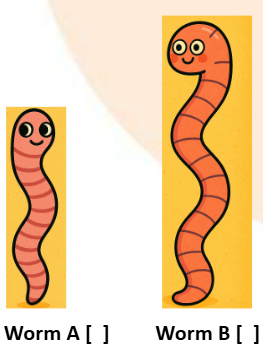
2. Tick the SHORTER worm.
Count and Write the Length
3. How many paper clips long is the crayon?

The crayon is __ paper clips long.
4. How many blocks long is the paintbrush?
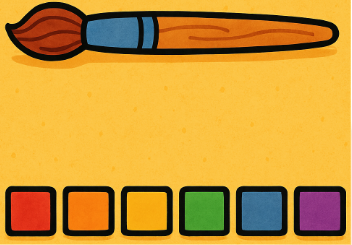
The paintbrush is __ blocks long.
5. How many hand spans long is the table?

The table is __ hand spans long.
Circle the Correct Word
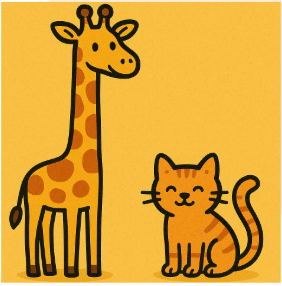
6. A giraffe is ( taller / shorter ) than a cat.
7. A bus is ( longer / shorter ) than a car.

True or False
8. The spoon is 3 blocks long.

True / False
9. The key is longer than the book.

True / False
Answer Key
1. The longer pencil (Pencil A) should be ticked.
2. The shorter worm (Worm A) should be ticked.
3. The crayon is 4 paper clips long.
4. The paintbrush is 6 blocks long.
5. The table is 5 hand spans long.
6. The correct word to circle is taller.
7. The correct word to circle is longer.
8. False (The spoon is 4 blocks long).
9. False.
How This Worksheet Helps You Learn?
This Class 1 Maths Convert Units Length worksheet provides young learners with hands-on practice in converting units of length such as centimeters and meters. Designed especially for Grade 1, it offers a printable worksheet filled with varied unit conversion exercises and engaging visuals for better understanding. By working through this PDF practice sheet, children build confidence in basic measurement concepts and comparison activities, laying a solid foundation for later maths learning.
Usage Tips for Parents and Teachers
- Let children try the fill-in-the-blank questions independently, then check answers together for better retention.
- Use the printable worksheet for daily revision, summer review, or quick homework support.
- Point to real-life objects around the house or classroom to help kids visually connect length measurement tasks.
- Take turns reading problems aloud to encourage both reading and measurement skills in a fun way.
Explore Related Worksheets
- 1st Grade Measurement Worksheets – More practice with primary length and height concepts.
- Place Value Worksheets for Grade 1 – Strengthen number sense with simple maths problems.
- Class 1 Maths Worksheets (All Chapters) – Explore worksheets that cover every key topic in Grade 1 maths.
- Maths Worksheet for Grade 2: Metric System Conversion – For advanced practice with metric units and conversions.
- Count and Write Worksheets – Practice counting, a vital skill for all measurement topics.
What You Learned
This page offered a Class 1 Maths Convert Units Length worksheet, focusing on measurement conversion practice with centimeters and meters. You explored how to use the printable worksheet at home or in class for quick, structured revision. Packed with kid-friendly examples and activities, this PDF practice sheet helps children understand and apply essential units of length. By completing these exercises, students boost their number sense and measurement skills in an enjoyable, clear format.
FAQs on Convert Units of Length: Grade 1 Maths Practice Worksheet
1. How do you convert units of length in Class 1 Maths?
Converting units of length in Class 1 Maths primarily involves understanding the relationship between centimeters (cm) and meters (m). The key concept for a first grader is that 100 centimeters make 1 meter. Worksheets often use fun activities like fill-in-the-blanks and matching to practice this concept.
2. What is measurement in maths for Grade 1?
In Grade 1 Maths, measurement is the process of finding the length, weight, or capacity of an object using standard units. For length, this involves learning to use basic units like centimeters (cm) for smaller objects and meters (m) for longer distances, and comparing which objects are longer or shorter.
3. What is the main rule for converting centimeters to meters?
The main rule for converting centimeters to meters, taught in first grade units of measurement, is based on one simple fact: 100 centimeters (cm) = 1 meter (m). This is the core formula used in every cm to m conversion problem on a worksheet for Class 1.
4. What topics are covered in this meter and centimeter worksheet?
This meter and centimeter worksheet is designed for Grade 1 students and covers essential length conversion topics. Key activities include:
- Understanding the relationship between cm and m.
- Converting simple length units (e.g., 200 cm = 2 m).
- Matching objects to their appropriate unit of measurement.
- Comparing the lengths of different items.
5. How can I help my child with this length conversion worksheet?
You can help your child by starting with real-life examples before using the length conversion worksheet. Use a ruler to measure small objects in centimeters and a measuring tape for larger items in meters. This hands-on practice makes the concepts in the free printable worksheet easier to understand.
6. What are some examples of objects measured in centimeters and meters?
Using clear examples helps children understand the difference between centimeters and meters for their measurement worksheet.
- Centimeters (cm) are used for small objects: A pencil, an eraser, a crayon, or a book.
- Meters (m) are used for bigger objects or distances: The length of a room, the height of a door, or the length of a car.
7. Is this measurement worksheet for Class 1 printable?
Yes, this measurement worksheet for Class 1 is designed to be easily printable. You can download it as a PDF file, making it a convenient resource for homework, classroom activities, or quick practice at home.
8. What skills does this length units worksheet for kids develop?
This length units worksheet for kids helps develop several foundational math skills beyond simple unit conversion. It strengthens:
- Number sense and counting.
- Comparison skills (longer vs. shorter).
- Problem-solving abilities through practical examples.
- An early understanding of the metric units of measurement.
9. Why is learning to convert units of length important for first graders?
Learning to convert units of length is important for first graders because it builds a strong foundation for future math concepts. Mastering measurement for class 1 helps children understand the world around them, apply math to real-life situations, and develop critical thinking and estimation skills.
10. Does this worksheet include an answer key?
Yes, an answer key is provided with this measurement worksheet for Grade 1. The solutions are included to help parents and teachers quickly check the child's work, which is helpful for independent study or homework revision.
