




You are standing at a distance of 2 meters from a plane mirror.
A. What is the distance of your image from the mirror?
B. What is the distance between you and your image?
Answer
 Verified
561.6k+ views
Hint: The laws of reflection state that,
(i) The angle of incidence is equal to the angle of reflection $\angle i = \angle r$
(ii) The incident ray, reflected ray and the normal ray lie in the same plane.
Image characteristics in a plane mirror are:
- The image formed is virtual.
- The image formed is of the same size.
- The image is laterally inverted.
- The image is formed at an equal distance from the mirror as of the object.
Complete step by step solution:
Let’s visualize the situation
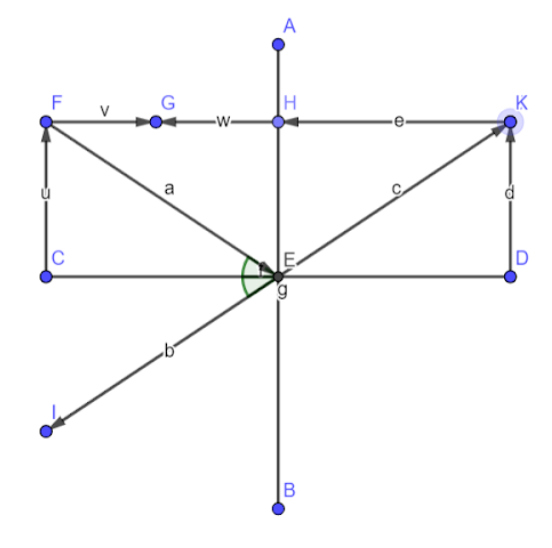
Here the line AB is the plane mirror and the line CD is the normal. When a ray FE is incident on the plane mirror it gets reflected along the path EI making equal angles of incidence and reflection as marked in green.
Consider yourself to be standing at point C where CF represents your height while CE is your distance from the mirror.
From the property of plane mirrors, we can say that CE=ED.
The distance of your image from the mirror is given by ED.
We have just now seen that ED=CE.
Hence
$ED = 2\,m$
So, the distance of your image from the mirror is $2\,m$
Now the distance between you and your image would be CE+ED
Since CE=ED the distance is 2ED
We know that $ED = 2\,m$ and so
The distance between you and your image is $2ED = 2 \times 2$ m
$ \Rightarrow 4\,m$
Note: In a plane mirror, though the image is laterally inverted, it is formed at the same distance as that of the object and has the same size. Any virtual image is formed by the backwards extrapolation of the incident and the reflected ray along the same angle. The angles are always measured from the normal and not from the baseline.
(i) The angle of incidence is equal to the angle of reflection $\angle i = \angle r$
(ii) The incident ray, reflected ray and the normal ray lie in the same plane.
Image characteristics in a plane mirror are:
- The image formed is virtual.
- The image formed is of the same size.
- The image is laterally inverted.
- The image is formed at an equal distance from the mirror as of the object.
Complete step by step solution:
Let’s visualize the situation
Here the line AB is the plane mirror and the line CD is the normal. When a ray FE is incident on the plane mirror it gets reflected along the path EI making equal angles of incidence and reflection as marked in green.
Consider yourself to be standing at point C where CF represents your height while CE is your distance from the mirror.
From the property of plane mirrors, we can say that CE=ED.
The distance of your image from the mirror is given by ED.
We have just now seen that ED=CE.
Hence
$ED = 2\,m$
So, the distance of your image from the mirror is $2\,m$
Now the distance between you and your image would be CE+ED
Since CE=ED the distance is 2ED
We know that $ED = 2\,m$ and so
The distance between you and your image is $2ED = 2 \times 2$ m
$ \Rightarrow 4\,m$
Note: In a plane mirror, though the image is laterally inverted, it is formed at the same distance as that of the object and has the same size. Any virtual image is formed by the backwards extrapolation of the incident and the reflected ray along the same angle. The angles are always measured from the normal and not from the baseline.
Recently Updated Pages
Explain the structure of megasporangium class 12 biology CBSE

Why is chloroform kept in dark coloured bottles class 12 chemistry CBSE
Derive the balancing condition of a Wheatstone bri class 12 physics CBSE
Draw VI characteristics of a pn junction diode Explain class 12 physics CBSE
Is it possible to carry pride in ones language too class 12 english CBSE
In a population at Hardy Weinberg equilibrium the allele class 12 biology CBSE
Trending doubts
Draw a labelled sketch of the human eye class 12 physics CBSE
Which are the Top 10 Largest Countries of the World?
Draw ray diagrams each showing i myopic eye and ii class 12 physics CBSE
Which is the correct genotypic ratio of mendel dihybrid class 12 biology CBSE
Differentiate between homogeneous and heterogeneous class 12 chemistry CBSE
Which animal never drinks water in its entire life class 12 biology CBSE