




Write the value of ${{\cos }^{-1}}\left( \cos \dfrac{7\pi }{6} \right)$ .
Answer
 Verified
638.1k+ views
Hint: For solving this question first, we will go through some important aspects like domain and range of the inverse trigonometric function $y={{\cos }^{-1}}x$ . First, we will use one of the basic formula of the trigonometric ratio to write $\cos \dfrac{7\pi }{6}=-\dfrac{\sqrt{3}}{2}$ in the given term. After that, we will use one of the basic formula of inverse trigonometric functions, i.e. ${{\cos }^{-1}}\left( -\dfrac{\sqrt{3}}{2} \right)=\dfrac{5\pi }{6}$ for giving the final answer for the question correctly.
Complete step-by-step solution -
Given:
We have to find the value of the following term:
${{\cos }^{-1}}\left( \cos \dfrac{7\pi }{6} \right)$
Now, before we proceed we should know about the inverse trigonometric function $y={{\cos }^{-1}}x$ . For more clarity look at the figure given below:
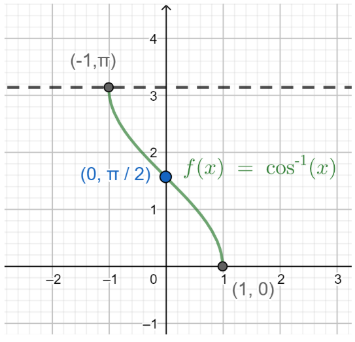
In the above figure, the plot $y=f\left( x \right)={{\cos }^{-1}}x$ is shown. And we should know that the function $y={{\cos }^{-1}}x$ is defined for $x\in \left[ -1,1 \right]$ and its range is $y\in \left[ 0,\pi \right]$ then, $y$ is the principal value of ${{\cos }^{-1}}x$ .
Now, we will use the above concept for giving the correct value of ${{\cos }^{-1}}\left( \cos \dfrac{7\pi }{6} \right)$ .
Now, before we proceed further we should know the following formulas:
$\begin{align}
& \cos \dfrac{7\pi }{6}=\cos \left( \pi +\dfrac{\pi }{6} \right)=-\cos \dfrac{\pi }{6}=-\dfrac{\sqrt{3}}{2}..................\left( 1 \right) \\
& {{\cos }^{-1}}\left( \dfrac{\sqrt{3}}{2} \right)=\dfrac{\pi }{6}...........\left( 2 \right) \\
& {{\cos }^{-1}}\left( -x \right)=\pi -{{\cos }^{-1}}x\text{ }\left( \text{if 0}\le \text{x}\le \text{1} \right)..............\left( 3 \right) \\
\end{align}$
Now, we will use the above two formulas to solve this question.
We have, ${{\cos }^{-1}}\left( \cos \dfrac{7\pi }{6} \right)$ .
Now, we will use the formula from the equation (1) to write $\cos \dfrac{7\pi }{6}=-\dfrac{\sqrt{3}}{2}$ in the term ${{\cos }^{-1}}\left( \cos \dfrac{7\pi }{6} \right)$ . Then,
$\begin{align}
& {{\cos }^{-1}}\left( \cos \dfrac{7\pi }{6} \right) \\
& \Rightarrow {{\cos }^{-1}}\left( -\dfrac{\sqrt{3}}{2} \right) \\
\end{align}$
Now, as $0<\dfrac{\sqrt{3}}{2}<1$ so, we will use the formula from the equation (3) to write ${{\cos }^{-1}}\left( -\dfrac{\sqrt{3}}{2} \right)=\pi -{{\cos }^{-1}}\left( \dfrac{\sqrt{3}}{2} \right)$ in the above line. Then,
$\begin{align}
& {{\cos }^{-1}}\left( -\dfrac{\sqrt{3}}{2} \right) \\
& \Rightarrow \pi -{{\cos }^{-1}}\left( \dfrac{\sqrt{3}}{2} \right) \\
\end{align}$
Now, we will use the formula from the equation (2) to write ${{\cos }^{-1}}\left( \dfrac{\sqrt{3}}{2} \right)=\dfrac{\pi }{6}$ in the above equation. Then,
$\begin{align}
& \pi -{{\cos }^{-1}}\left( \dfrac{\sqrt{3}}{2} \right) \\
& \Rightarrow \pi -\dfrac{\pi }{6} \\
& \Rightarrow \dfrac{5\pi }{6} \\
\end{align}$
Now, from the above result, we conclude that the value of the expression ${{\cos }^{-1}}\left( \cos \dfrac{7\pi }{6} \right)$ will be equal to $\dfrac{5\pi }{6}$ . Then,
${{\cos }^{-1}}\left( \cos \dfrac{7\pi }{6} \right)=\dfrac{5\pi }{6}$
Now, as it is evident that $\dfrac{5\pi }{6}$ lies in the range of the function $y={{\cos }^{-1}}x$ so, value of ${{\cos }^{-1}}\left( \cos \dfrac{7\pi }{6} \right)=\dfrac{5\pi }{6}$ .
Thus, ${{\cos }^{-1}}\left( \cos \dfrac{7\pi }{6} \right)=\dfrac{5\pi }{6}$ .
Note: Here, the student should first understand what is asked in the question and then proceed in the right direction to get the correct answer quickly. And we should avoid writing ${{\cos }^{-1}}\left( \cos \dfrac{7\pi }{6} \right)=\dfrac{7\pi }{6}$ directly and use the basic concepts of domain and range of the inverse trigonometric function $y={{\cos }^{-1}}x$ correctly. Moreover, as we know that, $\cos \dfrac{5\pi }{6}=-\dfrac{\sqrt{3}}{2}$ and $0<\dfrac{5\pi }{6}<\pi $ so, we can directly write ${{\cos }^{-1}}\left( -\dfrac{\sqrt{3}}{2} \right)=\dfrac{5\pi }{6}$ by the formula ${{\cos }^{-1}}\left( \cos \theta \right)=\theta $ if $\theta \in \left[ 0,\pi \right]$ . And after giving the final answer, we should check for the validity of our answer by checking whether it lies in the range of the function $y={{\cos }^{-1}}x$.
Complete step-by-step solution -
Given:
We have to find the value of the following term:
${{\cos }^{-1}}\left( \cos \dfrac{7\pi }{6} \right)$
Now, before we proceed we should know about the inverse trigonometric function $y={{\cos }^{-1}}x$ . For more clarity look at the figure given below:
In the above figure, the plot $y=f\left( x \right)={{\cos }^{-1}}x$ is shown. And we should know that the function $y={{\cos }^{-1}}x$ is defined for $x\in \left[ -1,1 \right]$ and its range is $y\in \left[ 0,\pi \right]$ then, $y$ is the principal value of ${{\cos }^{-1}}x$ .
Now, we will use the above concept for giving the correct value of ${{\cos }^{-1}}\left( \cos \dfrac{7\pi }{6} \right)$ .
Now, before we proceed further we should know the following formulas:
$\begin{align}
& \cos \dfrac{7\pi }{6}=\cos \left( \pi +\dfrac{\pi }{6} \right)=-\cos \dfrac{\pi }{6}=-\dfrac{\sqrt{3}}{2}..................\left( 1 \right) \\
& {{\cos }^{-1}}\left( \dfrac{\sqrt{3}}{2} \right)=\dfrac{\pi }{6}...........\left( 2 \right) \\
& {{\cos }^{-1}}\left( -x \right)=\pi -{{\cos }^{-1}}x\text{ }\left( \text{if 0}\le \text{x}\le \text{1} \right)..............\left( 3 \right) \\
\end{align}$
Now, we will use the above two formulas to solve this question.
We have, ${{\cos }^{-1}}\left( \cos \dfrac{7\pi }{6} \right)$ .
Now, we will use the formula from the equation (1) to write $\cos \dfrac{7\pi }{6}=-\dfrac{\sqrt{3}}{2}$ in the term ${{\cos }^{-1}}\left( \cos \dfrac{7\pi }{6} \right)$ . Then,
$\begin{align}
& {{\cos }^{-1}}\left( \cos \dfrac{7\pi }{6} \right) \\
& \Rightarrow {{\cos }^{-1}}\left( -\dfrac{\sqrt{3}}{2} \right) \\
\end{align}$
Now, as $0<\dfrac{\sqrt{3}}{2}<1$ so, we will use the formula from the equation (3) to write ${{\cos }^{-1}}\left( -\dfrac{\sqrt{3}}{2} \right)=\pi -{{\cos }^{-1}}\left( \dfrac{\sqrt{3}}{2} \right)$ in the above line. Then,
$\begin{align}
& {{\cos }^{-1}}\left( -\dfrac{\sqrt{3}}{2} \right) \\
& \Rightarrow \pi -{{\cos }^{-1}}\left( \dfrac{\sqrt{3}}{2} \right) \\
\end{align}$
Now, we will use the formula from the equation (2) to write ${{\cos }^{-1}}\left( \dfrac{\sqrt{3}}{2} \right)=\dfrac{\pi }{6}$ in the above equation. Then,
$\begin{align}
& \pi -{{\cos }^{-1}}\left( \dfrac{\sqrt{3}}{2} \right) \\
& \Rightarrow \pi -\dfrac{\pi }{6} \\
& \Rightarrow \dfrac{5\pi }{6} \\
\end{align}$
Now, from the above result, we conclude that the value of the expression ${{\cos }^{-1}}\left( \cos \dfrac{7\pi }{6} \right)$ will be equal to $\dfrac{5\pi }{6}$ . Then,
${{\cos }^{-1}}\left( \cos \dfrac{7\pi }{6} \right)=\dfrac{5\pi }{6}$
Now, as it is evident that $\dfrac{5\pi }{6}$ lies in the range of the function $y={{\cos }^{-1}}x$ so, value of ${{\cos }^{-1}}\left( \cos \dfrac{7\pi }{6} \right)=\dfrac{5\pi }{6}$ .
Thus, ${{\cos }^{-1}}\left( \cos \dfrac{7\pi }{6} \right)=\dfrac{5\pi }{6}$ .
Note: Here, the student should first understand what is asked in the question and then proceed in the right direction to get the correct answer quickly. And we should avoid writing ${{\cos }^{-1}}\left( \cos \dfrac{7\pi }{6} \right)=\dfrac{7\pi }{6}$ directly and use the basic concepts of domain and range of the inverse trigonometric function $y={{\cos }^{-1}}x$ correctly. Moreover, as we know that, $\cos \dfrac{5\pi }{6}=-\dfrac{\sqrt{3}}{2}$ and $0<\dfrac{5\pi }{6}<\pi $ so, we can directly write ${{\cos }^{-1}}\left( -\dfrac{\sqrt{3}}{2} \right)=\dfrac{5\pi }{6}$ by the formula ${{\cos }^{-1}}\left( \cos \theta \right)=\theta $ if $\theta \in \left[ 0,\pi \right]$ . And after giving the final answer, we should check for the validity of our answer by checking whether it lies in the range of the function $y={{\cos }^{-1}}x$.
Recently Updated Pages
Master Class 9 General Knowledge: Engaging Questions & Answers for Success

Master Class 9 Maths: Engaging Questions & Answers for Success
Master Class 9 Science: Engaging Questions & Answers for Success
Master Class 9 English: Engaging Questions & Answers for Success
Master Class 9 Social Science: Engaging Questions & Answers for Success
Class 9 Question and Answer - Your Ultimate Solutions Guide
Trending doubts
Which are the Top 10 Largest Countries of the World?
Draw a labelled sketch of the human eye class 12 physics CBSE
Differentiate between homogeneous and heterogeneous class 12 chemistry CBSE
Sulphuric acid is known as the king of acids State class 12 chemistry CBSE
Why is the cell called the structural and functional class 12 biology CBSE
A dentist uses a small mirror that gives a magnification class 12 physics CBSE