




Write a brief account of electrostatic precipitator with a neat labelled diagram.
Answer
 Verified
602.1k+ views
Hint: The major pollutants that cause air pollution are smoke dust, carbon dioxide, Sulphur dioxide, carbon monoxide, hydrogen fluorides, hydrocarbons, nitrogen oxides, fly ash, soot and rarely radioactive substances. Nearly 80 percent of industries which are the major source of air pollution in India are located in big cities.
Complete answer:
Electrostatic precipitator is most widely used in a thermal power plant as it can remove 99 percent particulate matter present in the exhaust of thermal power plants. The main principle behind its working is the electrical charging of the dust particles and its collection on a differently charged platform. In these devices, the electrically charged wastes are attracted on oppositely charged electrode wires of collecting surfaces due to development of corona effect around the electrodes due to high voltage properties.
Principally, two devices remove particulate air pollutants i.e.
- Arresters: It helps in separating particulate matters.
- Scrubbers: It is used to clean air for both dusts and gases by passing it through a dry or wet packing material. Both dry and wet types of scrubbers are used for dust separation. Scrubbers are best suited for the removal of gaseous pollutants and thus are not used much for separating the particulate matters from emissions.
- Filters are used for collecting particulate matters that are extremely fine. There are various types of filter materials available that suit different quality and size of the particulate matters.
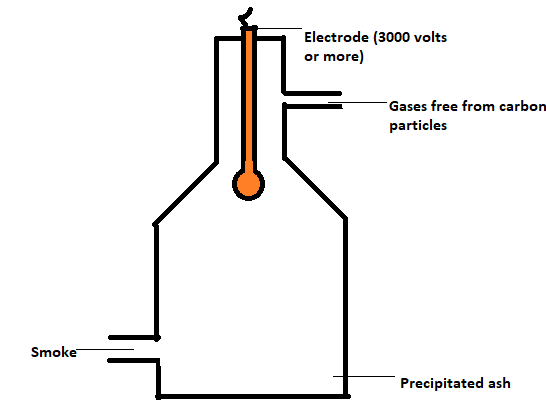
Note: These electrostatic precipitators are employed in thermal power plants, and industries involved in power generation, petroleum oil refineries, cement plants, paper mills, metallurgical plants, sludge incineration, etc. It is a device that removes particulate pollutants very effectively.
Complete answer:
Electrostatic precipitator is most widely used in a thermal power plant as it can remove 99 percent particulate matter present in the exhaust of thermal power plants. The main principle behind its working is the electrical charging of the dust particles and its collection on a differently charged platform. In these devices, the electrically charged wastes are attracted on oppositely charged electrode wires of collecting surfaces due to development of corona effect around the electrodes due to high voltage properties.
Principally, two devices remove particulate air pollutants i.e.
- Arresters: It helps in separating particulate matters.
- Scrubbers: It is used to clean air for both dusts and gases by passing it through a dry or wet packing material. Both dry and wet types of scrubbers are used for dust separation. Scrubbers are best suited for the removal of gaseous pollutants and thus are not used much for separating the particulate matters from emissions.
- Filters are used for collecting particulate matters that are extremely fine. There are various types of filter materials available that suit different quality and size of the particulate matters.
Note: These electrostatic precipitators are employed in thermal power plants, and industries involved in power generation, petroleum oil refineries, cement plants, paper mills, metallurgical plants, sludge incineration, etc. It is a device that removes particulate pollutants very effectively.
Recently Updated Pages
Master Class 12 Business Studies: Engaging Questions & Answers for Success

Master Class 12 Biology: Engaging Questions & Answers for Success
Master Class 12 Chemistry: Engaging Questions & Answers for Success
Class 12 Question and Answer - Your Ultimate Solutions Guide
Master Class 11 Social Science: Engaging Questions & Answers for Success
Master Class 11 English: Engaging Questions & Answers for Success
Trending doubts
Which are the Top 10 Largest Countries of the World?
Draw a labelled sketch of the human eye class 12 physics CBSE
Differentiate between homogeneous and heterogeneous class 12 chemistry CBSE
Sulphuric acid is known as the king of acids State class 12 chemistry CBSE
Why is the cell called the structural and functional class 12 biology CBSE
Which is the correct genotypic ratio of mendel dihybrid class 12 biology CBSE