




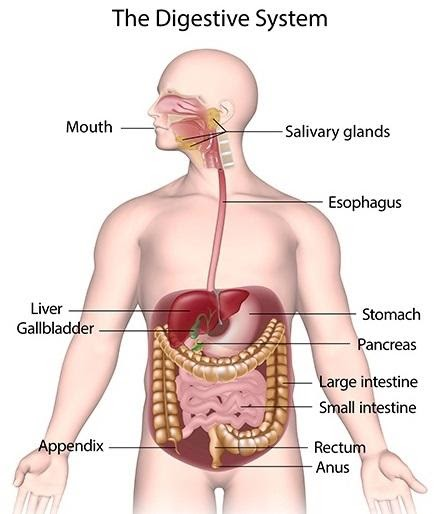
With the help of a diagram describe how food gets digested and assimilated in the human digestive system.
Answer
 Verified
577.5k+ views
Hint: Digestion is the process of breaking the food into a smaller and smallest component until it becomes a liquid. Seven steps are there in digestion. Twelve parts are involved in digestion. They are called digestive parts. In the digestion process three phases are there. Digestive system converts the food as the amino acid, glucose and fatty acids. The food after digestion is absorbed by the blood stream in the small intestine given to each cell.
Complete answer:
The digestive system is made up of the gastrointestinal tract and the auxiliary organs. Accessory organs are tongue, salivary glands, pancreas, liver and gallbladder. The processes in digestion are ingestion, propulsion, mechanical digestion, chemical digestion, absorption and defecation. The organs like the mouth, esophagus, stomach, large and small intestine, rectum and anus are participated in the digestion process. In the digestion process three phases are available; they are cephalic phase, gastric phase and intestinal phase. In the cephalic phase mouth identify the smell of a food. Chewing of food occurs and chemical breakdown is done by digestive enzymes. This process takes place in the mouth. In saliva, amylase and lipase enzymes are available. After the food breaks it is mixed with saliva. It produces bolus which is entering into the esophagus. In the second phase the food is further broken by mixing with gastric acid until it passes into duodenum. It is the first part of the small intestine. In the third stage partially digested food mixed with enzymes produced by the pancreas. Most of the digestion of food occurs in the small intestine. Water and some minerals are absorbed back to the blood by the colon of the large intestine. At last the waste products from digestion are exposed from anus via rectum.
Note:
Digestive system helps to get the nutrients and eliminate waste products. Large intestine helps to remove the waste. Stomach helps to protect the body from amino acids by providing digestive juice. Small intestine helps to absorb the nutrients from food. Peristalsis movement is an important thing in digestion. It is a wave-like muscle contraction that moves food towards the digestive tract. It starts with the esophagus and ends with the stomach. Food digestion completely finished within \[36\] hours.
Complete answer:
The digestive system is made up of the gastrointestinal tract and the auxiliary organs. Accessory organs are tongue, salivary glands, pancreas, liver and gallbladder. The processes in digestion are ingestion, propulsion, mechanical digestion, chemical digestion, absorption and defecation. The organs like the mouth, esophagus, stomach, large and small intestine, rectum and anus are participated in the digestion process. In the digestion process three phases are available; they are cephalic phase, gastric phase and intestinal phase. In the cephalic phase mouth identify the smell of a food. Chewing of food occurs and chemical breakdown is done by digestive enzymes. This process takes place in the mouth. In saliva, amylase and lipase enzymes are available. After the food breaks it is mixed with saliva. It produces bolus which is entering into the esophagus. In the second phase the food is further broken by mixing with gastric acid until it passes into duodenum. It is the first part of the small intestine. In the third stage partially digested food mixed with enzymes produced by the pancreas. Most of the digestion of food occurs in the small intestine. Water and some minerals are absorbed back to the blood by the colon of the large intestine. At last the waste products from digestion are exposed from anus via rectum.
Note:
Digestive system helps to get the nutrients and eliminate waste products. Large intestine helps to remove the waste. Stomach helps to protect the body from amino acids by providing digestive juice. Small intestine helps to absorb the nutrients from food. Peristalsis movement is an important thing in digestion. It is a wave-like muscle contraction that moves food towards the digestive tract. It starts with the esophagus and ends with the stomach. Food digestion completely finished within \[36\] hours.
Recently Updated Pages
If x a + bt + ct2 where x is in meters and t is in class 11 physics CBSE

A car covers the first half distance between two places class 11 physics CBSE
The resultant of two vectors overrightarrow P and overrightarrow class 11 physics CBSE
Find the value of cos 135 class 11 maths CBSE
A mass M is held in place by an applied force F and class 11 physics CBSE
A solution of glucose in water is labelled as 10 dfracwv class 11 chemistry CBSE
Trending doubts
One Metric ton is equal to kg A 10000 B 1000 C 100 class 11 physics CBSE
Find the value of the expression given below sin 30circ class 11 maths CBSE
Draw a diagram of nephron and explain its structur class 11 biology CBSE
10 examples of friction in our daily life
Proton was discovered by A Thomson B Rutherford C Chadwick class 11 chemistry CBSE
Bond order ofO2 O2+ O2 and O22 is in order A O2 langle class 11 chemistry CBSE