



Find the value of cos (135°).
Answer
 Verified
633.3k+ views
Hint:There are 4 quadrants in the trigonometric plane. Figure out in which quadrant does the given angle lie on. ALL, SINE, TAN, COS are positive in the order of quadrant 1,2,3 and 4 anticlockwise. The rest trigonometric functions are negative.
Complete step by step solution:
135° clearly lies in the 2 nd quadrant. All trigonometric functions except “sine” are negative in the 2 nd quadrant.
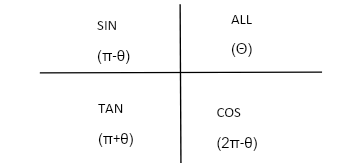
Let, 135° = Θ.
As we can see that whenever the required angle (Θ) is in 2 nd quadrant, we can write the angle as (π-
θ).
Therefore, cos (135°) = - cos (π-135°)
We know that π= 180°
∴ cos (135°) = - cos (π-135°) = - cos (180°−135°)
= - cos (45°)
= $ - \dfrac{1}{{\sqrt 2 }} $
Alternate method: Instead of the above steps, you might also write cos (135°) as the sum of two standard angles,
cos (135°) = cos (45°+90°)
Using the formula, cos (A+B) = cos A. cos B – sin A. sin B
= cos 45°. cos 90° - sin 45°. sin 90°
= $ \dfrac{1}{{\sqrt 2 }} $ . 0 - $ \dfrac{1}{{\sqrt 2 }} $ . 1 = - $ \dfrac{1}{{\sqrt 2 }} $
Note: Whenever there are trigonometric calculations to be done, the quadrants must be kept in mind. The signs play a major role in determining the correct answer. One might use the first approach to write in exams, and the second approach when such short questions are given to be answered in a very short time.
Complete step by step solution:
135° clearly lies in the 2 nd quadrant. All trigonometric functions except “sine” are negative in the 2 nd quadrant.
Let, 135° = Θ.
As we can see that whenever the required angle (Θ) is in 2 nd quadrant, we can write the angle as (π-
θ).
Therefore, cos (135°) = - cos (π-135°)
We know that π= 180°
∴ cos (135°) = - cos (π-135°) = - cos (180°−135°)
= - cos (45°)
= $ - \dfrac{1}{{\sqrt 2 }} $
Alternate method: Instead of the above steps, you might also write cos (135°) as the sum of two standard angles,
cos (135°) = cos (45°+90°)
Using the formula, cos (A+B) = cos A. cos B – sin A. sin B
= cos 45°. cos 90° - sin 45°. sin 90°
= $ \dfrac{1}{{\sqrt 2 }} $ . 0 - $ \dfrac{1}{{\sqrt 2 }} $ . 1 = - $ \dfrac{1}{{\sqrt 2 }} $
Note: Whenever there are trigonometric calculations to be done, the quadrants must be kept in mind. The signs play a major role in determining the correct answer. One might use the first approach to write in exams, and the second approach when such short questions are given to be answered in a very short time.
Recently Updated Pages
10 examples of friction in our daily life

Draw a diagram of nephron and explain its structur class 11 biology CBSE
Write structures of the following compounds i 2 Chloro3methylpentane class 11 chemistry CBSE
What is BLO What is the full form of BLO class 8 social science CBSE
Explain the Treaty of Vienna of 1815 class 10 social science CBSE
A Paragraph on Pollution in about 100-150 Words
Trending doubts
One Metric ton is equal to kg A 10000 B 1000 C 100 class 11 physics CBSE
Draw a diagram showing the external features of fish class 11 biology CBSE
Name the Largest and the Smallest Cell in the Human Body ?
Show that Newtons second law is the real law of mo class 11 physics CBSE
Lysosomes are known as suicidal bags of cell why class 11 biology CBSE
Why are mitochondria called the powerhouse of the class 11 biology CBSE