




Which rule gives the direction of induced current due to electromagnetic induction?
A) Fleming’s left hand rule
B) Maxwell’s left hand rule
C) Ampere’s rule
D) Fleming’s right hand rule
Answer
 Verified
616.5k+ views
Hint: The induced current due to the relative motion of a conductor in a magnetic field is perpendicular to the plane containing the directions of the magnetic field and the direction of the motion. This situation can be represented by the three outstretched fingers of a hand.
Complete answer:
The direction of the induced current when there is relative motion between a conductor in a magnetic field is perpendicular to the plane containing the direction of relative motion of the conductor and the magnetic field.
This direction can be very conveniently expressed using Fleming’s right hand rule. This rule states that if the thumb, index finger and middle finger of the right hand are outstretched in a mutually perpendicular fashion such that the thumb points towards the direction of the relative motion of the conductor and the index finger points towards the magnetic field, then the direction of the induced current is given by the direction of the outstretched middle finger.
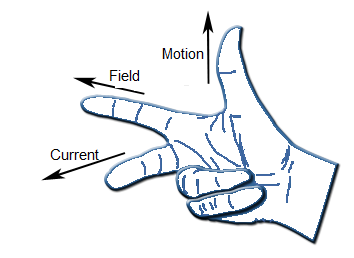
So, the correct answer is “Option D”.
Note:
Students must not get confused between Fleming’s left hand rule and Fleming’s right hand rule. Fleming’s left hand rule is used for finding the directions of the motion for electric motors while Fleming’s right hand rule is used for finding the direction of the induced current in electric generators. If students use Fleming’s left hand rule in a place where they should have used Fleming’s right hand rule or vice versa, they will end up getting the opposite direction of the quantity that they wanted to find.
Complete answer:
The direction of the induced current when there is relative motion between a conductor in a magnetic field is perpendicular to the plane containing the direction of relative motion of the conductor and the magnetic field.
This direction can be very conveniently expressed using Fleming’s right hand rule. This rule states that if the thumb, index finger and middle finger of the right hand are outstretched in a mutually perpendicular fashion such that the thumb points towards the direction of the relative motion of the conductor and the index finger points towards the magnetic field, then the direction of the induced current is given by the direction of the outstretched middle finger.
So, the correct answer is “Option D”.
Note:
Students must not get confused between Fleming’s left hand rule and Fleming’s right hand rule. Fleming’s left hand rule is used for finding the directions of the motion for electric motors while Fleming’s right hand rule is used for finding the direction of the induced current in electric generators. If students use Fleming’s left hand rule in a place where they should have used Fleming’s right hand rule or vice versa, they will end up getting the opposite direction of the quantity that they wanted to find.
Recently Updated Pages
Master Class 12 Business Studies: Engaging Questions & Answers for Success

Master Class 12 Biology: Engaging Questions & Answers for Success
Master Class 12 Chemistry: Engaging Questions & Answers for Success
Class 12 Question and Answer - Your Ultimate Solutions Guide
Master Class 11 Social Science: Engaging Questions & Answers for Success
Master Class 11 English: Engaging Questions & Answers for Success
Trending doubts
Which is more stable and why class 12 chemistry CBSE
What are the major means of transport Explain each class 12 social science CBSE
Sulphuric acid is known as the king of acids State class 12 chemistry CBSE
The value of constant k in coulombs law is beginalign class 12 physics CBSE
Why should a magnesium ribbon be cleaned before burning class 12 chemistry CBSE
Suicide bags of cells are aEndoplasmic reticulum bLysosome class 12 biology CBSE