




Which one of the following is the most widely accepted method of contraception in India at present?
(A) IUDs (Intrauterine devices)
(B) Cervical caps
(C) Male oral contraceptives
(D) Female oral contraceptives
Answer
 Verified
605.4k+ views
Hint: Contraception refers to any method or technique which prevents pregnancy in women. Population overgrowth is considered a serious threat nowadays, which can be managed by the use of various contraceptive methods. Women of different age groups prefer different contraceptive methods, however an ideal contraceptive should be user friendly and easily available, which then becomes the most widely accepted method of contraception.
Complete Answer:
Contraception, otherwise known as birth control, refers to any method or technique which prevents pregnancy or conception in women. India, being the second most populous country, the government of India was forced up to take serious measures to check population growth. The best step to overcome this problem is to motivate individuals to use contraceptive methods.
An ideal contraceptive should be,
(i) Easy to use,
(ii) Easily accessible,
(iii) Most effective,
(iv) With limited or no side-effects, and
(v) No way interfering with the sexual drive of the user.
- There are different ranges of contraceptive methods mainly, natural, barrier, IUDs, oral contraceptives, injectables, implants and surgical methods.
a. Natural methods include periodic abstinence, withdrawal or coitus interruptus and lactational amenorrhea. Use of condoms, diaphragms, cervical caps and vaults, which prevent the entry of sperm into the female reproductive tract, are considered as barrier methods.
b. IUDs (Intrauterine devices) are inserted by doctors or nurses in the uterus through vagina. Examples of IUDs are Lippes loop, copper releasing IUDs, and hormone releasing IUDs. These are ideal contraceptives and are the most widely accepted methods of contraception.
c. Oral contraceptives and injectables include administration of either progesterone or oestrogen.
d. Surgical methods include vasectomy or tubectomy, which are permanent methods to avoid pregnancy.
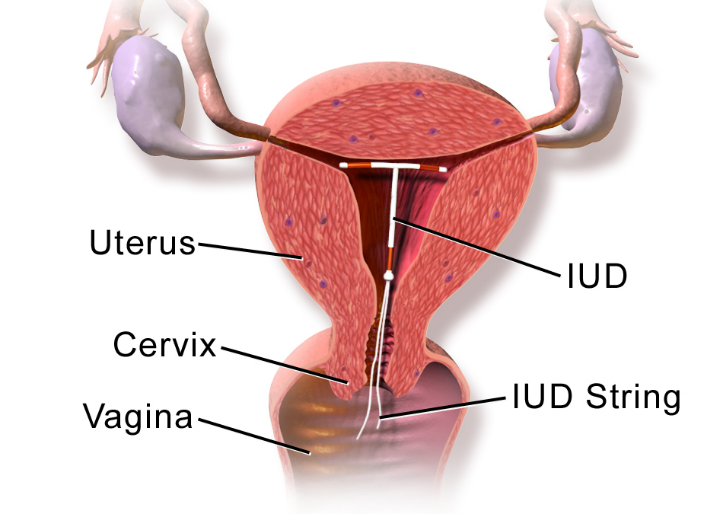
Of all the contraceptive methods, IUDs are widely accepted methods of contraception in India. There are different kinds of IUDs like copper releasing and hormones releasing. They are preferred by Indian women as these are ideal for those who want to delay pregnancy. Once inserted, IUDs remain in the female reproductive tract for 5 – 10 years, and hence the most widely accepted methods of contraception.
Therefore, Option (A) is correct.
Note: There are wide ranges of contraceptives. Each contraceptive has its own advantage and disadvantage. But IUDs are widely accepted since they phagocytose the sperms, suppress the motility of sperms and remain functional for 5 - 10 years inside the female reproductive tract. However, it is important to note that IUDs don’t prevent the transmission of STDs (Sexually Transmitted Disease).
Complete Answer:
Contraception, otherwise known as birth control, refers to any method or technique which prevents pregnancy or conception in women. India, being the second most populous country, the government of India was forced up to take serious measures to check population growth. The best step to overcome this problem is to motivate individuals to use contraceptive methods.
An ideal contraceptive should be,
(i) Easy to use,
(ii) Easily accessible,
(iii) Most effective,
(iv) With limited or no side-effects, and
(v) No way interfering with the sexual drive of the user.
- There are different ranges of contraceptive methods mainly, natural, barrier, IUDs, oral contraceptives, injectables, implants and surgical methods.
a. Natural methods include periodic abstinence, withdrawal or coitus interruptus and lactational amenorrhea. Use of condoms, diaphragms, cervical caps and vaults, which prevent the entry of sperm into the female reproductive tract, are considered as barrier methods.
b. IUDs (Intrauterine devices) are inserted by doctors or nurses in the uterus through vagina. Examples of IUDs are Lippes loop, copper releasing IUDs, and hormone releasing IUDs. These are ideal contraceptives and are the most widely accepted methods of contraception.
c. Oral contraceptives and injectables include administration of either progesterone or oestrogen.
d. Surgical methods include vasectomy or tubectomy, which are permanent methods to avoid pregnancy.
Of all the contraceptive methods, IUDs are widely accepted methods of contraception in India. There are different kinds of IUDs like copper releasing and hormones releasing. They are preferred by Indian women as these are ideal for those who want to delay pregnancy. Once inserted, IUDs remain in the female reproductive tract for 5 – 10 years, and hence the most widely accepted methods of contraception.
Therefore, Option (A) is correct.
Note: There are wide ranges of contraceptives. Each contraceptive has its own advantage and disadvantage. But IUDs are widely accepted since they phagocytose the sperms, suppress the motility of sperms and remain functional for 5 - 10 years inside the female reproductive tract. However, it is important to note that IUDs don’t prevent the transmission of STDs (Sexually Transmitted Disease).
Recently Updated Pages
Master Class 12 Economics: Engaging Questions & Answers for Success

Master Class 12 English: Engaging Questions & Answers for Success
Master Class 12 Social Science: Engaging Questions & Answers for Success
Master Class 12 Maths: Engaging Questions & Answers for Success
Master Class 12 Physics: Engaging Questions & Answers for Success
Master Class 9 General Knowledge: Engaging Questions & Answers for Success
Trending doubts
Which are the Top 10 Largest Countries of the World?
Draw a labelled sketch of the human eye class 12 physics CBSE
Differentiate between homogeneous and heterogeneous class 12 chemistry CBSE
Sulphuric acid is known as the king of acids State class 12 chemistry CBSE
Why is the cell called the structural and functional class 12 biology CBSE
Draw ray diagrams each showing i myopic eye and ii class 12 physics CBSE