



Which one of the following is a vinyl carbocation?
$\left( A \right)$ ${C_6}{H_5} - C{H_2}^ + $
$\left( B \right)$ $C{H_2} = CH - C{H_2}^ + $
$\left( C \right)\;\;C{H_2} = C{H^ + }$
$\left( D \right)\;$ All of the above
Answer
 Verified
609.6k+ views
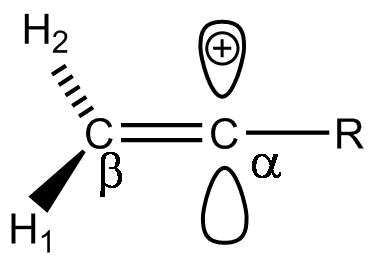
Hint: The vinyl carbocation is a carbocation with the charge on an alkene carbon. Vinylic cationic any disubstituted, trivalent carbon, where the carbon bearing the positive charge is a part of a double bond.
Complete answer:
Vinyl cation is one of the main types of reactive intermediates involving a non-tetrahedrally coordinated atom, and is important to refer to the broad class rather than the ${C^2}{H_3}^ + $ variant alone. The vinyl cation is one among the most sorts of reactive intermediates involving a non tetrahedrally coordinated atom, and is necessary to explain a wide variety of observed reactivity trends.
-Vinyl cations are observed as reactive intermediates in solvolysis, as well during electrophilic addition to alkynes. As expected from its ‘sp’ hybridization,
-Vinyl cation prefers a linear geometry
So, The correct answer is (C).
Additional Information: For vinyl cations, relative stabilities can be compared with respect to their neutral alkene analogs.

To obtain the stabilization properties of a substituent, the isodesmic reaction was used to calculate enthalpy difference between the substituted vinyl cation and its neutral alkenes precursor by getting its reaction enthalpy. This method is advantageous as it can be benchmarked against experimentally determined thermo chemical values.
Note:
Vinyl carbocations are the intermediate that are formed during reactions and can have a tendency to undergo rearrangements. These rearrangements into double bonds and rearrangements via the double bonds.
Complete answer:
Vinyl cation is one of the main types of reactive intermediates involving a non-tetrahedrally coordinated atom, and is important to refer to the broad class rather than the ${C^2}{H_3}^ + $ variant alone. The vinyl cation is one among the most sorts of reactive intermediates involving a non tetrahedrally coordinated atom, and is necessary to explain a wide variety of observed reactivity trends.
-Vinyl cations are observed as reactive intermediates in solvolysis, as well during electrophilic addition to alkynes. As expected from its ‘sp’ hybridization,
-Vinyl cation prefers a linear geometry
So, The correct answer is (C).
Additional Information: For vinyl cations, relative stabilities can be compared with respect to their neutral alkene analogs.
To obtain the stabilization properties of a substituent, the isodesmic reaction was used to calculate enthalpy difference between the substituted vinyl cation and its neutral alkenes precursor by getting its reaction enthalpy. This method is advantageous as it can be benchmarked against experimentally determined thermo chemical values.
Note:
Vinyl carbocations are the intermediate that are formed during reactions and can have a tendency to undergo rearrangements. These rearrangements into double bonds and rearrangements via the double bonds.
Recently Updated Pages
Master Class 12 Economics: Engaging Questions & Answers for Success

Master Class 12 English: Engaging Questions & Answers for Success
Master Class 12 Social Science: Engaging Questions & Answers for Success
Master Class 12 Maths: Engaging Questions & Answers for Success
Master Class 12 Physics: Engaging Questions & Answers for Success
Master Class 9 General Knowledge: Engaging Questions & Answers for Success
Trending doubts
Which are the Top 10 Largest Countries of the World?
Draw a labelled sketch of the human eye class 12 physics CBSE
Differentiate between homogeneous and heterogeneous class 12 chemistry CBSE
Why is the cell called the structural and functional class 12 biology CBSE
Draw ray diagrams each showing i myopic eye and ii class 12 physics CBSE
Which is the correct genotypic ratio of mendel dihybrid class 12 biology CBSE