



Which of the following is/are correct regarding candle clock?
A. Candle clock used tall candles to show passing of time
B. The candles had evenly spaced lines on them that were usually marked with numbers for each hour.
C. When the candle burned down to one of the numbers, it showed what time it was
D. All of the above
Answer
 Verified
651.9k+ views
Hint: As the name suggests, a candle-clock is indeed a time keeping device. We know that most often, a burning candle burns at a steady rate for a given composition and density of the material of the wax. The burning results in melting of wax which lowers the height of the candle. In such a case, think of how this process could be used to keep time.
Complete answer:
A candle clock is a time-keeping device that uses a thin candle with consistently spaced markings to indicate the passage of time. It consists of a metal holder at the base of the candle clock, and a scale with readings calibrated to specific intervals of time. The scale can either be marked on the candle itself or can be etched onto a separate piece of wood or metal that is mounted behind the candle. As the candle burns and melts the wax, the changing height of the candle is indicative of the amount of time that has passed. When the candle burns down to one of the readings on the scale, it shows what time it is.
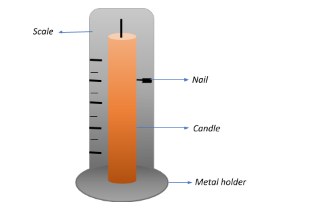
A candle clock was also used as a timer or an alarm clock by simply sticking in a heavy nail into the body of the candle at the mark indicating the desired interval. When the wax surrounding the area of the nail would melt, the nail would eventually clatter audibly onto the metal plate or holder below.
So, the correct answer is “Option D”.
Note:
Though candle clocks are no longer used, they were very versatile in ancient times. In addition to time keeping and alarm purposes, they provided an effective way to tell time indoors, at night, or on a cloudy day. This is because people relied on the position of the celestial bodies such as the Sun and the Moon as the day progressed to tell time, and in case the sky was overcast or in case it was a moonless night, there was no way to keep track of the passage of time. Thus, candle clocks were an independent indoor setup, and people did not have to rely on the ambient conditions or celestial bodies to tell time anymore. Candle clocks were further optimized by placing them in wind blocking contraptions to prevent them from blowing out in case of heavy winds, and by providing a spillway to effectively direct the melting wax away from the body of the candle to prevent it from clumping up and affecting the burn rate of the candle.
Complete answer:
A candle clock is a time-keeping device that uses a thin candle with consistently spaced markings to indicate the passage of time. It consists of a metal holder at the base of the candle clock, and a scale with readings calibrated to specific intervals of time. The scale can either be marked on the candle itself or can be etched onto a separate piece of wood or metal that is mounted behind the candle. As the candle burns and melts the wax, the changing height of the candle is indicative of the amount of time that has passed. When the candle burns down to one of the readings on the scale, it shows what time it is.
A candle clock was also used as a timer or an alarm clock by simply sticking in a heavy nail into the body of the candle at the mark indicating the desired interval. When the wax surrounding the area of the nail would melt, the nail would eventually clatter audibly onto the metal plate or holder below.
So, the correct answer is “Option D”.
Note:
Though candle clocks are no longer used, they were very versatile in ancient times. In addition to time keeping and alarm purposes, they provided an effective way to tell time indoors, at night, or on a cloudy day. This is because people relied on the position of the celestial bodies such as the Sun and the Moon as the day progressed to tell time, and in case the sky was overcast or in case it was a moonless night, there was no way to keep track of the passage of time. Thus, candle clocks were an independent indoor setup, and people did not have to rely on the ambient conditions or celestial bodies to tell time anymore. Candle clocks were further optimized by placing them in wind blocking contraptions to prevent them from blowing out in case of heavy winds, and by providing a spillway to effectively direct the melting wax away from the body of the candle to prevent it from clumping up and affecting the burn rate of the candle.
Recently Updated Pages
What are the two major island groups in India class 9 social science CBSE

What is Jhum cultivation class 9 biology CBSE
Write an Article on Save Earth Save Life
Silk is obtained from of the silk moth APupa BLarva class 9 chemistry CBSE
Write chemical formulas of the following compounds class 9 chemistry CBSE
The Indo Gangetic Plains of India are fertile due to class 9 social science CBSE
Trending doubts
Fill the blanks with the suitable prepositions 1 The class 9 english CBSE
Who was referred to as Amitraghata by the Greeks AChandragupta class 9 social science CBSE
Difference Between Plant Cell and Animal Cell
Name 10 Living and Non living things class 9 biology CBSE
What is the full form of pH?
On an outline map of India show its neighbouring c class 9 social science CBSE