




Which of the following is true for, the reflex arc
(A) Brain$\xrightarrow [ ]{ } $ spinal cord$\xrightarrow [ ]{ } $ muscles
(B) Receptor$\xrightarrow [ ]{ } $ spinal cord$\xrightarrow [ ]{ } $ muscles
(C) Muscle$\xrightarrow [ ]{ } $ receptor$\xrightarrow [ ]{ } $ brain
(D) Muscle$\xrightarrow [ ]{ } $ spinal cord$\xrightarrow [ ]{ } $ receptor
Answer
 Verified
578.1k+ views
Hint: Reflex arc is the pathway followed by the neurons while controlling a certain reflex. For faster reaction, in vertebrates, the sensory neuron doesn't pass into the brain but creates a synapse in the spinal cord.
Complete answer:
In a reflex action, the reflex arc is formed by receptor $ \xrightarrow [ ]{ } $ spinal cord$\xrightarrow [ ]{ } $ muscles.
The reflex arc is a neural pathway that is responsible for controlling a reflex. The characteristic of vertebrate sensory neurons of not passing into the brain directly and synapse in the spinal cord allows in faster reflex action by activating spinal motor neurons without any delay of routing the signal through the brain. After the reflex action, an analysis of the signal takes place.
Additional Information:
The reflex arc is the pathway followed by the two types of nerves involved in the reflex actions. The two types of nerves are
$\xrightarrow [ ]{ } $the one that carries sensory information from the receptor to the spinal cord
$\xrightarrow [ ]{ } $the one that carries the response generated by the spinal cord to effector organs
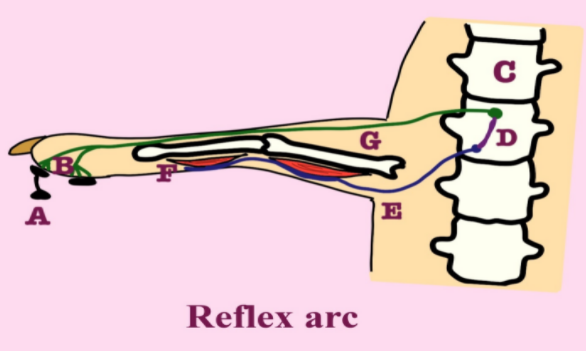
Above is the diagram for a reflex arc. Here when stimulus A is encountered by the organ, the signal travels up to the sensory neuron B and to the spinal column C. The signal will pass through D Which is a short interneuron, then will continue down a motor neuron E to the organ in contact with the stimulus. The contraction of muscles F will move the bone and the reflex will occur.
So, the correct answer is "Receptor$\xrightarrow [ ]{ } $ spinal cord$\xrightarrow [ ]{ } $ muscles".
Note:
There are two main types of reflex arc which are the autonomic reflex arc that affects the inner organs and the somatic reflex arc that affects muscles. Involvement of the spinal cord is noticed in the autonomic nervous system whereas some somatic reflexes are mediated more by the brain than the spinal cord.
Complete answer:
In a reflex action, the reflex arc is formed by receptor $ \xrightarrow [ ]{ } $ spinal cord$\xrightarrow [ ]{ } $ muscles.
The reflex arc is a neural pathway that is responsible for controlling a reflex. The characteristic of vertebrate sensory neurons of not passing into the brain directly and synapse in the spinal cord allows in faster reflex action by activating spinal motor neurons without any delay of routing the signal through the brain. After the reflex action, an analysis of the signal takes place.
Additional Information:
The reflex arc is the pathway followed by the two types of nerves involved in the reflex actions. The two types of nerves are
$\xrightarrow [ ]{ } $the one that carries sensory information from the receptor to the spinal cord
$\xrightarrow [ ]{ } $the one that carries the response generated by the spinal cord to effector organs
Above is the diagram for a reflex arc. Here when stimulus A is encountered by the organ, the signal travels up to the sensory neuron B and to the spinal column C. The signal will pass through D Which is a short interneuron, then will continue down a motor neuron E to the organ in contact with the stimulus. The contraction of muscles F will move the bone and the reflex will occur.
So, the correct answer is "Receptor$\xrightarrow [ ]{ } $ spinal cord$\xrightarrow [ ]{ } $ muscles".
Note:
There are two main types of reflex arc which are the autonomic reflex arc that affects the inner organs and the somatic reflex arc that affects muscles. Involvement of the spinal cord is noticed in the autonomic nervous system whereas some somatic reflexes are mediated more by the brain than the spinal cord.
Recently Updated Pages
Master Class 10 Computer Science: Engaging Questions & Answers for Success

Differentiate between voluntary action and reflex class 10 biology CBSE
The uses of bleaching powder are A It is used bleaching class 10 chemistry CBSE
Fill in the blanks with abstract nouns of the words class 10 english CBSE
How many threedigit numbers are there class 10 maths CBSE
What is a reflex arc class 10 biology CBSE
Trending doubts
Explain the Treaty of Vienna of 1815 class 10 social science CBSE
10 examples of evaporation in daily life with explanations
Which country is known as "The land of Fire and Ice"?
What is the full form of POSCO class 10 social science CBSE
Make a sketch of the human nerve cell What function class 10 biology CBSE
In which year voting age was reduced from 21 to 18?