




Which of the following is the most stable diazonium salt?
A. \[{{\text{C}}_{\text{6}}}{{\text{H}}_{\text{5}}}\text{C}{{\text{H}}_{\text{2}}}\text{N}_{\text{2}}^{\text{+}}{{\text{X}}^{\text{-}}}\]
B. \[\text{C}{{\text{H}}_{\text{3}}}\text{N}_{_{\text{2}}}^{\text{+}}{{\text{X}}^{\text{-}}}\]
C. \[\text{C}{{\text{H}}_{\text{3}}}\text{C}{{\text{H}}_{\text{2}}}\text{N}_{\text{2}}^{\text{+}}{{\text{X}}^{\text{-}}}\]
D. \[{{\text{C}}_{\text{6}}}{{\text{H}}_{\text{5}}}\text{N}_{\text{2}}^{\text{+}}{{\text{X}}^{\text{-}}}\]
Answer
 Verified
621.6k+ views
Hint: When we talk about the stability of diazonium salts,one important factor that is considered is the stabilisation of aromatic compounds by resonance.So,we should try drawing the resonance stabilized structure and check for the most stable diazonium salt.
Complete step by step solution: Now in the following question,let’s check whether the compounds are aliphatic or aromatic:
- We should first try eliminating the options B and C ,as aliphatic amines do not give any diazonium compounds under normal conditions,as they form highly unstable alkyl diazonium salts.
- So,now let's check for the aryl diazonium salts,so here resonance comes into play,as there is a dispersal of positive charge on the benzene ring,due to which the ring acquires partial double bond character,and thus is more stable, but less reactive whereas the aliphatic ones are more reactive and less stable.
- Let's see the resonance stabilised structure of benzene diazonium salt.
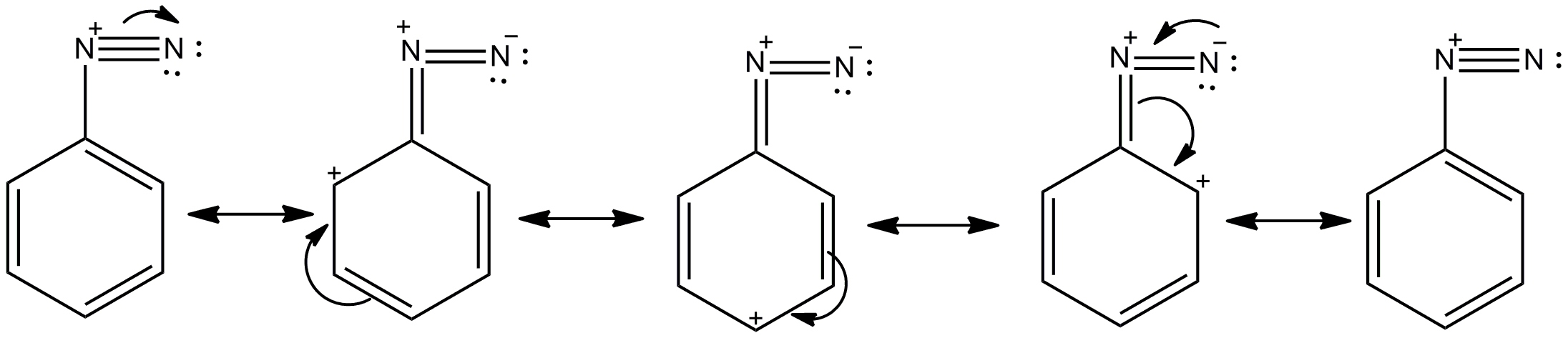
- So here we can see through the diagram the stability achieved by the resonance structures of option D,which is the benzene diazonium salt,which allows the distribution of charge in the whole ring.
-So option D is the correct answer.
Note: In case of aromatic diazonium salts ,we must remember that the positive charge on nitrogen stays in conjugation with the benzene ring,and hence stabilises the carbons of the ring,which the aliphatic diazonium fails to do and they simply liberate nitrogen gas, and form Alcohols,thus accounting for low stability.
Complete step by step solution: Now in the following question,let’s check whether the compounds are aliphatic or aromatic:
- We should first try eliminating the options B and C ,as aliphatic amines do not give any diazonium compounds under normal conditions,as they form highly unstable alkyl diazonium salts.
- So,now let's check for the aryl diazonium salts,so here resonance comes into play,as there is a dispersal of positive charge on the benzene ring,due to which the ring acquires partial double bond character,and thus is more stable, but less reactive whereas the aliphatic ones are more reactive and less stable.
- Let's see the resonance stabilised structure of benzene diazonium salt.
- So here we can see through the diagram the stability achieved by the resonance structures of option D,which is the benzene diazonium salt,which allows the distribution of charge in the whole ring.
-So option D is the correct answer.
Note: In case of aromatic diazonium salts ,we must remember that the positive charge on nitrogen stays in conjugation with the benzene ring,and hence stabilises the carbons of the ring,which the aliphatic diazonium fails to do and they simply liberate nitrogen gas, and form Alcohols,thus accounting for low stability.
Recently Updated Pages
Master Class 12 Business Studies: Engaging Questions & Answers for Success

Master Class 12 Chemistry: Engaging Questions & Answers for Success
Master Class 12 Biology: Engaging Questions & Answers for Success
Class 12 Question and Answer - Your Ultimate Solutions Guide
Master Class 11 English: Engaging Questions & Answers for Success
Master Class 11 Social Science: Engaging Questions & Answers for Success
Trending doubts
Which are the Top 10 Largest Countries of the World?
Draw a labelled sketch of the human eye class 12 physics CBSE
Differentiate between homogeneous and heterogeneous class 12 chemistry CBSE
In order to find out the different types of gametes class 12 biology NEET_UG
Why is the cell called the structural and functional class 12 biology CBSE
Draw ray diagrams each showing i myopic eye and ii class 12 physics CBSE