




Which of the following is an example of bisporic embryo sac?
A) Polygonum
B) Allium
C) Peperomia
D) None of the above
Answer
 Verified
621.3k+ views
Hint: The most common type of embryo sac is monosporic or Polygonum type.
Complete Answer:
In the flowering plants or angiosperms, embryo sac is the female gametophyte that is composed of the haploid female gamete. The female gametophyte or the embryo sac denotes the female haploid generation in the diplontic life cycle of the flowering plants. Therefore, these are produced through the process of meiosis.
Let us understand the basics of embryo sac development before knowing their different types. The ovule acts as the megasporangium in which some cells differentiate to develop into the megaspore mother cells in the nucellus of the ovule.
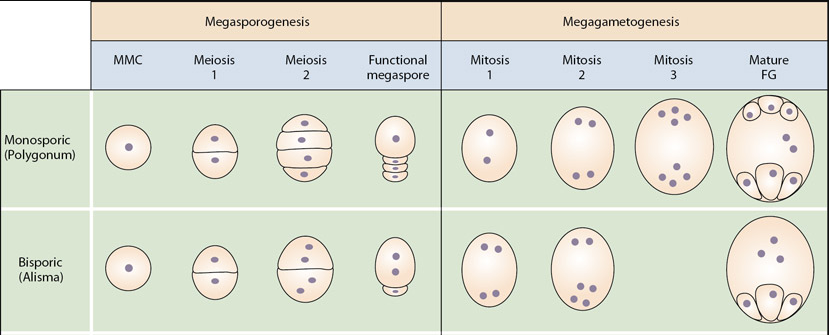
Now, this megaspore mother cell undergoes meiotic division to produce four haploid megaspores. This process is called megasporogenesis. Out of these four megaspores, three undergo degeneration (usually the ones present towards the micropylar end) and the one remaining now undergoes the process of megagametogenesis.
What happens to this remaining megaspore is way too interesting. Its haploid nucleus divides mitotically to produce eight nuclei. These eight nuclei are then arranged as:
1) An egg apparatus made of two synergid cells and an egg cell, towards the micropylar end of the ovule.
2) Three antipodals towards the chalazal end of the ovule.
3) A central cell with two nuclei called polar nuclei.
Such a structure is called a 7-celled, 8-nucleated structure of embryo sac. What you just have studied is also called the monosporic development of embryo sac or Polygonum type of embryo sac.
However, there is one another way through which the embryo sac could develop. It is called the bisporic development because instead of four, two megaspores are produced as a result of meiosis in the megaspore mother cell. Each megaspore has two haploid nuclei. One of these degenerates, the other undergoes megagametogenesis to form the embryo sac. It is also called the Allium type of embryo sac.
Therefore, the correct answer is option B.
Note: In the tetrasporic type of embryo sac, a single megaspore is formed after meiosis which contains 4 haploid nuclei. It is also called the Peperomia type of embryo sac.
Complete Answer:
In the flowering plants or angiosperms, embryo sac is the female gametophyte that is composed of the haploid female gamete. The female gametophyte or the embryo sac denotes the female haploid generation in the diplontic life cycle of the flowering plants. Therefore, these are produced through the process of meiosis.
Let us understand the basics of embryo sac development before knowing their different types. The ovule acts as the megasporangium in which some cells differentiate to develop into the megaspore mother cells in the nucellus of the ovule.
Now, this megaspore mother cell undergoes meiotic division to produce four haploid megaspores. This process is called megasporogenesis. Out of these four megaspores, three undergo degeneration (usually the ones present towards the micropylar end) and the one remaining now undergoes the process of megagametogenesis.
What happens to this remaining megaspore is way too interesting. Its haploid nucleus divides mitotically to produce eight nuclei. These eight nuclei are then arranged as:
1) An egg apparatus made of two synergid cells and an egg cell, towards the micropylar end of the ovule.
2) Three antipodals towards the chalazal end of the ovule.
3) A central cell with two nuclei called polar nuclei.
Such a structure is called a 7-celled, 8-nucleated structure of embryo sac. What you just have studied is also called the monosporic development of embryo sac or Polygonum type of embryo sac.
However, there is one another way through which the embryo sac could develop. It is called the bisporic development because instead of four, two megaspores are produced as a result of meiosis in the megaspore mother cell. Each megaspore has two haploid nuclei. One of these degenerates, the other undergoes megagametogenesis to form the embryo sac. It is also called the Allium type of embryo sac.
Therefore, the correct answer is option B.
Note: In the tetrasporic type of embryo sac, a single megaspore is formed after meiosis which contains 4 haploid nuclei. It is also called the Peperomia type of embryo sac.
Recently Updated Pages
Master Class 12 Business Studies: Engaging Questions & Answers for Success

Master Class 12 Biology: Engaging Questions & Answers for Success
Master Class 12 Chemistry: Engaging Questions & Answers for Success
Class 12 Question and Answer - Your Ultimate Solutions Guide
Master Class 11 Social Science: Engaging Questions & Answers for Success
Master Class 11 English: Engaging Questions & Answers for Success
Trending doubts
Which are the Top 10 Largest Countries of the World?
Draw a labelled sketch of the human eye class 12 physics CBSE
Differentiate between homogeneous and heterogeneous class 12 chemistry CBSE
Sulphuric acid is known as the king of acids State class 12 chemistry CBSE
Why is the cell called the structural and functional class 12 biology CBSE
Which is the correct genotypic ratio of mendel dihybrid class 12 biology CBSE