




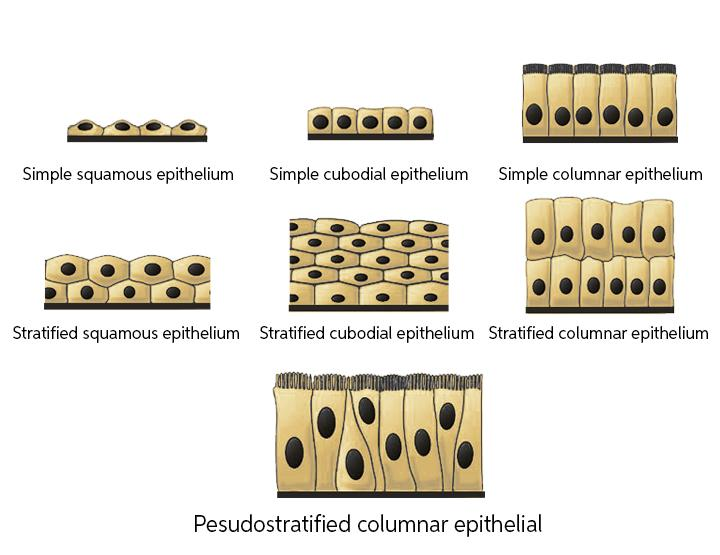
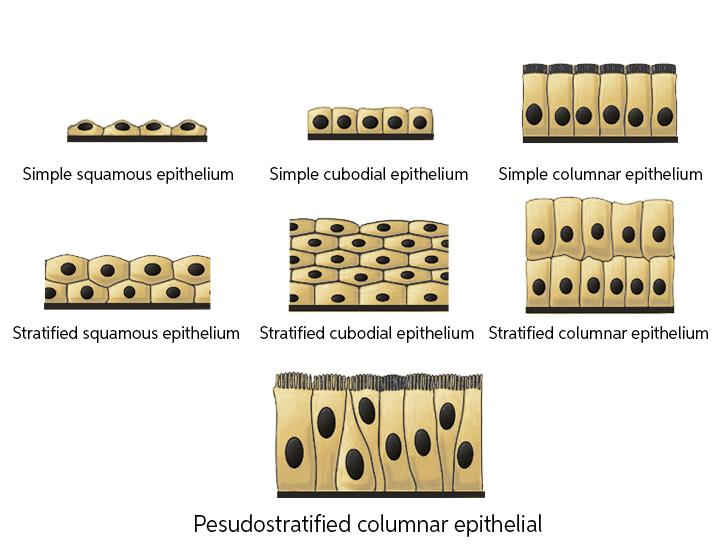
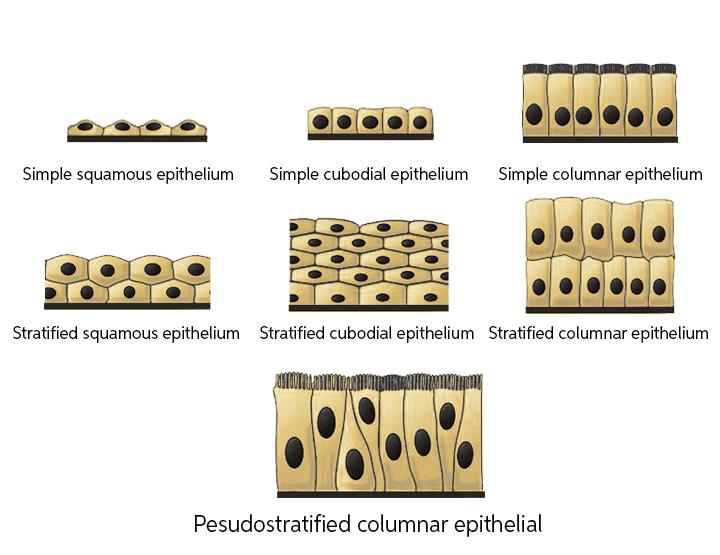
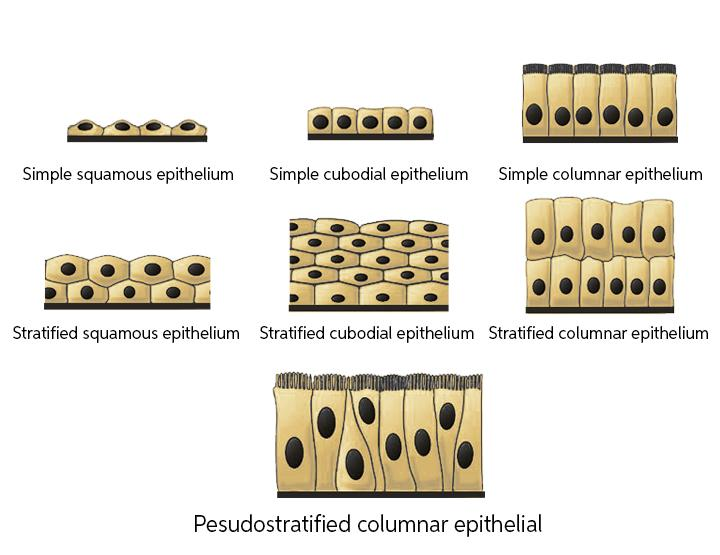
Which of the following epithelia is chiefly involved in function like diffusion and thereby is found in the wall of blood vessels and air sacs of the lungs?
(a)
(b)
(c)
(d)
Answer
 Verified
654.3k+ views
Hint: This is composed of a single layer of flattened cells lying on a basement membrane. This contains only their flattened nuclei which are often visible. This membrane provides a selective barrier which allows for filtration, passive diffusion and pinocytosis.
Complete step by step answer:
Squamous epithelium makes up the alveoli which is tiny hollow sacs in the lungs. This makes short distance between air in the alveoli and the blood in the capillary. This means gas exchange is very efficient. Alveolar duct lined by simple squamous epithelium which helps in increasing the surface area of gaseous exchange and surrounded by a network of capillaries.
- Goblet cells are shaped like a goblet hence their name which produces large amounts of mucus, a glycoprotein. Dirt and bacteria in the air that we inhale in gets trapped in the mucus.
- When mucus reaches the throat it is swallowed. The dirt and bacterias from air we inhale are destroyed by the hydrochloric acid and enzymes present in the stomach.
- Ciliated epithelium have tiny hairs called cilia which beat together in a rhythm moving mucus back up the trachea into the throat. Cigarette smoke damages cilia.
So, the correct answer is ‘(d) Simple Squamous.’
Note:
- The right lung is divided into three lobes by two fissures that are oblique and horizontal, the left lung is divided into two lobes by oblique fissure.
- The tongue shaped like the structure of the left lung below the cardiac notch is called lingula which corresponds to the middle lobe of the right lung.
- The lungs expand maximally in the inferior direction because movements of the thoracic wall and diaphragm are maximal toward the base of the lung.
Complete step by step answer:
Squamous epithelium makes up the alveoli which is tiny hollow sacs in the lungs. This makes short distance between air in the alveoli and the blood in the capillary. This means gas exchange is very efficient. Alveolar duct lined by simple squamous epithelium which helps in increasing the surface area of gaseous exchange and surrounded by a network of capillaries.
- Goblet cells are shaped like a goblet hence their name which produces large amounts of mucus, a glycoprotein. Dirt and bacteria in the air that we inhale in gets trapped in the mucus.
- When mucus reaches the throat it is swallowed. The dirt and bacterias from air we inhale are destroyed by the hydrochloric acid and enzymes present in the stomach.
- Ciliated epithelium have tiny hairs called cilia which beat together in a rhythm moving mucus back up the trachea into the throat. Cigarette smoke damages cilia.
So, the correct answer is ‘(d) Simple Squamous.’
Note:
- The right lung is divided into three lobes by two fissures that are oblique and horizontal, the left lung is divided into two lobes by oblique fissure.
- The tongue shaped like the structure of the left lung below the cardiac notch is called lingula which corresponds to the middle lobe of the right lung.
- The lungs expand maximally in the inferior direction because movements of the thoracic wall and diaphragm are maximal toward the base of the lung.
Recently Updated Pages
If x a + bt + ct2 where x is in meters and t is in class 11 physics CBSE

A car covers the first half distance between two places class 11 physics CBSE
The resultant of two vectors overrightarrow P and overrightarrow class 11 physics CBSE
Find the value of cos 135 class 11 maths CBSE
A mass M is held in place by an applied force F and class 11 physics CBSE
A solution of glucose in water is labelled as 10 dfracwv class 11 chemistry CBSE
Trending doubts
One Metric ton is equal to kg A 10000 B 1000 C 100 class 11 physics CBSE
Find the value of the expression given below sin 30circ class 11 maths CBSE
Draw a diagram of nephron and explain its structur class 11 biology CBSE
10 examples of friction in our daily life
Proton was discovered by A Thomson B Rutherford C Chadwick class 11 chemistry CBSE
Bond order ofO2 O2+ O2 and O22 is in order A O2 langle class 11 chemistry CBSE