




Which of the following compounds are chiral?
A. $Cis - 1,2 - Dichlorocyclohexane$
B. $trans - 1,2 - dichlorohexane$
C. $cis - 1,3 - Dichlorohexane$
D. $Trans - 1,3 - Dichlorohexane$
Answer
 Verified
573.9k+ views
Hint: The concept of chirality is based on the concepts of spatial arrangement of the atoms which are attached to the central atom of the compound under consideration.
Chirality refers to the mirror-images which are also non-superimposable compounds. Asymmetric molecules or carbon have a chiral configuration.
Complete step by step answer:
In order to answer this question we need to know the definition of chiral carbon or molecule. Chirality refers to the compound which is non-superimposable with the mirror image of the same compound. A stereocenter refers to one of the carbon which is asymmetric in nature. Now, we will draw the structure of each of the compounds whose name is provided in the question and we would figure out if it is chiral or not.
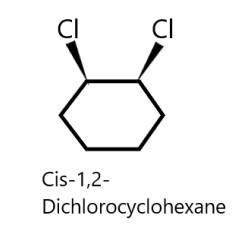
Above shown is the figure of the compound which is provided to us in option A, the name of this compound is $Cis - 1,2 - Dichlorocyclohexane$ and it is an achiral compound as it does now have a non-superimposable mirror image.
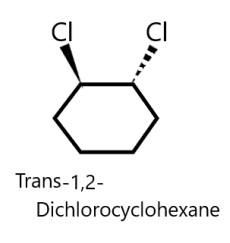
Above shown is the figure of the compound which is provided to us in option B, the name of this compound is $trans - 1,2 - dichlorohexane$ and it is a chiral compound as it has a non-superimposable mirror image.
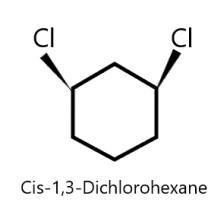
Above shown is the figure of the compound which is provided to us in option C, the name of this compound is $cis - 1,3 - Dichlorohexane$ and it is an achiral compound as it does not have a non-superimposable mirror image.
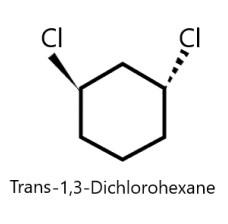
Above shown is the figure of the compound which is provided to us in option D, the name of this compound is $Trans - 1,3 - Dichlorohexane$ and it is a chiral compound as it has a non-superimposable mirror image.
So, the correct answer is Option D.
Note: For the purpose of determining the chirality of any compound the first step is to draw the structures of the compounds whose names are provided in the question.
Now, the carbons having four different groups attached to it could be considered a chiral carbon.
Chirality refers to the mirror-images which are also non-superimposable compounds. Asymmetric molecules or carbon have a chiral configuration.
Complete step by step answer:
In order to answer this question we need to know the definition of chiral carbon or molecule. Chirality refers to the compound which is non-superimposable with the mirror image of the same compound. A stereocenter refers to one of the carbon which is asymmetric in nature. Now, we will draw the structure of each of the compounds whose name is provided in the question and we would figure out if it is chiral or not.
Above shown is the figure of the compound which is provided to us in option A, the name of this compound is $Cis - 1,2 - Dichlorocyclohexane$ and it is an achiral compound as it does now have a non-superimposable mirror image.
Above shown is the figure of the compound which is provided to us in option B, the name of this compound is $trans - 1,2 - dichlorohexane$ and it is a chiral compound as it has a non-superimposable mirror image.
Above shown is the figure of the compound which is provided to us in option C, the name of this compound is $cis - 1,3 - Dichlorohexane$ and it is an achiral compound as it does not have a non-superimposable mirror image.
Above shown is the figure of the compound which is provided to us in option D, the name of this compound is $Trans - 1,3 - Dichlorohexane$ and it is a chiral compound as it has a non-superimposable mirror image.
So, the correct answer is Option D.
Note: For the purpose of determining the chirality of any compound the first step is to draw the structures of the compounds whose names are provided in the question.
Now, the carbons having four different groups attached to it could be considered a chiral carbon.
Recently Updated Pages
Master Class 12 Economics: Engaging Questions & Answers for Success

Master Class 12 English: Engaging Questions & Answers for Success
Master Class 12 Social Science: Engaging Questions & Answers for Success
Master Class 12 Maths: Engaging Questions & Answers for Success
Master Class 12 Physics: Engaging Questions & Answers for Success
Master Class 9 General Knowledge: Engaging Questions & Answers for Success
Trending doubts
One Metric ton is equal to kg A 10000 B 1000 C 100 class 11 physics CBSE
Difference Between Prokaryotic Cells and Eukaryotic Cells
Two of the body parts which do not appear in MRI are class 11 biology CBSE
1 ton equals to A 100 kg B 1000 kg C 10 kg D 10000 class 11 physics CBSE
Draw a diagram of nephron and explain its structur class 11 biology CBSE
10 examples of friction in our daily life