




Which among the given elements form the strongest base?
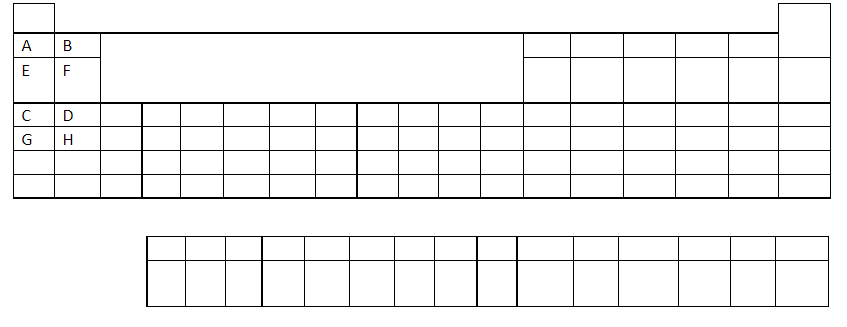
(a) A
(b) B
(c) C
(d) D
(e) E
(f) F
(g) G
Answer
 Verified
564.9k+ views
Hint: A base is a substance which has the tendency to lose the electrons and in the periodic table, as we move across a period, the losing tendency of an element decreases whereas on the other hand, as we move down the group, the losing tendency of an element increases. Now using this answer the statement accordingly.
Complete answer:
First of all, let’s discuss what a base is. A base is a substance which has the tendency to lose electrons easily.
We can also define base as those substances or the compounds which have a strong tendency to lose the hydroxyl ions i.e.-OH ions.
Now considering three statement as;
In the periodic table , the elements are arranged in the increasing order of their atomic numbers.
From the periodic table, we come to know the elements A,B, C,D , E, F,G and H are the alkali metals and the alkaline earth metals. These are;- lithium, beryllium, potassium, calcium, sodium, magnesium, rubidium and strontium.
In the periodic table, as we move from right to left , the tendency of the elements to lose the electrons decreases whereas to gain the electrons increases. So, thus, the acidic character increases as we move across the group and the basic character decreases.
Whereas on the other hand, as we move from top to bottom , the tendency of the elements to lose the electrons increases whereas to gain the electrons decreases. So, thus, the basic character increases as we move down the group and the acidic character decreases.
So, the increasing order of the basic character of the elements as;
Beryllium < lithium < magnesium < sodium < calcium < potassium < strontium < rubidium.
Hence, the strongest base is rubidium (G).
So, the correct answer is “Option G”.
Note:
As the basic character of an element increases as we move down the down , the tendency of an element to lose the electron also increases and therefore, its metallic character also increases. On the other hand, as the basic character decreases across a period, the metallic character also decreases.
Complete answer:
First of all, let’s discuss what a base is. A base is a substance which has the tendency to lose electrons easily.
We can also define base as those substances or the compounds which have a strong tendency to lose the hydroxyl ions i.e.-OH ions.
Now considering three statement as;
In the periodic table , the elements are arranged in the increasing order of their atomic numbers.
From the periodic table, we come to know the elements A,B, C,D , E, F,G and H are the alkali metals and the alkaline earth metals. These are;- lithium, beryllium, potassium, calcium, sodium, magnesium, rubidium and strontium.
In the periodic table, as we move from right to left , the tendency of the elements to lose the electrons decreases whereas to gain the electrons increases. So, thus, the acidic character increases as we move across the group and the basic character decreases.
Whereas on the other hand, as we move from top to bottom , the tendency of the elements to lose the electrons increases whereas to gain the electrons decreases. So, thus, the basic character increases as we move down the group and the acidic character decreases.
So, the increasing order of the basic character of the elements as;
Beryllium < lithium < magnesium < sodium < calcium < potassium < strontium < rubidium.
Hence, the strongest base is rubidium (G).
So, the correct answer is “Option G”.
Note:
As the basic character of an element increases as we move down the down , the tendency of an element to lose the electron also increases and therefore, its metallic character also increases. On the other hand, as the basic character decreases across a period, the metallic character also decreases.
Recently Updated Pages
If x a + bt + ct2 where x is in meters and t is in class 11 physics CBSE

A car covers the first half distance between two places class 11 physics CBSE
The resultant of two vectors overrightarrow P and overrightarrow class 11 physics CBSE
Find the value of cos 135 class 11 maths CBSE
A mass M is held in place by an applied force F and class 11 physics CBSE
A solution of glucose in water is labelled as 10 dfracwv class 11 chemistry CBSE
Trending doubts
Find the value of the expression given below sin 30circ class 11 maths CBSE
One Metric ton is equal to kg A 10000 B 1000 C 100 class 11 physics CBSE
Draw a diagram of nephron and explain its structur class 11 biology CBSE
10 examples of friction in our daily life
Proton was discovered by A Thomson B Rutherford C Chadwick class 11 chemistry CBSE
Bond order ofO2 O2+ O2 and O22 is in order A O2 langle class 11 chemistry CBSE