



What is the unit circle?
Answer
 Verified
603.3k+ views
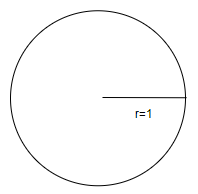
Hint: Before starting the problem, we should have ample knowledge regarding all the definitions of a circle. We should understand the only fact that in geometry, any circle is only defined by its radius. Thus, the term “unit circle” would only mean a circle having a radius $1$.
Complete step-by-step solution:
In geometry, a circle is a shape that has infinite axes of symmetry. In common terms, anything round is termed a circle. It is the most symmetric shape that can exist on earth. In cartesian coordinates, the definition of circle is a little different, the crux of the definitions remaining the same. In this coordinate system, a circle is the locus of a point which moves on a plane such that the distance of the point from a predefined point remains the same. The predefined point is known as the centre of the circle and the distance of the arbitrary point from the predefined point is called the radius.
Circles differ from one another solely based on their radii. Different radii infer to different circles. Thus, we can say that the radius is the most vital characteristic of a circle. Larger the radius, larger is the circle and smaller the radius, smaller is the circle.
Now, the term “unit” always refers to one, that is $1$ . Anything associated with $1$ is known as unit or unity. So, radius being the sole characteristic of a circle, a unit circle would simply mean a circle with radius $1$ .
Therefore, we can conclude that unit circle means a circle with radius $1$.
Note: In such problems, we should understand the language of the problem before jumping into solving the problem. Students might often get confused with the term “unit circle”. So, it's better if we break it down into two parts ``unit” and “circle”. Unit means $1$ and then we should associate it with the characteristic of the circle, that is its radius.
Complete step-by-step solution:
In geometry, a circle is a shape that has infinite axes of symmetry. In common terms, anything round is termed a circle. It is the most symmetric shape that can exist on earth. In cartesian coordinates, the definition of circle is a little different, the crux of the definitions remaining the same. In this coordinate system, a circle is the locus of a point which moves on a plane such that the distance of the point from a predefined point remains the same. The predefined point is known as the centre of the circle and the distance of the arbitrary point from the predefined point is called the radius.
Circles differ from one another solely based on their radii. Different radii infer to different circles. Thus, we can say that the radius is the most vital characteristic of a circle. Larger the radius, larger is the circle and smaller the radius, smaller is the circle.
Now, the term “unit” always refers to one, that is $1$ . Anything associated with $1$ is known as unit or unity. So, radius being the sole characteristic of a circle, a unit circle would simply mean a circle with radius $1$ .
Therefore, we can conclude that unit circle means a circle with radius $1$.
Note: In such problems, we should understand the language of the problem before jumping into solving the problem. Students might often get confused with the term “unit circle”. So, it's better if we break it down into two parts ``unit” and “circle”. Unit means $1$ and then we should associate it with the characteristic of the circle, that is its radius.
Recently Updated Pages
What are the two major island groups in India class 9 social science CBSE

What is Jhum cultivation class 9 biology CBSE
Write an Article on Save Earth Save Life
Silk is obtained from of the silk moth APupa BLarva class 9 chemistry CBSE
Write chemical formulas of the following compounds class 9 chemistry CBSE
The Indo Gangetic Plains of India are fertile due to class 9 social science CBSE
Trending doubts
Fill the blanks with the suitable prepositions 1 The class 9 english CBSE
Who was referred to as Amitraghata by the Greeks AChandragupta class 9 social science CBSE
Difference Between Plant Cell and Animal Cell
Name 10 Living and Non living things class 9 biology CBSE
What is the full form of pH?
On an outline map of India show its neighbouring c class 9 social science CBSE