




What is the micropylar end?
Answer
 Verified
585.9k+ views
Hint: Micropyle is an abbreviation for micropyle It is typically found at the top of the seed or ovule. After maturation, the ovary becomes the fruit and the ovule becomes the seed. As a result, the location where the pollen tube enters the ovule is converted into the micro Pyle.
Complete answer:
In Botany, A micropyle is a small opening in the integument of a seed plant's ovule.
In zoology, A micropyle is a differentiated area of the surface in an egg through which sperm enters.
MICROPYLE is a narrow pore or passage formed by integument projections through which the pollen tube enters the ovule.
1. The micropyle opening allows the pollen tube to enter the ovule and fertilize it.
2. It absorbs water to germinate.
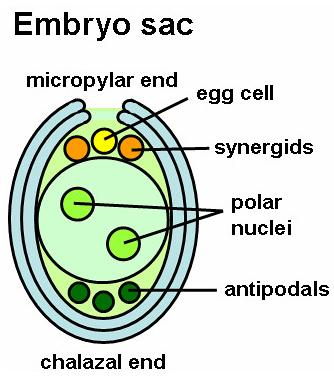
A micropyle is a pore in the membrane that surrounds the ovum that allows sperm to enter. Micropyles can also be found in the sporozoites of some digenetic microorganisms, such as Plasmodium, at the anterior part of the cell, which eventually leads to the apical cap. Bombyx Mandarina and Ceratitis capitata are two other organisms that have micropyles.
The micropyle aids in the absorption of water during seed germination. At the time of seed germination, the root emerges through this micropyle. The micropyle opening allows pollen to enter the ovule and fertilize it.
Thus, Micropyle is also referred to as the micropylar end. It is the outer coat of a cell with a small opening just adjacent to the hilum.
Note: An integument is a layer of cells that protects the ovule. Gymnosperms have one integument (unitegmic), whereas angiosperms have two integuments (bitegmic). When the ovule matures after fertilization, the integuments develop into the seed coat. the micropylar end lacks an integument.
Complete answer:
In Botany, A micropyle is a small opening in the integument of a seed plant's ovule.
In zoology, A micropyle is a differentiated area of the surface in an egg through which sperm enters.
MICROPYLE is a narrow pore or passage formed by integument projections through which the pollen tube enters the ovule.
1. The micropyle opening allows the pollen tube to enter the ovule and fertilize it.
2. It absorbs water to germinate.
A micropyle is a pore in the membrane that surrounds the ovum that allows sperm to enter. Micropyles can also be found in the sporozoites of some digenetic microorganisms, such as Plasmodium, at the anterior part of the cell, which eventually leads to the apical cap. Bombyx Mandarina and Ceratitis capitata are two other organisms that have micropyles.
The micropyle aids in the absorption of water during seed germination. At the time of seed germination, the root emerges through this micropyle. The micropyle opening allows pollen to enter the ovule and fertilize it.
Thus, Micropyle is also referred to as the micropylar end. It is the outer coat of a cell with a small opening just adjacent to the hilum.
Note: An integument is a layer of cells that protects the ovule. Gymnosperms have one integument (unitegmic), whereas angiosperms have two integuments (bitegmic). When the ovule matures after fertilization, the integuments develop into the seed coat. the micropylar end lacks an integument.
Recently Updated Pages
Which will be the least stable resonating structure class 11 chemistry CBSE

How many 5 digit telephone numbers can be construc-class-11-maths-CBSE
How do you find the angle of the resultant vector class 11 physics CBSE
Draw labelled diagram of the following i Gram seed class 11 biology CBSE
1 Quintal is equal to a 110 kg b 10 kg c 100kg d 1000 class 11 physics CBSE
What is the need and importance of classification class 11 biology CBSE
Trending doubts
Find the value of the expression given below sin 30circ class 11 maths CBSE
One Metric ton is equal to kg A 10000 B 1000 C 100 class 11 physics CBSE
10 examples of friction in our daily life
Draw a diagram of a plant cell and label at least eight class 11 biology CBSE
Difference between physical and chemical change class 11 chemistry CBSE
Proton was discovered by A Thomson B Rutherford C Chadwick class 11 chemistry CBSE