



What is the dipole moment of benzene?
Answer
 Verified
544.8k+ views
Hint: Benzene is hydrocarbon, carbon and hydrogen have similar electronegativities. Therefore there is no shift in electron density. Dipole moment can be calculated by product of the magnitude of the charge and the distance between the centers of the positive and negative charges or dipole is the measure of polarity of the molecule.
Complete answer: \[ \bullet \]Dipole moment is denoted by \[\mu \], measured in Debye units which is denoted by 'D'. Where $1D = 3.33564 \times {10^{ - 30}}$ Cm. ( C is Coulomb and m is meter).
\[ \bullet \]
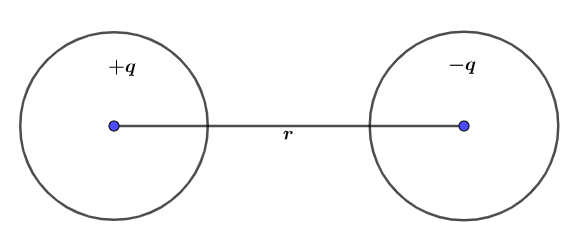
\[\mu = q.r\]
\[\mu \] is dipole moment, \[q\] is a separated charge and \[r\]is distance between them.
\[ \bullet \]Benzene \[{C_6}{H_6}\]
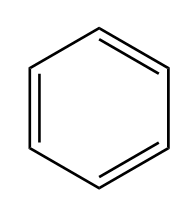
\[ \bullet \] Benzene is an organic compound, consisting of 6 carbon atoms joined in a planar ring with one hydrogen atom attached to each carbon. It contains only carbon and hydrogen. Therefore, it is a hydrocarbon.
\[ \bullet \] Molecules which have dipole moments are either asymmetrical or have different electronegativities.
\[ \bullet \] Dipole moment of benzene is zero. It's not exactly zero, but negligible.
\[ \bullet \] Benzene is hydrocarbon, carbon and hydrogen have similar electronegativities. Therefore there is no shift in electron density.
\[ \bullet \] Benzene is aromatic, due to resonance net charge displacement is almost zero . It has symmetrical planar, the $C-H$ bonds or the six dipole moments cancel out one another. Hence, the net dipole is zero and all the individual dipoles cancel out.
\[ \bullet \] A dipole moment arises anywhere there is a separation of charge. Therefore, they arise in ionic bonds as well as in covalent bonds.
And hence the dipole moment of Benzene is zero.
Note:
Make sure that you don't confuse benzene with its derivatives such as phenol, toluene and aniline. The bond dipole moment is a vector quantity as it has both magnitude and direction
Diagrams are necessary to solve such problems as it eases the question.
Complete answer: \[ \bullet \]Dipole moment is denoted by \[\mu \], measured in Debye units which is denoted by 'D'. Where $1D = 3.33564 \times {10^{ - 30}}$ Cm. ( C is Coulomb and m is meter).
\[ \bullet \]
\[\mu = q.r\]
\[\mu \] is dipole moment, \[q\] is a separated charge and \[r\]is distance between them.
\[ \bullet \]Benzene \[{C_6}{H_6}\]
\[ \bullet \] Benzene is an organic compound, consisting of 6 carbon atoms joined in a planar ring with one hydrogen atom attached to each carbon. It contains only carbon and hydrogen. Therefore, it is a hydrocarbon.
\[ \bullet \] Molecules which have dipole moments are either asymmetrical or have different electronegativities.
\[ \bullet \] Dipole moment of benzene is zero. It's not exactly zero, but negligible.
\[ \bullet \] Benzene is hydrocarbon, carbon and hydrogen have similar electronegativities. Therefore there is no shift in electron density.
\[ \bullet \] Benzene is aromatic, due to resonance net charge displacement is almost zero . It has symmetrical planar, the $C-H$ bonds or the six dipole moments cancel out one another. Hence, the net dipole is zero and all the individual dipoles cancel out.
\[ \bullet \] A dipole moment arises anywhere there is a separation of charge. Therefore, they arise in ionic bonds as well as in covalent bonds.
And hence the dipole moment of Benzene is zero.
Note:
Make sure that you don't confuse benzene with its derivatives such as phenol, toluene and aniline. The bond dipole moment is a vector quantity as it has both magnitude and direction
Diagrams are necessary to solve such problems as it eases the question.
Recently Updated Pages
Master Class 12 Economics: Engaging Questions & Answers for Success

Master Class 12 English: Engaging Questions & Answers for Success
Master Class 12 Social Science: Engaging Questions & Answers for Success
Master Class 12 Maths: Engaging Questions & Answers for Success
Master Class 12 Physics: Engaging Questions & Answers for Success
Master Class 9 General Knowledge: Engaging Questions & Answers for Success
Trending doubts
Which are the Top 10 Largest Countries of the World?
Draw a labelled sketch of the human eye class 12 physics CBSE
Differentiate between homogeneous and heterogeneous class 12 chemistry CBSE
Sulphuric acid is known as the king of acids State class 12 chemistry CBSE
Why is the cell called the structural and functional class 12 biology CBSE
Draw ray diagrams each showing i myopic eye and ii class 12 physics CBSE