




What is polycyclic steel?
Answer
 Verified
534.3k+ views
Hint: One should be having at first a clear idea about what is called a stele. A stele is actually the association of central vascular cylindrical bundles (composed of xylem and phloem) along with the endodermis layer of the cortex. The stele was discovered by two scientists Van Tieghem and Douliot in the year 1886. The term stele actually means ‘pillar’.
Complete answer:
Steles are of 5 types. They are listed below:
1. Protostele
a. Haplostele
b. Actinostele
c. Plectostele
d. Mixed-pith stele
2. Siphonostele
a. Ectophloic
b. Amphiphloic
3. Solenostele
4. Dictyostele
5. Polycyclic stele
6. Eustele
Among all these types, we may have a look at the polycyclic stele.
A polycyclic stele is the most complex of all the steles. This type is basically siphonostelic in structure. A typical polycyclic stele consists of two or more concentric rings of vascular tissues. Each such stele actually consists of an internal vascular system connected with an outer siphonostele.
Sometimes, the structure may also be solenostelic or dictyostelic, which are themselves derived from siphonostele.
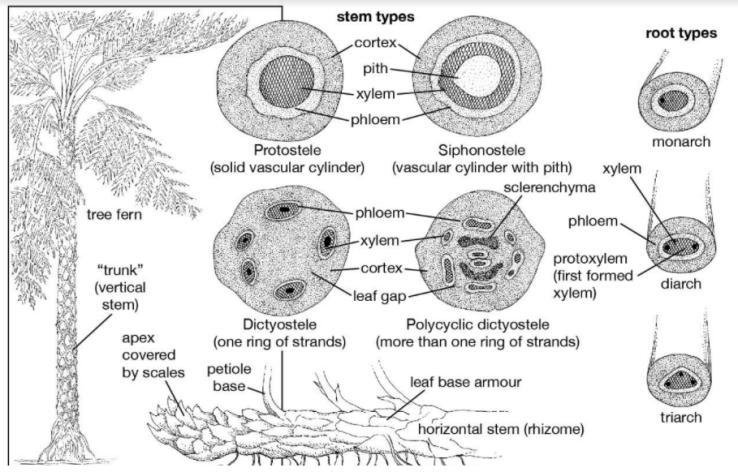
Note:
As discussed above, a polycyclic stele basically consists of two or more concentric vascular bundle rings which are siphonostelic or solenostelic or dictyostelic in structure.
Solenostelic and dictyostelic are also derived from siphonosteles.
So, it would be useful for us to learn the basic structure of siphonostele.
A stele in which the protostele is medullated is known as siphonostele. Such steles contain a tubular vascular region and a parenchymatous central region.
Complete answer:
Steles are of 5 types. They are listed below:
1. Protostele
a. Haplostele
b. Actinostele
c. Plectostele
d. Mixed-pith stele
2. Siphonostele
a. Ectophloic
b. Amphiphloic
3. Solenostele
4. Dictyostele
5. Polycyclic stele
6. Eustele
Among all these types, we may have a look at the polycyclic stele.
A polycyclic stele is the most complex of all the steles. This type is basically siphonostelic in structure. A typical polycyclic stele consists of two or more concentric rings of vascular tissues. Each such stele actually consists of an internal vascular system connected with an outer siphonostele.
Sometimes, the structure may also be solenostelic or dictyostelic, which are themselves derived from siphonostele.
Note:
As discussed above, a polycyclic stele basically consists of two or more concentric vascular bundle rings which are siphonostelic or solenostelic or dictyostelic in structure.
Solenostelic and dictyostelic are also derived from siphonosteles.
So, it would be useful for us to learn the basic structure of siphonostele.
A stele in which the protostele is medullated is known as siphonostele. Such steles contain a tubular vascular region and a parenchymatous central region.
Recently Updated Pages
Master Class 11 English: Engaging Questions & Answers for Success

Master Class 11 Social Science: Engaging Questions & Answers for Success
Master Class 11 Maths: Engaging Questions & Answers for Success
Master Class 11 Biology: Engaging Questions & Answers for Success
Master Class 11 Physics: Engaging Questions & Answers for Success
Master Class 11 Chemistry: Engaging Questions & Answers for Success
Trending doubts
Find the value of the expression given below sin 30circ class 11 maths CBSE
Difference between physical and chemical change class 11 chemistry CBSE
Draw a diagram of a plant cell and label at least eight class 11 biology CBSE
Draw a diagram showing the external features of fish class 11 biology CBSE
10 examples of law on inertia in our daily life
Draw a diagram of nephron and explain its structur class 11 biology CBSE