




What is glandular epithelium?
Answer
 Verified
430.5k+ views
Hint: Glands are a collected group of secretory epithelial cells. They are located beneath the connective tissue. The majority of glands arise as epithelial cells proliferate. They are columnar epithelium that have been changed.
Complete step by step answer:
The secretory sections of the glands are made up of the parenchyma of glandular epithelium.
The glandular epithelium is a form of columnar epithelium that has been changed. Their cells are altered for them to secrete certain chemicals. It is abundant in the stomach, intestine, and other secretory organs. The glands exist in isolation as unicellular glands. The goblet cells in the alimentary canal's mucosal membrane are unicellular glands.
Sweat glands and sebaceous glands in the skin, mammary glands and salivary glands, and other multicellular glands can gather to form.
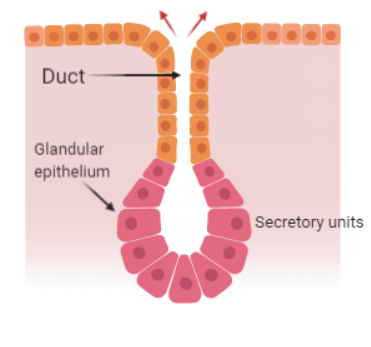
Image: Glandular epithelium
The glandular epithelium secretes sweat, milk, digestive enzymes, oil, and other hormones.
The two types of glands are exocrine and endocrine glands.
Unicellular or multicellular exocrine glands exist. They have ducts through which secretion is transported and ends up on the epithelial surface. For example, Sweat glands.
The secretions of endocrine glands are discharged directly into the bloodstream because they lack ducts. The pineal gland and pituitary gland are two examples.
Note: The glandular epithelium are specialised epithelial cells that secrete glands. There are two types of glands: endocrine and exocrine. Exocrine glands store secretion until it is needed for the body's covering and lining. Hormone development is regulated by endocrine glands, which contain hormones created before they are needed in the body.
Complete step by step answer:
The secretory sections of the glands are made up of the parenchyma of glandular epithelium.
The glandular epithelium is a form of columnar epithelium that has been changed. Their cells are altered for them to secrete certain chemicals. It is abundant in the stomach, intestine, and other secretory organs. The glands exist in isolation as unicellular glands. The goblet cells in the alimentary canal's mucosal membrane are unicellular glands.
Sweat glands and sebaceous glands in the skin, mammary glands and salivary glands, and other multicellular glands can gather to form.
Image: Glandular epithelium
The glandular epithelium secretes sweat, milk, digestive enzymes, oil, and other hormones.
The two types of glands are exocrine and endocrine glands.
Unicellular or multicellular exocrine glands exist. They have ducts through which secretion is transported and ends up on the epithelial surface. For example, Sweat glands.
The secretions of endocrine glands are discharged directly into the bloodstream because they lack ducts. The pineal gland and pituitary gland are two examples.
Note: The glandular epithelium are specialised epithelial cells that secrete glands. There are two types of glands: endocrine and exocrine. Exocrine glands store secretion until it is needed for the body's covering and lining. Hormone development is regulated by endocrine glands, which contain hormones created before they are needed in the body.
Recently Updated Pages
Master Class 11 English: Engaging Questions & Answers for Success

Master Class 11 Social Science: Engaging Questions & Answers for Success
Master Class 11 Maths: Engaging Questions & Answers for Success
Master Class 11 Biology: Engaging Questions & Answers for Success
Master Class 11 Physics: Engaging Questions & Answers for Success
Master Class 11 Chemistry: Engaging Questions & Answers for Success
Trending doubts
Which are the Top 10 Largest Countries of the World?
One Metric ton is equal to kg A 10000 B 1000 C 100 class 11 physics CBSE
Explain the Treaty of Vienna of 1815 class 10 social science CBSE
Draw a labelled sketch of the human eye class 12 physics CBSE
What is BLO What is the full form of BLO class 8 social science CBSE
Which Indian state shares the longest international class 8 social science CBSE