




The value of 6 more than -7 is
A. 1
B. -1
C. 13
D. -13
Answer
 Verified
586.2k+ views
Hint: 6 is a positive integer and -7 is a negative integer. 6 more than -7 is a sum of -7 with 6. Sum of a positive integer and negative integer is not exactly a sum, rather a difference. So subtract the smaller number from the larger number and put the sign of the larger number for the result. The result will have the sign of the larger number.
Complete step-by-step answer:
We are given to find the value of 6 more than -7.
More indicates addition. Less indicates subtraction. So we have to add 6 to -7.
The numbers 6 and -7 are integers. Integers are numbers which can be written without fractional components. Integers can be either negative or positive. Fractions are not integers. For example 2, -4, -5, 7 are integers whereas 7.5, $ \dfrac{2}{3} $ , $ \sqrt 5 $ are not integers.
Here 6 is a positive integer and -7 is a negative integer. Sum of a positive and negative integer is a difference.
So $ 6 + \left( { - 7} \right) $ can also be written as $ 6 - 7 $ .
In a subtraction, we always subtract the smaller number from the bigger number. Here 6 is smaller than 7. So subtract 6 from 7 and the result will have the sign of the larger number. 7 is the larger one and it has a negative sign (-7 is negative). So the result will have a negative sign.
Therefore, $ 6 - 7 = - 1 $
Hence, 6 more than -7 is $-1$.
So, the correct answer is “Option B”.
Note: Another approach
We can find 6 more than -7 by drawing the integer number line.
First point -7 and its successors on an integer number line.
6 more than -7 is the 6th successor of -7. Successor of an integer is its rightmost integer.
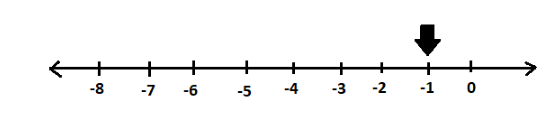
As we can see in the above diagram, -1 is the 6th successor of -7. This means 6 more than -7 is -1.
Complete step-by-step answer:
We are given to find the value of 6 more than -7.
More indicates addition. Less indicates subtraction. So we have to add 6 to -7.
The numbers 6 and -7 are integers. Integers are numbers which can be written without fractional components. Integers can be either negative or positive. Fractions are not integers. For example 2, -4, -5, 7 are integers whereas 7.5, $ \dfrac{2}{3} $ , $ \sqrt 5 $ are not integers.
Here 6 is a positive integer and -7 is a negative integer. Sum of a positive and negative integer is a difference.
So $ 6 + \left( { - 7} \right) $ can also be written as $ 6 - 7 $ .
In a subtraction, we always subtract the smaller number from the bigger number. Here 6 is smaller than 7. So subtract 6 from 7 and the result will have the sign of the larger number. 7 is the larger one and it has a negative sign (-7 is negative). So the result will have a negative sign.
Therefore, $ 6 - 7 = - 1 $
Hence, 6 more than -7 is $-1$.
So, the correct answer is “Option B”.
Note: Another approach
We can find 6 more than -7 by drawing the integer number line.
First point -7 and its successors on an integer number line.
6 more than -7 is the 6th successor of -7. Successor of an integer is its rightmost integer.
As we can see in the above diagram, -1 is the 6th successor of -7. This means 6 more than -7 is -1.

Recently Updated Pages
Master Class 7 Social Science: Engaging Questions & Answers for Success

Master Class 7 Science: Engaging Questions & Answers for Success
Master Class 7 Maths: Engaging Questions & Answers for Success
Class 7 Question and Answer - Your Ultimate Solutions Guide
Master Class 9 Social Science: Engaging Questions & Answers for Success
Master Class 9 Science: Engaging Questions & Answers for Success
Trending doubts
Full Form of IASDMIPSIFSIRSPOLICE class 7 social science CBSE
She sings a song Change into passive voice class 7 english CBSE
List of coprime numbers from 1 to 100 class 7 maths CBSE
One lakh eight thousand how can we write it in num class 7 maths CBSE
The founder of Jainism was A Rishabhadev B Neminath class 7 social science CBSE
Write a short note on the great bath of MohenjoDar class 7 social science CBSE