




Two point charges q and 2q are placed some distance apart. If the electric field at the location of q be E, then that at the location of 2q will be
(a). 2E
(b). E/2
(c). E
(d). None of these
Answer
 Verified
579.4k+ views
Hint: We can find the electric field at both the points where the charges are located due to each other. And then we can find the relation between the two values of the electric field by comparing the two values of electric fields we got.
Formula used:
Electric field due to a charge Q at a distance r from the charge is given by $E=\dfrac{kq}{r^2}$, where k is a constant with value $8.99\times 10^9\; Nm^2 /C^2$.
Complete step by step solution:
Let us consider the distance between the two charges q and 2q be d.
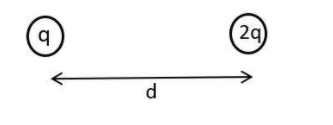
So, we know that electric field due to a charge Q at a distance r is given by the formula
$E=\dfrac{kQ}{r^2}$
Now, the electric field at charge 2q due to charge q will be, ${E}_{2q}=\dfrac{kq}{d^2}$
Similarly, electric field at charge q due to charge 2q will be, $E={E}_{q}=\dfrac{2kq}{d^2}$
Now, let us take the ratio of ${E}_{q}$ and ${E}_{2q}$,
Therefore, $\dfrac{{E}_{q}}{{E}_{2q}}=\dfrac{\dfrac{2kq}{d^2}}{\dfrac{kq}{d^2}}=2$
As, electric field at q is E, so $E={E}_{q}$
$\implies \dfrac{E}{{E}_{2q}}=2\implies {E}_{2q}=\dfrac{E}{2}$
Hence, option b is the correct answer.
Note: Mistake may happen while writing the formula for the electric field, that is on which charge the electric field is generated by which other charge.
We can also solve this question by using the formula of force due to a charge in an electric field as according to Newton’s third law, the forces on both the charges will be equal.
Formula used:
Electric field due to a charge Q at a distance r from the charge is given by $E=\dfrac{kq}{r^2}$, where k is a constant with value $8.99\times 10^9\; Nm^2 /C^2$.
Complete step by step solution:
Let us consider the distance between the two charges q and 2q be d.
So, we know that electric field due to a charge Q at a distance r is given by the formula
$E=\dfrac{kQ}{r^2}$
Now, the electric field at charge 2q due to charge q will be, ${E}_{2q}=\dfrac{kq}{d^2}$
Similarly, electric field at charge q due to charge 2q will be, $E={E}_{q}=\dfrac{2kq}{d^2}$
Now, let us take the ratio of ${E}_{q}$ and ${E}_{2q}$,
Therefore, $\dfrac{{E}_{q}}{{E}_{2q}}=\dfrac{\dfrac{2kq}{d^2}}{\dfrac{kq}{d^2}}=2$
As, electric field at q is E, so $E={E}_{q}$
$\implies \dfrac{E}{{E}_{2q}}=2\implies {E}_{2q}=\dfrac{E}{2}$
Hence, option b is the correct answer.
Note: Mistake may happen while writing the formula for the electric field, that is on which charge the electric field is generated by which other charge.
We can also solve this question by using the formula of force due to a charge in an electric field as according to Newton’s third law, the forces on both the charges will be equal.
Recently Updated Pages
Basicity of sulphurous acid and sulphuric acid are

Master Class 12 Economics: Engaging Questions & Answers for Success
Master Class 12 Biology: Engaging Questions & Answers for Success
Master Class 11 English: Engaging Questions & Answers for Success
Master Class 11 Physics: Engaging Questions & Answers for Success
Master Class 11 Computer Science: Engaging Questions & Answers for Success
Trending doubts
Draw a labelled sketch of the human eye class 12 physics CBSE
Why is the cell called the structural and functional class 12 biology CBSE
Draw ray diagrams each showing i myopic eye and ii class 12 physics CBSE
Which are the Top 10 Largest Countries of the World?
Differentiate between homogeneous and heterogeneous class 12 chemistry CBSE
Which is the correct genotypic ratio of mendel dihybrid class 12 biology CBSE