




Two identical thin rings each of radius ‘R’ are coaxially placed at a distance R apart. If $Q_1\ and\ Q_2$are respectively the charges uniformly spread on the two rings, the work done in moving a charge ‘q’ from the centre of one ring to the other is:
$\text{A.}\quad \dfrac{q(Q_1/Q_2)(\sqrt2+1)}{4\pi\epsilon_{\circ}\sqrt2 R}$
$\text{B.}\quad \dfrac{q(Q_1-Q_2)(\sqrt2-1)}{4\pi\epsilon_{\circ}\sqrt2 R}$
$\text{C.}\quad \dfrac{q(Q_1+Q_2)\sqrt2}{4\pi\epsilon_{\circ} R}$
$\text{D.}\quad zero$
Answer
 Verified
609k+ views
Hint: Potential energy is a quantity which defines the stability of the system. If it is less, the system is stable and if it is more, the system is unstable. P.E. can be positive, negative or zero. A positive potential energy is when two charges/bodies repel each other due to their nature whereas negative potential energy signifies that there is attraction between two bodies.
Formula used:
$Work\ done = q\Delta V$, potential at a co-axial distance of a uniformly charged ring = $\dfrac{Kq}{d}$
Complete answer:
This question could be easily solved by finding the potential at the centre of any ring.
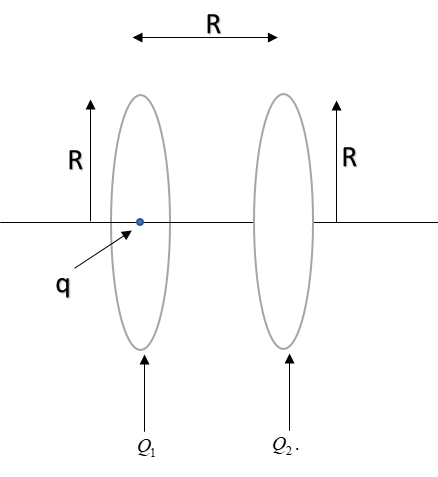
Potential at the centre of a ring will be the sum of potential of the individual ring at that point.
$V_{Total} (at\ the\ centre\ of\ Q_1) = \dfrac{KQ_1}{R} + \dfrac{KQ_2}{d}$
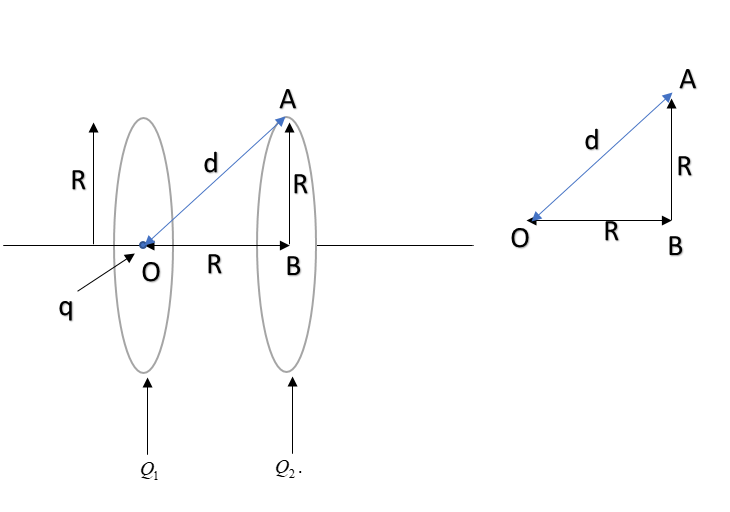
Now, from geometry we can see that in right angled $\Delta ABO$, $d = \sqrt{R^2+R^2} = \sqrt2 R$
Thus, $V_{total\ Q_1} = \dfrac{KQ_1}{R} + \dfrac{kQ_2}{\sqrt2 R} = \dfrac{K}{R}\left[ Q_1 + \dfrac{Q_2}{\sqrt2}\right]$
By, symmetry, we can write $V_{Total\ Q_2} = \dfrac{K}{R}\left( Q_2 + \dfrac{Q_2}{\sqrt2} \right)$
Now, using $Work\ done = q\Delta V$, where ‘q’ is the charge to be moved and $\Delta V$being the change in the potential, we get;
$W = q\times \left[\dfrac{K}R \left( Q_1 + \dfrac{Q_2}{\sqrt2} \right) - \dfrac{K}{R}\left(Q_2 + \dfrac{Q_1}{\sqrt2} \right)\right]$
$W = \dfrac{Kq(Q_1-Q_2)}{R} \times (1-\dfrac{1}{\sqrt2})$
As $K = \dfrac{1}{4\pi\epsilon_{\circ}}$
Hence $W = \quad \dfrac{q(Q_1-Q_2)(\sqrt2-1)}{4\pi\epsilon_{\circ}\sqrt2 R}$.
So, the correct answer is “Option B”.
Note:
These types of questions are very easy. No need for integration and we can get the answers. Students should realize that work done on any charge is given by $Work\ done = q\Delta V$. We just have to take the difference in potential of two points. This is the advantage of a state function or path function, we just have to take the difference between two points and we are done. Hence electrostatic work is a state function. Students just need to remember the potential due to different bodies at a particular point.
Formula used:
$Work\ done = q\Delta V$, potential at a co-axial distance of a uniformly charged ring = $\dfrac{Kq}{d}$
Complete answer:
This question could be easily solved by finding the potential at the centre of any ring.
Potential at the centre of a ring will be the sum of potential of the individual ring at that point.
$V_{Total} (at\ the\ centre\ of\ Q_1) = \dfrac{KQ_1}{R} + \dfrac{KQ_2}{d}$
Now, from geometry we can see that in right angled $\Delta ABO$, $d = \sqrt{R^2+R^2} = \sqrt2 R$
Thus, $V_{total\ Q_1} = \dfrac{KQ_1}{R} + \dfrac{kQ_2}{\sqrt2 R} = \dfrac{K}{R}\left[ Q_1 + \dfrac{Q_2}{\sqrt2}\right]$
By, symmetry, we can write $V_{Total\ Q_2} = \dfrac{K}{R}\left( Q_2 + \dfrac{Q_2}{\sqrt2} \right)$
Now, using $Work\ done = q\Delta V$, where ‘q’ is the charge to be moved and $\Delta V$being the change in the potential, we get;
$W = q\times \left[\dfrac{K}R \left( Q_1 + \dfrac{Q_2}{\sqrt2} \right) - \dfrac{K}{R}\left(Q_2 + \dfrac{Q_1}{\sqrt2} \right)\right]$
$W = \dfrac{Kq(Q_1-Q_2)}{R} \times (1-\dfrac{1}{\sqrt2})$
As $K = \dfrac{1}{4\pi\epsilon_{\circ}}$
Hence $W = \quad \dfrac{q(Q_1-Q_2)(\sqrt2-1)}{4\pi\epsilon_{\circ}\sqrt2 R}$.
So, the correct answer is “Option B”.
Note:
These types of questions are very easy. No need for integration and we can get the answers. Students should realize that work done on any charge is given by $Work\ done = q\Delta V$. We just have to take the difference in potential of two points. This is the advantage of a state function or path function, we just have to take the difference between two points and we are done. Hence electrostatic work is a state function. Students just need to remember the potential due to different bodies at a particular point.
Recently Updated Pages
Master Class 12 Business Studies: Engaging Questions & Answers for Success

Master Class 12 Biology: Engaging Questions & Answers for Success
Master Class 12 Chemistry: Engaging Questions & Answers for Success
Class 12 Question and Answer - Your Ultimate Solutions Guide
Master Class 11 Social Science: Engaging Questions & Answers for Success
Master Class 11 English: Engaging Questions & Answers for Success
Trending doubts
Which is more stable and why class 12 chemistry CBSE
Which are the Top 10 Largest Countries of the World?
Draw a labelled sketch of the human eye class 12 physics CBSE
Differentiate between homogeneous and heterogeneous class 12 chemistry CBSE
What are the major means of transport Explain each class 12 social science CBSE
Sulphuric acid is known as the king of acids State class 12 chemistry CBSE