




Two conductors PQ and RS are made to slide on the rails with speeds 4m/s and 5m/s respectively in a region of transverse uniform magnetic field B=1 T as shown in the figure. The electric current in the 9 ohm resistance is
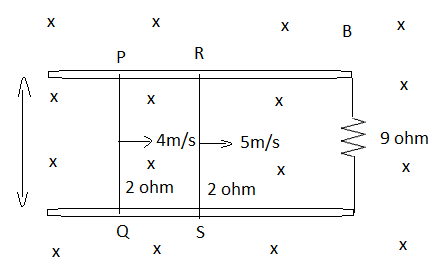
A. 40 mA
B. 45 mA
C. 90 mA
D. 80 mA
Answer
 Verified
557.1k+ views
Hint: This problem can be solved by the concept of motional emf , which is caused by change in flux. When PQ and RS are moving due to change in area of magnetic field emf is produced and current will flow through the circuit, which will be discussed in the below sections.
Formula used:
$\phi =BA$,
Emf $E=Blv$,
$\dfrac{{{E}_{eq}}}{{{\operatorname{R}}_{eq}}}=\dfrac{{{E}_{1}}}{{{R}_{1}}}+\dfrac{{{E}_{2}}}{{{R}_{2}}}$
Complete Step by step solution:
Magnetic flux depends on three factors: strength of magnetic field, area within the field and orientation of field, change in any of these three factors will lead to change in magnetic flux.
Our problem due to movement of roads is changing continuously and Emf is produced in the circuit.
The flux in a circuit with variable area will be given by ,
$\phi =BA$ here, $\phi $ (flux), B (magnitude of magnetic field ) and A (area)
Now, due to movement of rods area is changing continuously so we can change our equation to,
$\Rightarrow \phi =Blx$
Now by faraday's law, change in magnetic flux will leads to induced emf in a circuit so,
$\Rightarrow E=\dfrac{d\phi }{dt}$
$\Rightarrow E=Bl\dfrac{dx}{dt}=Blv$
Now, given in the question, B=1, $l=10cm=0.1m$, ${{v}_{PQ}}=4m/s$and ${{v}_{RS}}=5m/s$.
So, induced emf in PQ is ${{E}_{1}}=1\times 0.1\times 4=\dfrac{2}{5}$,
Induced emf in RS is ${{E}_{2}}=1\times 0.1\times 5=\dfrac{1}{2}$
Now, we know that equivalent voltage across parallel combination is given by,
$\dfrac{{{E}_{eq}}}{{{\operatorname{R}}_{eq}}}=\dfrac{{{E}_{1}}}{{{R}_{1}}}+\dfrac{{{E}_{2}}}{{{R}_{2}}}$, here ${{R}_{1}}$and${{R}_{2}}$ are resistance of PQ and RS, and this equation will also gives total current flowing the circuit so,
$\Rightarrow \dfrac{{{E}_{eq}}}{{{\operatorname{R}}_{eq}}}=\dfrac{2/5}{2}+\dfrac{1/2}{2}$
$\Rightarrow \dfrac{{{E}_{eq}}}{{{\operatorname{R}}_{eq}}}=\dfrac{1}{2}\left( \dfrac{5+4}{10} \right)$
$\Rightarrow \dfrac{{{E}_{eq}}}{{{\operatorname{R}}_{eq}}}=\dfrac{9}{20}=0.45=45mA$
So, due to change in flux and induced emf in the circuit the current flowing through $9\Omega $ resistance is equal to 45mA.
Hence, option (B) is correct.
Note:
The calculation of motional emf is not only limited to rods, because of Faraday's law we can see that change in magnetic flux caused by any conductor with motion can induce emf in a circuit. So this law holds for all flux changes either due to change in magnetic field or due to motion of conductor.
Formula used:
$\phi =BA$,
Emf $E=Blv$,
$\dfrac{{{E}_{eq}}}{{{\operatorname{R}}_{eq}}}=\dfrac{{{E}_{1}}}{{{R}_{1}}}+\dfrac{{{E}_{2}}}{{{R}_{2}}}$
Complete Step by step solution:
Magnetic flux depends on three factors: strength of magnetic field, area within the field and orientation of field, change in any of these three factors will lead to change in magnetic flux.
Our problem due to movement of roads is changing continuously and Emf is produced in the circuit.
The flux in a circuit with variable area will be given by ,
$\phi =BA$ here, $\phi $ (flux), B (magnitude of magnetic field ) and A (area)
Now, due to movement of rods area is changing continuously so we can change our equation to,
$\Rightarrow \phi =Blx$
Now by faraday's law, change in magnetic flux will leads to induced emf in a circuit so,
$\Rightarrow E=\dfrac{d\phi }{dt}$
$\Rightarrow E=Bl\dfrac{dx}{dt}=Blv$
Now, given in the question, B=1, $l=10cm=0.1m$, ${{v}_{PQ}}=4m/s$and ${{v}_{RS}}=5m/s$.
So, induced emf in PQ is ${{E}_{1}}=1\times 0.1\times 4=\dfrac{2}{5}$,
Induced emf in RS is ${{E}_{2}}=1\times 0.1\times 5=\dfrac{1}{2}$
Now, we know that equivalent voltage across parallel combination is given by,
$\dfrac{{{E}_{eq}}}{{{\operatorname{R}}_{eq}}}=\dfrac{{{E}_{1}}}{{{R}_{1}}}+\dfrac{{{E}_{2}}}{{{R}_{2}}}$, here ${{R}_{1}}$and${{R}_{2}}$ are resistance of PQ and RS, and this equation will also gives total current flowing the circuit so,
$\Rightarrow \dfrac{{{E}_{eq}}}{{{\operatorname{R}}_{eq}}}=\dfrac{2/5}{2}+\dfrac{1/2}{2}$
$\Rightarrow \dfrac{{{E}_{eq}}}{{{\operatorname{R}}_{eq}}}=\dfrac{1}{2}\left( \dfrac{5+4}{10} \right)$
$\Rightarrow \dfrac{{{E}_{eq}}}{{{\operatorname{R}}_{eq}}}=\dfrac{9}{20}=0.45=45mA$
So, due to change in flux and induced emf in the circuit the current flowing through $9\Omega $ resistance is equal to 45mA.
Hence, option (B) is correct.
Note:
The calculation of motional emf is not only limited to rods, because of Faraday's law we can see that change in magnetic flux caused by any conductor with motion can induce emf in a circuit. So this law holds for all flux changes either due to change in magnetic field or due to motion of conductor.
Recently Updated Pages
Master Class 12 Economics: Engaging Questions & Answers for Success

Master Class 12 Physics: Engaging Questions & Answers for Success
Master Class 12 English: Engaging Questions & Answers for Success
Master Class 12 Social Science: Engaging Questions & Answers for Success
Master Class 12 Maths: Engaging Questions & Answers for Success
Master Class 12 Business Studies: Engaging Questions & Answers for Success
Trending doubts
Which are the Top 10 Largest Countries of the World?
What are the major means of transport Explain each class 12 social science CBSE
Draw a labelled sketch of the human eye class 12 physics CBSE
What is a transformer Explain the principle construction class 12 physics CBSE
Why cannot DNA pass through cell membranes class 12 biology CBSE
Differentiate between insitu conservation and exsitu class 12 biology CBSE