




Two charges $q$ and $ - 4q$ are kept in a straight line. At how many points on this line, the electric potential is zero?
A. $1$
B. $2$
C. $3$
D. Infinite
Answer
 Verified
508.8k+ views
Hint: In order to solve this question we need to understand what electric potential is. Electric potential or potential difference is the amount of work done in moving a unit positive test charge from infinite to a point against the electric field with negligible acceleration so as to avoid energy lost due to radiation in motion. It is a scalar quantity, mathematically electrostatic potential directly proportional to the amount of test charge and inversely proportional to distance between the point and test charge.
Complete step by step answer:
Consider a charge $q$ at origin then the electrostatic potential due to this charge at point A which is at distance $r$ from charge is given by,
$V = \dfrac{{kq}}{r}$
Whereas “k” is proportionality constant and it is equal to $k = \dfrac{1}{{4\pi {\varepsilon _0}}}$. Here ${\varepsilon _0}$ is permittivity of free space and is equal to $8.854 \times {10^{ - 12}}{C^2}{N^{ - 1}}{m^{ - 2}}$
Let us consider charges situated on the x axis. So let us consider that charge $q$ is at origin and charge $ - 4q$ is at distance $d$ from charge $q$ having coordinate $(d,0)$.So let us take a point P at a distance x from q having coordinate as $(x,0)$.
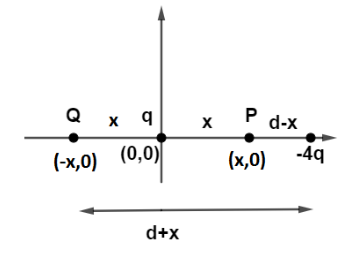
So electrostatic potential at P due to $q$ is given by ${V_1} = \dfrac{{kq}}{x}$.
Similarly, electrostatic potential at P due to $ - 4q$ is given by ${V_2} = \dfrac{{ - 4kq}}{{(d - x)}}$.
So net potential is $V = {V_1} + {V_2}$.
$V = kq(\dfrac{1}{x} - \dfrac{4}{{d - x}})$
So this potential is zero as $V = 0$
$kq\left( {\dfrac{1}{x} - \dfrac{4}{{d - x}}} \right) = 0$
$\Rightarrow \dfrac{{(d - x) - 4x}}{{x(d - x)}} = 0$
Equating the numerator to be zero we have
$d - 5x = 0$ Or $x = \dfrac{d}{5}$
So at $x = \dfrac{d}{5}$ electrostatic potential is zero
Now consider point Q at a distance x from q having coordinate as $( - x,0)$.
So electrostatic potential at Q due to $q$ is given by ${V_1} = \dfrac{{kq}}{x}$.
Similarly, electrostatic potential at Q due to $ - 4q$ is given by ${V_2} = \dfrac{{ - 4kq}}{{(d + x)}}$
So net potential is $V = {V_1} + {V_2}$
$V = kq(\dfrac{1}{x} - \dfrac{4}{{d + x}})$
So this potential is zero as $V = 0$
$kq\left( {\dfrac{1}{x} - \dfrac{4}{{d + x}}} \right) = 0$
$\Rightarrow \dfrac{{(d + x) - 4x}}{{x(d + x)}} = 0$
Equating the numerator to be zero we have
$d - 3x = 0$ Or $x = \dfrac{d}{3}$
So at $x = \dfrac{d}{3}$ electrostatic potential is zero
So the correct answer is A.
Note: It should be remembered that from multiple expansion of electrostatic potential it is clear that monopole is not zero so monopole contribution in electrostatic potential dominates compared to dipole and Quadrupole. If the monopole is zero then only the dipole contribution is necessary and also we can choose origin according to our own convenience.
Complete step by step answer:
Consider a charge $q$ at origin then the electrostatic potential due to this charge at point A which is at distance $r$ from charge is given by,
$V = \dfrac{{kq}}{r}$
Whereas “k” is proportionality constant and it is equal to $k = \dfrac{1}{{4\pi {\varepsilon _0}}}$. Here ${\varepsilon _0}$ is permittivity of free space and is equal to $8.854 \times {10^{ - 12}}{C^2}{N^{ - 1}}{m^{ - 2}}$
Let us consider charges situated on the x axis. So let us consider that charge $q$ is at origin and charge $ - 4q$ is at distance $d$ from charge $q$ having coordinate $(d,0)$.So let us take a point P at a distance x from q having coordinate as $(x,0)$.
So electrostatic potential at P due to $q$ is given by ${V_1} = \dfrac{{kq}}{x}$.
Similarly, electrostatic potential at P due to $ - 4q$ is given by ${V_2} = \dfrac{{ - 4kq}}{{(d - x)}}$.
So net potential is $V = {V_1} + {V_2}$.
$V = kq(\dfrac{1}{x} - \dfrac{4}{{d - x}})$
So this potential is zero as $V = 0$
$kq\left( {\dfrac{1}{x} - \dfrac{4}{{d - x}}} \right) = 0$
$\Rightarrow \dfrac{{(d - x) - 4x}}{{x(d - x)}} = 0$
Equating the numerator to be zero we have
$d - 5x = 0$ Or $x = \dfrac{d}{5}$
So at $x = \dfrac{d}{5}$ electrostatic potential is zero
Now consider point Q at a distance x from q having coordinate as $( - x,0)$.
So electrostatic potential at Q due to $q$ is given by ${V_1} = \dfrac{{kq}}{x}$.
Similarly, electrostatic potential at Q due to $ - 4q$ is given by ${V_2} = \dfrac{{ - 4kq}}{{(d + x)}}$
So net potential is $V = {V_1} + {V_2}$
$V = kq(\dfrac{1}{x} - \dfrac{4}{{d + x}})$
So this potential is zero as $V = 0$
$kq\left( {\dfrac{1}{x} - \dfrac{4}{{d + x}}} \right) = 0$
$\Rightarrow \dfrac{{(d + x) - 4x}}{{x(d + x)}} = 0$
Equating the numerator to be zero we have
$d - 3x = 0$ Or $x = \dfrac{d}{3}$
So at $x = \dfrac{d}{3}$ electrostatic potential is zero
So the correct answer is A.
Note: It should be remembered that from multiple expansion of electrostatic potential it is clear that monopole is not zero so monopole contribution in electrostatic potential dominates compared to dipole and Quadrupole. If the monopole is zero then only the dipole contribution is necessary and also we can choose origin according to our own convenience.
Recently Updated Pages
Master Class 12 Economics: Engaging Questions & Answers for Success

Master Class 12 Physics: Engaging Questions & Answers for Success
Master Class 12 English: Engaging Questions & Answers for Success
Master Class 12 Social Science: Engaging Questions & Answers for Success
Master Class 12 Maths: Engaging Questions & Answers for Success
Master Class 12 Business Studies: Engaging Questions & Answers for Success
Trending doubts
Which are the Top 10 Largest Countries of the World?
What are the major means of transport Explain each class 12 social science CBSE
Draw a labelled sketch of the human eye class 12 physics CBSE
What is a transformer Explain the principle construction class 12 physics CBSE
Why cannot DNA pass through cell membranes class 12 biology CBSE
Differentiate between insitu conservation and exsitu class 12 biology CBSE