




How many times does decarboxylation occur in the aerobic breakdown of one glucose molecule and when does it occur?
Answer
 Verified
553.2k+ views
Hint :Decarboxylation is indeed a chemical reaction in which a carboxyl group is removed and carbon dioxide is released. Decarboxylation is usually described as a reaction between carboxylic acids that removes a carbon atom from a carbon chain. Carboxylation, or the addition of $ C{O_2} $ to a compound, is the reverse process, and is the first chemical step in photosynthesis.
Complete Step By Step Answer:
During the aerobic breakdown of one glucose molecule, decarboxylation happens six times.
Each of the six carbon atoms in a glucose molecule must be converted into $ C{O_2} $ .
The glucose molecule gets split into two three-carbon fragments during glycolysis (pyruvate).
In a preparatory step, these fragments are fed into the Tricarboxylic Acid Cycle.
Preparatory Step:
As pyruvate is converted into $ Acetyl - CoA $ by pyruvate dehydrogenase, the first carbon atom of pyruvate is removed as $ C{O_2} $ .
$ \underbrace {C{H_3}COCO{O^ - }}_{pyruvate} + NA{D^ + } + H - SCoA\xrightarrow[{dehydrogenase}]{{pyruvate}}NADH + C{O_2} + \underbrace {C{H_3}CO - SCoA}_{Acetyl - CoA} $
Tricarboxylic Acid Cycle:
The Tricarboxylic Acid Cycle is shown in detail.
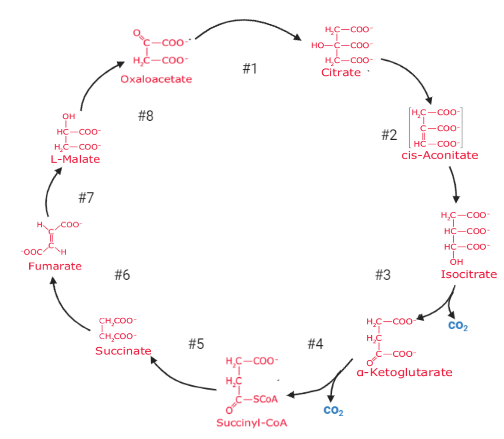
In Steps $ 3 $ and $ 4 $ of the Tricarboxylic Acid Cycle, the remaining two carbons are lost as $ C{O_2} $
Step $ 3 $ . Isocitrate to $ \alpha - ketoglutarate $
In this step, the second $ C{O_2} $ molecule is formed.
$ \underbrace {\mathop O\limits^ - COH\left( {OH} \right)C\left( {CO{O^ - }} \right)C{H_2}CO{O^ - }}_{isocitrate} + NA{D^ + }\xrightarrow[{dehydrogenase}]{{isocitrate}}\underbrace {\mathop O\limits^ - COCOCH\left( {CO{O^ - }} \right)C{H_2}CO{O^ - }}_{oxaloacetate} + NADH + {H^ + } $
$ \underbrace {\mathop O\limits^ - COCOCH\left( {CO{O^ - }} \right)C{H_2}CO{O^ - }}_{oxaloacetate} + NADH + {H^ + }\xrightarrow[{dehydrogenase}]{{isocitrate}}\underbrace {\mathop O\limits^ - COCOC{H_2}C{H_2}CO{O^ - }}_{\alpha - ketoglutarate} + C{O_2} $
Step $ 4 $ . $ \alpha - ketoglutarate $ to $ succinyl - CoA $
In this step, the third $ C{O_2} $ molecule is formed.
$ \underbrace {\mathop O\limits^ - COCOC{H_2}C{H_2}CO{O^ - }}_{\alpha - ketoglutarate} + CoASH + NA{D^ + } \\
\xrightarrow[{dehydrogenase}]{{\alpha - ketoglutarate}}\underbrace {CoA - S - COC{H_2}C{H_2}CO{O^ - }}_{succinyl - CoA} + C{O_2} + NADH \\ $
Note :
The Tricarboxylic acid cycle (TCA cycle), also known as the Krebs cycle or the citric acid cycle, is the second stage of the three-stage mechanism by which living cells break down organic fuel molecules which is in the presence of oxygen to harvest the energy they need to expand and divide.
Complete Step By Step Answer:
During the aerobic breakdown of one glucose molecule, decarboxylation happens six times.
Each of the six carbon atoms in a glucose molecule must be converted into $ C{O_2} $ .
The glucose molecule gets split into two three-carbon fragments during glycolysis (pyruvate).
In a preparatory step, these fragments are fed into the Tricarboxylic Acid Cycle.
Preparatory Step:
As pyruvate is converted into $ Acetyl - CoA $ by pyruvate dehydrogenase, the first carbon atom of pyruvate is removed as $ C{O_2} $ .
$ \underbrace {C{H_3}COCO{O^ - }}_{pyruvate} + NA{D^ + } + H - SCoA\xrightarrow[{dehydrogenase}]{{pyruvate}}NADH + C{O_2} + \underbrace {C{H_3}CO - SCoA}_{Acetyl - CoA} $
Tricarboxylic Acid Cycle:
The Tricarboxylic Acid Cycle is shown in detail.
In Steps $ 3 $ and $ 4 $ of the Tricarboxylic Acid Cycle, the remaining two carbons are lost as $ C{O_2} $
Step $ 3 $ . Isocitrate to $ \alpha - ketoglutarate $
In this step, the second $ C{O_2} $ molecule is formed.
$ \underbrace {\mathop O\limits^ - COH\left( {OH} \right)C\left( {CO{O^ - }} \right)C{H_2}CO{O^ - }}_{isocitrate} + NA{D^ + }\xrightarrow[{dehydrogenase}]{{isocitrate}}\underbrace {\mathop O\limits^ - COCOCH\left( {CO{O^ - }} \right)C{H_2}CO{O^ - }}_{oxaloacetate} + NADH + {H^ + } $
$ \underbrace {\mathop O\limits^ - COCOCH\left( {CO{O^ - }} \right)C{H_2}CO{O^ - }}_{oxaloacetate} + NADH + {H^ + }\xrightarrow[{dehydrogenase}]{{isocitrate}}\underbrace {\mathop O\limits^ - COCOC{H_2}C{H_2}CO{O^ - }}_{\alpha - ketoglutarate} + C{O_2} $
Step $ 4 $ . $ \alpha - ketoglutarate $ to $ succinyl - CoA $
In this step, the third $ C{O_2} $ molecule is formed.
$ \underbrace {\mathop O\limits^ - COCOC{H_2}C{H_2}CO{O^ - }}_{\alpha - ketoglutarate} + CoASH + NA{D^ + } \\
\xrightarrow[{dehydrogenase}]{{\alpha - ketoglutarate}}\underbrace {CoA - S - COC{H_2}C{H_2}CO{O^ - }}_{succinyl - CoA} + C{O_2} + NADH \\ $
Note :
The Tricarboxylic acid cycle (TCA cycle), also known as the Krebs cycle or the citric acid cycle, is the second stage of the three-stage mechanism by which living cells break down organic fuel molecules which is in the presence of oxygen to harvest the energy they need to expand and divide.
Recently Updated Pages
Master Class 12 Economics: Engaging Questions & Answers for Success

Master Class 12 English: Engaging Questions & Answers for Success
Master Class 12 Social Science: Engaging Questions & Answers for Success
Master Class 12 Maths: Engaging Questions & Answers for Success
Master Class 12 Physics: Engaging Questions & Answers for Success
Master Class 12 Business Studies: Engaging Questions & Answers for Success
Trending doubts
Which are the Top 10 Largest Countries of the World?
Draw a labelled sketch of the human eye class 12 physics CBSE
Differentiate between homogeneous and heterogeneous class 12 chemistry CBSE
Why is the cell called the structural and functional class 12 biology CBSE
Draw ray diagrams each showing i myopic eye and ii class 12 physics CBSE
Which is the correct genotypic ratio of mendel dihybrid class 12 biology CBSE