




Three girls Reshma, Salma and Mandip are playing a game by standing on a circle of the radius $5m$ drawn in a park. Reshma throws a ball to Salma, Salma to Mandip, Mandip to Reshma. The distance between Reshma and Salma and between Salma and Mandip is $6m$ each, what is the distance between Reshma and Mandip?
Answer
 Verified
598.2k+ views
Hint: Here we will first construct a diagram based on the given data, first we will draw a circle of radius $5m$ and then we will mark the places where Reshma, Salma and Mandip stood as $R,S,M$ on the circle. Now we will list all the lengths of the parameters we have in the circle. Now we will calculate the required distance by using the triangles that are formed by joining the points on the circle with each of them and with the center of the circle.
Complete step-by-step answer:
Given that,
Three girls Reshma, Salma and Mandip are playing a game by standing on a circle of the radius $5m$ drawn in a park. Reshma throws a ball to Salma, Salma to Mandip, Mandip to Reshma.
The diagrammatical representation of the above data is shown below
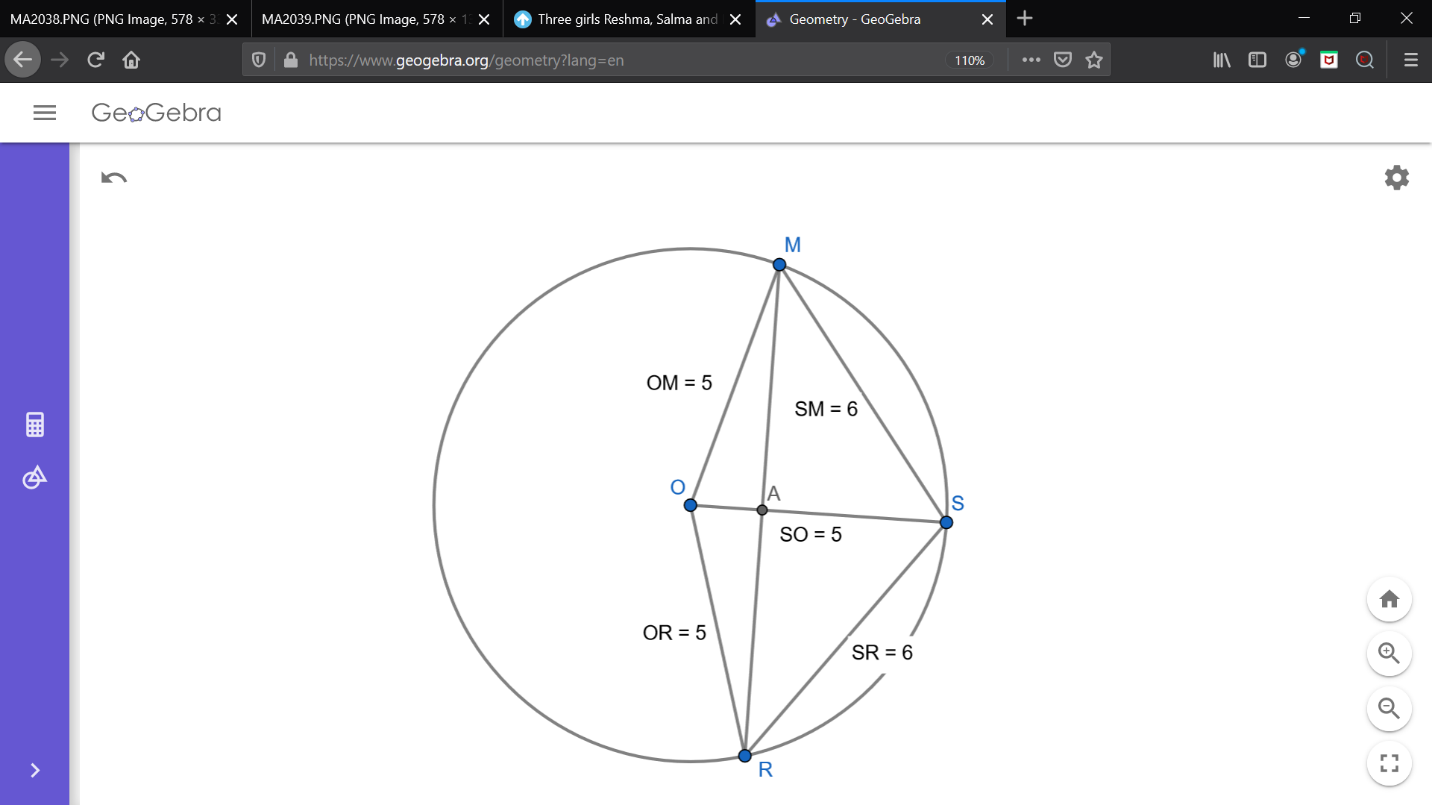
Here the points
$O$ is the center of the circle.
$S$ is the point where Salma stood on the circle.
$R$ is the point where Reshma stood on the circle.
$M$ is the point where Mandip stood on the circle.
Here the lengths
$SM$ is the distance between Salma and Mandip, according to problem $SM=6m$
$SR$ is the distance between Salma and Reshma, according to the problem $SR=6m$
$MR$ is the distance between Mandip and Reshma, we need to calculate this length.
We know that the distance between the center of the circle to the any point on the circle is called as the radius, hence
$OM=OR=OS=r=5m$
From the diagram we can observe that, $OS$ is the angular bisector of $\angle RSM$ and it is also passing through the center, so we know that it will perpendicularly bisects the chords of the circles i.e. $OS$ is the perpendicular bisector of the line $MR$ and it bisects the line $MR$ at point $A$, hence
$MA=RA...\left( \text{i} \right)$
From the right-angled triangle $SAR$, using Pythagoras theorem
$\begin{align}
& S{{R}^{2}}=R{{A}^{2}}+S{{A}^{2}} \\
&\Rightarrow R{{A}^{2}}=S{{R}^{2}}-S{{A}^{2}} \\
&\Rightarrow R{{A}^{2}}={{6}^{2}}-S{{A}^{2}}...\left( \text{ii} \right) \\
\end{align}$
Now from the right-angled triangle $OAR$, using the Pythagoras theorem
$\begin{align}
& O{{R}^{2}}=O{{A}^{2}}+A{{R}^{2}} \\
&\Rightarrow {{5}^{2}}=O{{A}^{2}}+A{{R}^{2}} \\
&\Rightarrow A{{R}^{2}}={{5}^{2}}-O{{A}^{2}} \\
\end{align}$
Now from the diagram we can write $OA=OS-SA$ in the above equation, then we will have
$\begin{align}
& A{{R}^{2}}={{5}^{2}}-\left( O{{S}^{2}}-S{{A}^{2}} \right) \\
& ={{5}^{2}}-{{\left( 5-SA \right)}^{2}}....\left( \text{iii} \right) \\
\end{align}$
Equating the equations $\left( \text{ii} \right)$ and $\left( \text{iii} \right)$, then we will get
${{6}^{2}}-S{{A}^{2}}={{5}^{2}}-{{\left( 5-SA \right)}^{2}}$
Using the formula ${{\left( a-b \right)}^{2}}={{a}^{2}}+{{b}^{2}}-2ab$ in the above equation, then we will get
$\begin{align}
& 36-S{{A}^{2}}=25-\left( 25+S{{A}^{2}}-2.5.SA \right) \\
&\Rightarrow 36-S{{A}^{2}}=25-25-S{{A}^{2}}+10SA \\
&\Rightarrow 36-S{{A}^{2}}+S{{A}^{2}}=0+10SA \\
&\Rightarrow 36+0=10SA \\
&\Rightarrow 10SA=36 \\
&\Rightarrow SA=\dfrac{36}{10} \\
&\Rightarrow SA=3.6 \\
\end{align}$
Substituting the value of $SA=3.6$ in equation $\left( \text{ii} \right)$, then we will get
$\begin{align}
& R{{A}^{2}}={{6}^{2}}-{{3.6}^{2}} \\
&\Rightarrow R{{A}^{2}}=36-12.96 \\
&\Rightarrow R{{A}^{2}}=23.04 \\
&\Rightarrow RA=\sqrt{23.04} \\
&\Rightarrow RA\simeq 4.8m \\
\end{align}$
Now from the equation $\left( \text{i} \right)$, we can write that
$\begin{align}
&\Rightarrow RM=2RA \\
&\Rightarrow RM=2\times 4.8 \\
& =9.6m \\
\end{align}$
Hence the distance between Reshma and Mandip is $9.6m$
Note: For this problem diagrammatic representation takes a major part. After plotting the given data into picture, we can use any of the triangles in order to get the solution. Students must mark the given distances properly in the figure. By mistake, if they mark OR = OM = 6 instead of 5, then the results will vary. We are supposed to find the distance between Reshma and Mandip, so we must find the total length RM by adding RA and AM.
Complete step-by-step answer:
Given that,
Three girls Reshma, Salma and Mandip are playing a game by standing on a circle of the radius $5m$ drawn in a park. Reshma throws a ball to Salma, Salma to Mandip, Mandip to Reshma.
The diagrammatical representation of the above data is shown below
Here the points
$O$ is the center of the circle.
$S$ is the point where Salma stood on the circle.
$R$ is the point where Reshma stood on the circle.
$M$ is the point where Mandip stood on the circle.
Here the lengths
$SM$ is the distance between Salma and Mandip, according to problem $SM=6m$
$SR$ is the distance between Salma and Reshma, according to the problem $SR=6m$
$MR$ is the distance between Mandip and Reshma, we need to calculate this length.
We know that the distance between the center of the circle to the any point on the circle is called as the radius, hence
$OM=OR=OS=r=5m$
From the diagram we can observe that, $OS$ is the angular bisector of $\angle RSM$ and it is also passing through the center, so we know that it will perpendicularly bisects the chords of the circles i.e. $OS$ is the perpendicular bisector of the line $MR$ and it bisects the line $MR$ at point $A$, hence
$MA=RA...\left( \text{i} \right)$
From the right-angled triangle $SAR$, using Pythagoras theorem
$\begin{align}
& S{{R}^{2}}=R{{A}^{2}}+S{{A}^{2}} \\
&\Rightarrow R{{A}^{2}}=S{{R}^{2}}-S{{A}^{2}} \\
&\Rightarrow R{{A}^{2}}={{6}^{2}}-S{{A}^{2}}...\left( \text{ii} \right) \\
\end{align}$
Now from the right-angled triangle $OAR$, using the Pythagoras theorem
$\begin{align}
& O{{R}^{2}}=O{{A}^{2}}+A{{R}^{2}} \\
&\Rightarrow {{5}^{2}}=O{{A}^{2}}+A{{R}^{2}} \\
&\Rightarrow A{{R}^{2}}={{5}^{2}}-O{{A}^{2}} \\
\end{align}$
Now from the diagram we can write $OA=OS-SA$ in the above equation, then we will have
$\begin{align}
& A{{R}^{2}}={{5}^{2}}-\left( O{{S}^{2}}-S{{A}^{2}} \right) \\
& ={{5}^{2}}-{{\left( 5-SA \right)}^{2}}....\left( \text{iii} \right) \\
\end{align}$
Equating the equations $\left( \text{ii} \right)$ and $\left( \text{iii} \right)$, then we will get
${{6}^{2}}-S{{A}^{2}}={{5}^{2}}-{{\left( 5-SA \right)}^{2}}$
Using the formula ${{\left( a-b \right)}^{2}}={{a}^{2}}+{{b}^{2}}-2ab$ in the above equation, then we will get
$\begin{align}
& 36-S{{A}^{2}}=25-\left( 25+S{{A}^{2}}-2.5.SA \right) \\
&\Rightarrow 36-S{{A}^{2}}=25-25-S{{A}^{2}}+10SA \\
&\Rightarrow 36-S{{A}^{2}}+S{{A}^{2}}=0+10SA \\
&\Rightarrow 36+0=10SA \\
&\Rightarrow 10SA=36 \\
&\Rightarrow SA=\dfrac{36}{10} \\
&\Rightarrow SA=3.6 \\
\end{align}$
Substituting the value of $SA=3.6$ in equation $\left( \text{ii} \right)$, then we will get
$\begin{align}
& R{{A}^{2}}={{6}^{2}}-{{3.6}^{2}} \\
&\Rightarrow R{{A}^{2}}=36-12.96 \\
&\Rightarrow R{{A}^{2}}=23.04 \\
&\Rightarrow RA=\sqrt{23.04} \\
&\Rightarrow RA\simeq 4.8m \\
\end{align}$
Now from the equation $\left( \text{i} \right)$, we can write that
$\begin{align}
&\Rightarrow RM=2RA \\
&\Rightarrow RM=2\times 4.8 \\
& =9.6m \\
\end{align}$
Hence the distance between Reshma and Mandip is $9.6m$
Note: For this problem diagrammatic representation takes a major part. After plotting the given data into picture, we can use any of the triangles in order to get the solution. Students must mark the given distances properly in the figure. By mistake, if they mark OR = OM = 6 instead of 5, then the results will vary. We are supposed to find the distance between Reshma and Mandip, so we must find the total length RM by adding RA and AM.
Recently Updated Pages
Three beakers labelled as A B and C each containing 25 mL of water were taken A small amount of NaOH anhydrous CuSO4 and NaCl were added to the beakers A B and C respectively It was observed that there was an increase in the temperature of the solutions contained in beakers A and B whereas in case of beaker C the temperature of the solution falls Which one of the following statements isarecorrect i In beakers A and B exothermic process has occurred ii In beakers A and B endothermic process has occurred iii In beaker C exothermic process has occurred iv In beaker C endothermic process has occurred

Master Class 10 Social Science: Engaging Questions & Answers for Success
Master Class 10 Science: Engaging Questions & Answers for Success
Master Class 10 Maths: Engaging Questions & Answers for Success
Master Class 10 General Knowledge: Engaging Questions & Answers for Success
Master Class 10 Computer Science: Engaging Questions & Answers for Success
Three beakers labelled as A B and C each containing 25 mL of water were taken A small amount of NaOH anhydrous CuSO4 and NaCl were added to the beakers A B and C respectively It was observed that there was an increase in the temperature of the solutions contained in beakers A and B whereas in case of beaker C the temperature of the solution falls Which one of the following statements isarecorrect i In beakers A and B exothermic process has occurred ii In beakers A and B endothermic process has occurred iii In beaker C exothermic process has occurred iv In beaker C endothermic process has occurred
Master Class 10 Social Science: Engaging Questions & Answers for Success
Master Class 10 Science: Engaging Questions & Answers for Success
Trending doubts
In cricket, what is the term for a bowler taking five wickets in an innings?
Who Won 36 Oscar Awards? Record Holder Revealed
What is the name of Japan Parliament?
What is the median of the first 10 natural numbers class 10 maths CBSE
What is deficiency disease class 10 biology CBSE
Select the word that is correctly spelled a Twelveth class 10 english CBSE