




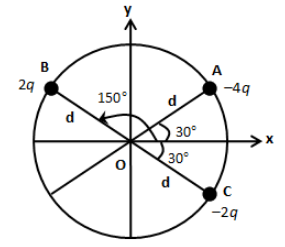
Three charged particles A, B and C with charges \[ - 4q\], \[2q\] and \[ - 2q\] are present on the circumference of a circle of radius d. The charged particles A, C and centre O of the circle formed an equilateral triangle as shown in the figure. Electric field at O along x-direction is:
Answer
 Verified
592.2k+ views
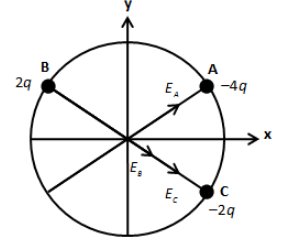
Hint: The imaginary test charge at point O, will be attracted by charges A and C and repelled by charge B. So, the direction of the electric field at point O due to charges \[ - 4q\]and \[ - 2q\] is towards A and C respectively. Also, the electric field at point o due to charge \[2q\] is towards point C. Calculate the x-component of the electric field at point O by taking the addition of electric fields due to each charge.
Formula used:
Electric field, \[E = \dfrac{1}{{4\pi {\varepsilon _0}}}\dfrac{q}{{{d^2}}}\],
where, \[{\varepsilon _0}\] is the permittivity of free space, q is the charge and d is the distance.
Complete step by step answer:
We know the like charges repel each other while unlike charges attract towards each other. Therefore, the imaginary test charge at point O, will be attracted by charges A and C and repelled by charge B. So, the direction of the electric field at point O due to charges \[ - 4q\]and \[ - 2q\] is towards A and C respectively. Also, the electric field at point o due to charge \[2q\] is towards point C as shown in the figure below.
Let us express the magnitude of electric field at point O due to charge \[ - 4q\] as follows,
\[{E_A} = k\dfrac{{ - 4q}}{{{d^2}}}\] …… (1)
Here, k is the constant and it has value \[k = \dfrac{1}{{4\pi {\varepsilon _0}}}\], where, \[{\varepsilon _0}\] is the permittivity of the free space.
Let us express the magnitude of electric field at point O due to charge \[2q\] as follows,
\[{E_B} = k\dfrac{{2q}}{{{d^2}}}\] …… (2)
Let us express the magnitude of electric field at point O due to charge \[ - 2q\] as follows,
\[{E_C} = k\dfrac{{ - 2q}}{{{d^2}}}\] …… (3)
The direction of the electric field at point O along the horizontal direction x is can be expressed as,
\[{E_x} = {E_A}\cos 30^\circ + {E_B}\cos 30^\circ + {E_C}\cos 30^\circ \]
\[ \Rightarrow {E_x} = \left( {{E_A} + {E_B} + {E_C}} \right)\cos 30^\circ \]
\[ \Rightarrow {E_x} = \left( {{E_A} + {E_B} + {E_C}} \right)\dfrac{{\sqrt 3 }}{2}\]
Using equation (1), (2) and (3) in the above equation, we get,
\[{E_x} = \left( {k\dfrac{{ - 4q}}{{{d^2}}} + k\dfrac{{2q}}{{{d^2}}} + k\dfrac{{ - 2q}}{{{d^2}}}} \right)\dfrac{{\sqrt 3 }}{2}\]
\[ \Rightarrow {E_x} = k\dfrac{q}{{{d^2}}}\left( { - 4 + 2 + - 2} \right)\dfrac{{\sqrt 3 }}{2}\]
\[ \therefore {E_x} = - 2\sqrt 3 \,k\dfrac{q}{{{d^2}}}\]
This is the expression for the horizontal component of the electric field at point O.
Note:The crucial step in the solution is to determine the direction of the electric field due to the given charges. If the charge at B is negative, then the direction of the electric field would be towards the charge. The x-component of this electric field would be along the negative x-axis. Note that \[\cos \left( { - \theta } \right) = \cos \theta \].
Formula used:
Electric field, \[E = \dfrac{1}{{4\pi {\varepsilon _0}}}\dfrac{q}{{{d^2}}}\],
where, \[{\varepsilon _0}\] is the permittivity of free space, q is the charge and d is the distance.
Complete step by step answer:
We know the like charges repel each other while unlike charges attract towards each other. Therefore, the imaginary test charge at point O, will be attracted by charges A and C and repelled by charge B. So, the direction of the electric field at point O due to charges \[ - 4q\]and \[ - 2q\] is towards A and C respectively. Also, the electric field at point o due to charge \[2q\] is towards point C as shown in the figure below.
Let us express the magnitude of electric field at point O due to charge \[ - 4q\] as follows,
\[{E_A} = k\dfrac{{ - 4q}}{{{d^2}}}\] …… (1)
Here, k is the constant and it has value \[k = \dfrac{1}{{4\pi {\varepsilon _0}}}\], where, \[{\varepsilon _0}\] is the permittivity of the free space.
Let us express the magnitude of electric field at point O due to charge \[2q\] as follows,
\[{E_B} = k\dfrac{{2q}}{{{d^2}}}\] …… (2)
Let us express the magnitude of electric field at point O due to charge \[ - 2q\] as follows,
\[{E_C} = k\dfrac{{ - 2q}}{{{d^2}}}\] …… (3)
The direction of the electric field at point O along the horizontal direction x is can be expressed as,
\[{E_x} = {E_A}\cos 30^\circ + {E_B}\cos 30^\circ + {E_C}\cos 30^\circ \]
\[ \Rightarrow {E_x} = \left( {{E_A} + {E_B} + {E_C}} \right)\cos 30^\circ \]
\[ \Rightarrow {E_x} = \left( {{E_A} + {E_B} + {E_C}} \right)\dfrac{{\sqrt 3 }}{2}\]
Using equation (1), (2) and (3) in the above equation, we get,
\[{E_x} = \left( {k\dfrac{{ - 4q}}{{{d^2}}} + k\dfrac{{2q}}{{{d^2}}} + k\dfrac{{ - 2q}}{{{d^2}}}} \right)\dfrac{{\sqrt 3 }}{2}\]
\[ \Rightarrow {E_x} = k\dfrac{q}{{{d^2}}}\left( { - 4 + 2 + - 2} \right)\dfrac{{\sqrt 3 }}{2}\]
\[ \therefore {E_x} = - 2\sqrt 3 \,k\dfrac{q}{{{d^2}}}\]
This is the expression for the horizontal component of the electric field at point O.
Note:The crucial step in the solution is to determine the direction of the electric field due to the given charges. If the charge at B is negative, then the direction of the electric field would be towards the charge. The x-component of this electric field would be along the negative x-axis. Note that \[\cos \left( { - \theta } \right) = \cos \theta \].
Recently Updated Pages
Master Class 12 Economics: Engaging Questions & Answers for Success

Master Class 12 English: Engaging Questions & Answers for Success
Master Class 12 Social Science: Engaging Questions & Answers for Success
Master Class 12 Maths: Engaging Questions & Answers for Success
Master Class 12 Physics: Engaging Questions & Answers for Success
Master Class 9 General Knowledge: Engaging Questions & Answers for Success
Trending doubts
Which are the Top 10 Largest Countries of the World?
Draw a labelled sketch of the human eye class 12 physics CBSE
Differentiate between homogeneous and heterogeneous class 12 chemistry CBSE
Sulphuric acid is known as the king of acids State class 12 chemistry CBSE
Why is the cell called the structural and functional class 12 biology CBSE
Draw ray diagrams each showing i myopic eye and ii class 12 physics CBSE