




The word species was coined by
(a) John Ray
(b) Mayr
(c) Ernst Haeckel
(d) Linnaeus
Answer
 Verified
648.6k+ views
Hint: Taxonomy is the study of the arrangement of organisms into different levels or groups based on their mode of nutrition, reproduction, cell structure, etc. These levels include kingdom, phylum, classes, order, families, genus, and species.
Complete answer
John Ray, a well known English naturalist coined the term species. He was the first to give a biological definition for the concept of species. A group of similar living organisms capable of interbreeding is called species. Other ways of defining species include their karyotype, DNA sequence, morphology, behaviour, or ecological niche. The qualities of all the organisms of the species, like body mass, length or height are defined as species traits. Different organisms of a species have different trait values because of intraspecific variation, eg. body mass, but together they define a distribution, which is characteristic for each species.
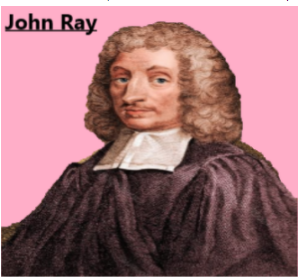
So, the correct answer is 'John Ray'.
Additional Information:
-Ernst Walter Mayr was a leading evolutionary biologist in the 20th century. He was also known for being one of the leading taxonomists, tropical explorer, ornithologist, philosopher of biology, and historian of science.
-Ernst Heinrich Philipp August Haeckel was a German zoologist, naturalist, eugenicist, philosopher, physician, professor, marine biologist, and artist.
-Carl Linnaeus was a Swedish botanist, zoologist, and physician who formalized binomial nomenclature, that is, the modern system of naming organisms. He is also known as the "father of modern taxonomy".
Note:
1. A system of categorizing living things is called classification or taxonomy. This classification is done through seven categories: (1) Kingdom; (2) Phylum; (3) Class; (4) Order; (5) Family; (6) Genus; (7) Species.
2. Organisms of the same species can reproduce successfully but not with the organisms of different species. Species are the most basic level or group in the system of taxonomy.
3. The range of genetic information available among all individuals of a species is called intraspecific variation.
Complete answer
John Ray, a well known English naturalist coined the term species. He was the first to give a biological definition for the concept of species. A group of similar living organisms capable of interbreeding is called species. Other ways of defining species include their karyotype, DNA sequence, morphology, behaviour, or ecological niche. The qualities of all the organisms of the species, like body mass, length or height are defined as species traits. Different organisms of a species have different trait values because of intraspecific variation, eg. body mass, but together they define a distribution, which is characteristic for each species.
So, the correct answer is 'John Ray'.
Additional Information:
-Ernst Walter Mayr was a leading evolutionary biologist in the 20th century. He was also known for being one of the leading taxonomists, tropical explorer, ornithologist, philosopher of biology, and historian of science.
-Ernst Heinrich Philipp August Haeckel was a German zoologist, naturalist, eugenicist, philosopher, physician, professor, marine biologist, and artist.
-Carl Linnaeus was a Swedish botanist, zoologist, and physician who formalized binomial nomenclature, that is, the modern system of naming organisms. He is also known as the "father of modern taxonomy".
Note:
1. A system of categorizing living things is called classification or taxonomy. This classification is done through seven categories: (1) Kingdom; (2) Phylum; (3) Class; (4) Order; (5) Family; (6) Genus; (7) Species.
2. Organisms of the same species can reproduce successfully but not with the organisms of different species. Species are the most basic level or group in the system of taxonomy.
3. The range of genetic information available among all individuals of a species is called intraspecific variation.
Recently Updated Pages
Basicity of sulphurous acid and sulphuric acid are

Master Class 11 English: Engaging Questions & Answers for Success
Master Class 11 Physics: Engaging Questions & Answers for Success
Master Class 11 Computer Science: Engaging Questions & Answers for Success
Master Class 11 Chemistry: Engaging Questions & Answers for Success
Master Class 11 Social Science: Engaging Questions & Answers for Success
Trending doubts
Difference Between Prokaryotic Cells and Eukaryotic Cells
Two of the body parts which do not appear in MRI are class 11 biology CBSE
One Metric ton is equal to kg A 10000 B 1000 C 100 class 11 physics CBSE
10 examples of friction in our daily life
Draw a diagram of nephron and explain its structur class 11 biology CBSE
What will happen if the mucus is not secreted by the class 11 biology CBSE