




The unit of angular displacement in SI units is
(a). Radians
(b). Degrees
(c). Degree Celsius
(d). Radians/sec
Answer
 Verified
631.8k+ views
- Hint: To find the SI unit of angular displacement, understand its formula. With this formula, find the dimensional formula of angular displacement. Then find its units with help of its dimensional formula.
Complete step-by-step solution -
We all know about normal displacement, which tells you about the change in position of a body along a straight line. For example, if a body moves from point A to point B, then the displacement of that is the line joining the points A and B.
There is one more type of displacement called angular displacement. Sometimes, we tend to analyse certain cases with respect to a fixed point or fixed line (axis).
Then the moving body appears to be resolving around this fixed point/axis. This is where angular displacement comes into play. Now, we measure the change in the position of the body in terms of the distance of the body from the fixed point/axis and the angle the body makes with respect to the fixed point/axis while moving. This angle is called angular displacement. The SI unit of angular displacement is radians.
Now, let us consider a simple case. A body is revolving around a fixed point in a circular path with a fixed point as the centre. Suppose it moves from point A to point B, along the circular path, which makes arc AB. An angle is defined as the ratio of the length of the arc to the radius of the circle.
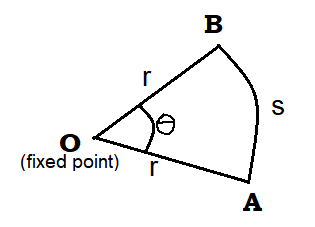
Therefore, $\theta =\dfrac{s}{r}$
The dimensional formula of angular displacement is $\dfrac{[L]}{[L]}=1$. Hence, it does not have any dimension and it is true that it will not have any units, but for some reason it has been given a SI unit i.e. radians. Other unit is degree.
Hence, the correct answer is (a) radians.
Note: It is important to note that in reality, the angular displacement has no unit but just to avoid confusion with other numbers it is represented with radians/degrees.
Complete step-by-step solution -
We all know about normal displacement, which tells you about the change in position of a body along a straight line. For example, if a body moves from point A to point B, then the displacement of that is the line joining the points A and B.
There is one more type of displacement called angular displacement. Sometimes, we tend to analyse certain cases with respect to a fixed point or fixed line (axis).
Then the moving body appears to be resolving around this fixed point/axis. This is where angular displacement comes into play. Now, we measure the change in the position of the body in terms of the distance of the body from the fixed point/axis and the angle the body makes with respect to the fixed point/axis while moving. This angle is called angular displacement. The SI unit of angular displacement is radians.
Now, let us consider a simple case. A body is revolving around a fixed point in a circular path with a fixed point as the centre. Suppose it moves from point A to point B, along the circular path, which makes arc AB. An angle is defined as the ratio of the length of the arc to the radius of the circle.
Therefore, $\theta =\dfrac{s}{r}$
The dimensional formula of angular displacement is $\dfrac{[L]}{[L]}=1$. Hence, it does not have any dimension and it is true that it will not have any units, but for some reason it has been given a SI unit i.e. radians. Other unit is degree.
Hence, the correct answer is (a) radians.
Note: It is important to note that in reality, the angular displacement has no unit but just to avoid confusion with other numbers it is represented with radians/degrees.
Recently Updated Pages
Master Class 12 Economics: Engaging Questions & Answers for Success

Master Class 12 English: Engaging Questions & Answers for Success
Master Class 12 Social Science: Engaging Questions & Answers for Success
Master Class 12 Maths: Engaging Questions & Answers for Success
Master Class 12 Physics: Engaging Questions & Answers for Success
Master Class 9 General Knowledge: Engaging Questions & Answers for Success
Trending doubts
One Metric ton is equal to kg A 10000 B 1000 C 100 class 11 physics CBSE
Difference Between Prokaryotic Cells and Eukaryotic Cells
Two of the body parts which do not appear in MRI are class 11 biology CBSE
Find the value of the expression given below sin 30circ class 11 maths CBSE
1 ton equals to A 100 kg B 1000 kg C 10 kg D 10000 class 11 physics CBSE
Draw a diagram of nephron and explain its structur class 11 biology CBSE