




The sum of the exterior angles of a hexagon is:
(A) ${360^ \circ }$
(B) ${540^ \circ }$
(C) ${720^ \circ }$
(D) None of these
Answer
 Verified
646.8k+ views
Hint: Hexagon is a polygon having six sides. Sum of its interior angles is ${720^ \circ }$. But the sum of exterior angles of any polygons is ${360^ \circ }$ irrespective of the number of sides in the polygon.
Complete step-by-step answer:
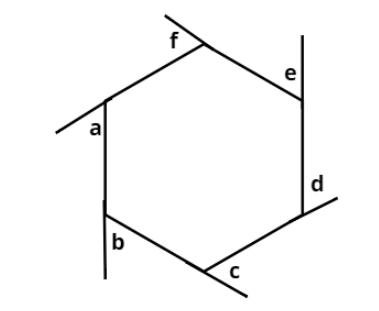
A hexagon is a polygon consisting of six sides. The total of the internal angles of a hexagon is ${720^ \circ }$.
If the hexagon is a regular hexagon, all the six sides of it are equal and all the six internal angles are also equal. And the measure of each angle is ${120^ \circ }$.
While the sum of interior angles of a polygon varies with the number of sides in a polygon, the sum of exterior angles remains the same for all polygons and it is ${360^ \circ }$.
In our case, if the hexagon is a regular hexagon, all the six exterior angles will be equal and each of them will measure ${60^ \circ }$. But if it is not regular, their values will differ. But the sum will always be the same which is ${360^ \circ }$.
Therefore, in the figure:
$ \Rightarrow a + b + c + d + e + f = {360^ \circ }$
(A) is the correct option.
Note: Sum of the interior angles of a polygon is determined by the formula $\left( {n - 2} \right) \times {180^ \circ }$ where $n$ is the number of sides in the polygon. And the sum of exterior angles is ${360^ \circ }$ irrespective of the number of sides in the polygon.
Complete step-by-step answer:
A hexagon is a polygon consisting of six sides. The total of the internal angles of a hexagon is ${720^ \circ }$.
If the hexagon is a regular hexagon, all the six sides of it are equal and all the six internal angles are also equal. And the measure of each angle is ${120^ \circ }$.
While the sum of interior angles of a polygon varies with the number of sides in a polygon, the sum of exterior angles remains the same for all polygons and it is ${360^ \circ }$.
In our case, if the hexagon is a regular hexagon, all the six exterior angles will be equal and each of them will measure ${60^ \circ }$. But if it is not regular, their values will differ. But the sum will always be the same which is ${360^ \circ }$.
Therefore, in the figure:
$ \Rightarrow a + b + c + d + e + f = {360^ \circ }$
(A) is the correct option.
Note: Sum of the interior angles of a polygon is determined by the formula $\left( {n - 2} \right) \times {180^ \circ }$ where $n$ is the number of sides in the polygon. And the sum of exterior angles is ${360^ \circ }$ irrespective of the number of sides in the polygon.
Recently Updated Pages
Master Class 12 Economics: Engaging Questions & Answers for Success

Master Class 12 Social Science: Engaging Questions & Answers for Success
Master Class 12 English: Engaging Questions & Answers for Success
Master Class 12 Maths: Engaging Questions & Answers for Success
Master Class 12 Physics: Engaging Questions & Answers for Success
Master Class 12 Biology: Engaging Questions & Answers for Success
Trending doubts
How many sides does a circle have a 10 sides b 20 sides class 8 maths CBSE
What is BLO What is the full form of BLO class 8 social science CBSE
What does the color green in the national flag of India class 8 social science CBSE
Citizens of India can vote at the age of A 18 years class 8 social science CBSE
Full form of STD, ISD and PCO
One cusec is equal to how many liters class 8 maths CBSE