




The refractive index of the core of an optical fiber is $ {\mu _2} $ and that of the cladding is $ {\mu _1} $ . The angle of incidence on the face of the core so that the light ray just undergoes total internal reflection at the cladding is:
(A) $ {\sin ^{ - 1}}\left( {\dfrac{{{\mu _2}}}{{{\mu _1}}}} \right) $
(B) $ {\sin ^{ - 1}}\sqrt {{\mu _2}^2 - {\mu _1}^2} $
(C) $ {\sin ^{ - 1}}\sqrt {{\mu _2} - {\mu _1}} $
(D) $ {\sin ^{ - 1}}\sqrt {{\mu _1}^2 + {\mu _2}^2} $
Answer
 Verified
598.8k+ views
Hint To solve this question, we have to apply the phenomenon of total internal reflection on the light rays entering into an optical fiber. We have to obtain the angle of incidence in terms of the refractive indices of the core and the cladding to get the final answer.
Formula used: In this solution we will be using the following formula,
$ {\mu _1}\sin i = {\mu _2}\sin r $
where $ {\mu _1} $ is the refractive index of the medium where the ray is incident with the angle of incidence $ i $ .
$ {\mu _2} $ is the refractive index of the medium where the ray is refracted with the angle of refraction $ r $ .
Complete step by step solution:
Consider the given optical fiber as shown in the figure below. According to the question, the refractive index of the core is $ {\mu _2} $ and that of the cladding is $ {\mu _1} $ .
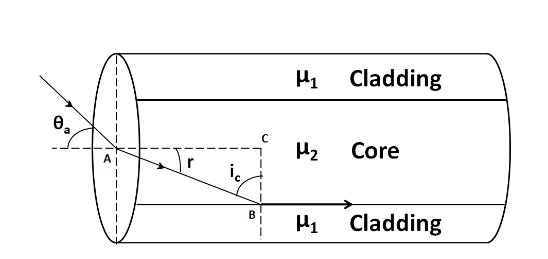
Applying the Snell’s law at the point A, we get
$1 \times \sin {\theta _a} = {\mu _2}\sin r $
$\Rightarrow \sin {\theta _a} = {\mu _2}\sin r $ …………...(1)
Now, for the total internal reflection to take place, the light ray refracted from point A should be incident at an angle equal to the critical angle of incidence at point B.
$\Rightarrow \therefore \angle ABC = {i_C} $
In the triangle ABC, from the angle sum property we have
$\Rightarrow r + {i_c} + {90^ \circ } = {180^ \circ } $
$\Rightarrow r + {i_c} = {90^ \circ } $
So we get the angle of refraction as
$\Rightarrow r = {90^ \circ } - {i_c} $ ……………….(2)
Substituting (2) in (1) we get
$\Rightarrow \sin {\theta _a} = {\mu _2}\sin \left( {{{90}^ \circ } - {i_c}} \right) $
We know that $ \sin \left( {{{90}^ \circ } - \theta } \right) = \cos \theta $ . Therefore
$\Rightarrow \sin {\theta _a} = {\mu _2}\cos {i_c} $
Dividing by $ {\mu _2} $ we get
$\Rightarrow \cos {i_c} = \dfrac{{\sin {\theta _a}}}{{{\mu _2}}} $ ……………..(3)
Now, applying the Snell’s law at the point B, we have
$\Rightarrow {\mu _2} \times \sin {i_c} = {\mu _1}\sin {90^ \circ } $
$\Rightarrow {\mu _2}\sin {i_c} = {\mu _1} $
Dividing by $ {\mu _2} $ we get
$\Rightarrow \sin {i_c} = \dfrac{{{\mu _1}}}{{{\mu _2}}} $ ………………….(4)
On squaring and adding (3) and (4) we have
$\Rightarrow {\cos ^2}{i_c} + {\sin ^2}{i_c} = {\left( {\dfrac{{\sin {\theta _a}}}{{{\mu _2}}}} \right)^2} + {\left( {\dfrac{{{\mu _1}}}{{{\mu _2}}}} \right)^2} $
We know that $ {\cos ^2}\theta + {\sin ^2}\theta = 1 $ . So we have
$\Rightarrow 1 = {\left( {\dfrac{{\sin {\theta _a}}}{{{\mu _2}}}} \right)^2} + {\left( {\dfrac{{{\mu _1}}}{{{\mu _2}}}} \right)^2} $
$\Rightarrow {\left( {\dfrac{{\sin {\theta _a}}}{{{\mu _2}}}} \right)^2} = 1 - {\left( {\dfrac{{{\mu _1}}}{{{\mu _2}}}} \right)^2} $
Multiplying both sides by $ {\mu _2}^2 $ we have
$\Rightarrow {\sin ^2}{\theta _a} = {\mu _2}^2 - {\mu _1}^2 $
Taking square root both the sides
$\Rightarrow \sin {\theta _a} = \sqrt {{\mu _2}^2 - {\mu _1}^2} $
Finally, taking sine inverse both the sides, we get
$\Rightarrow {\theta _a} = {\sin ^{ - 1}}\sqrt {{\mu _2}^2 - {\mu _1}^2} $
Thus, the angle of incidence on the face of the core is equal to $ {\sin ^{ - 1}}\sqrt {{\mu _2}^2 - {\mu _1}^2} $ .
Hence, the correct answer is option B.
Note:
We must note that we have assumed the medium outside the optical fiber to be air, so the refractive index is taken as unity. The reason is that nothing related to the outside medium is mentioned. And in such a situation, the medium has to be taken as air unless stated otherwise.
Formula used: In this solution we will be using the following formula,
$ {\mu _1}\sin i = {\mu _2}\sin r $
where $ {\mu _1} $ is the refractive index of the medium where the ray is incident with the angle of incidence $ i $ .
$ {\mu _2} $ is the refractive index of the medium where the ray is refracted with the angle of refraction $ r $ .
Complete step by step solution:
Consider the given optical fiber as shown in the figure below. According to the question, the refractive index of the core is $ {\mu _2} $ and that of the cladding is $ {\mu _1} $ .
Applying the Snell’s law at the point A, we get
$1 \times \sin {\theta _a} = {\mu _2}\sin r $
$\Rightarrow \sin {\theta _a} = {\mu _2}\sin r $ …………...(1)
Now, for the total internal reflection to take place, the light ray refracted from point A should be incident at an angle equal to the critical angle of incidence at point B.
$\Rightarrow \therefore \angle ABC = {i_C} $
In the triangle ABC, from the angle sum property we have
$\Rightarrow r + {i_c} + {90^ \circ } = {180^ \circ } $
$\Rightarrow r + {i_c} = {90^ \circ } $
So we get the angle of refraction as
$\Rightarrow r = {90^ \circ } - {i_c} $ ……………….(2)
Substituting (2) in (1) we get
$\Rightarrow \sin {\theta _a} = {\mu _2}\sin \left( {{{90}^ \circ } - {i_c}} \right) $
We know that $ \sin \left( {{{90}^ \circ } - \theta } \right) = \cos \theta $ . Therefore
$\Rightarrow \sin {\theta _a} = {\mu _2}\cos {i_c} $
Dividing by $ {\mu _2} $ we get
$\Rightarrow \cos {i_c} = \dfrac{{\sin {\theta _a}}}{{{\mu _2}}} $ ……………..(3)
Now, applying the Snell’s law at the point B, we have
$\Rightarrow {\mu _2} \times \sin {i_c} = {\mu _1}\sin {90^ \circ } $
$\Rightarrow {\mu _2}\sin {i_c} = {\mu _1} $
Dividing by $ {\mu _2} $ we get
$\Rightarrow \sin {i_c} = \dfrac{{{\mu _1}}}{{{\mu _2}}} $ ………………….(4)
On squaring and adding (3) and (4) we have
$\Rightarrow {\cos ^2}{i_c} + {\sin ^2}{i_c} = {\left( {\dfrac{{\sin {\theta _a}}}{{{\mu _2}}}} \right)^2} + {\left( {\dfrac{{{\mu _1}}}{{{\mu _2}}}} \right)^2} $
We know that $ {\cos ^2}\theta + {\sin ^2}\theta = 1 $ . So we have
$\Rightarrow 1 = {\left( {\dfrac{{\sin {\theta _a}}}{{{\mu _2}}}} \right)^2} + {\left( {\dfrac{{{\mu _1}}}{{{\mu _2}}}} \right)^2} $
$\Rightarrow {\left( {\dfrac{{\sin {\theta _a}}}{{{\mu _2}}}} \right)^2} = 1 - {\left( {\dfrac{{{\mu _1}}}{{{\mu _2}}}} \right)^2} $
Multiplying both sides by $ {\mu _2}^2 $ we have
$\Rightarrow {\sin ^2}{\theta _a} = {\mu _2}^2 - {\mu _1}^2 $
Taking square root both the sides
$\Rightarrow \sin {\theta _a} = \sqrt {{\mu _2}^2 - {\mu _1}^2} $
Finally, taking sine inverse both the sides, we get
$\Rightarrow {\theta _a} = {\sin ^{ - 1}}\sqrt {{\mu _2}^2 - {\mu _1}^2} $
Thus, the angle of incidence on the face of the core is equal to $ {\sin ^{ - 1}}\sqrt {{\mu _2}^2 - {\mu _1}^2} $ .
Hence, the correct answer is option B.
Note:
We must note that we have assumed the medium outside the optical fiber to be air, so the refractive index is taken as unity. The reason is that nothing related to the outside medium is mentioned. And in such a situation, the medium has to be taken as air unless stated otherwise.
Recently Updated Pages
Master Class 12 Business Studies: Engaging Questions & Answers for Success

Master Class 12 Biology: Engaging Questions & Answers for Success
Master Class 12 Chemistry: Engaging Questions & Answers for Success
Class 12 Question and Answer - Your Ultimate Solutions Guide
Master Class 11 Social Science: Engaging Questions & Answers for Success
Master Class 11 English: Engaging Questions & Answers for Success
Trending doubts
Which are the Top 10 Largest Countries of the World?
Draw a labelled sketch of the human eye class 12 physics CBSE
Differentiate between homogeneous and heterogeneous class 12 chemistry CBSE
Sulphuric acid is known as the king of acids State class 12 chemistry CBSE
Why is the cell called the structural and functional class 12 biology CBSE
Which is the correct genotypic ratio of mendel dihybrid class 12 biology CBSE