



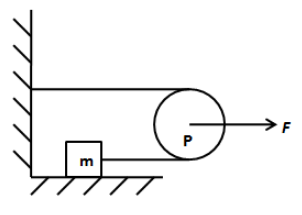
The ratio of acceleration of pulley to the acceleration of the block is (string is inextensible).
A. $0.5$
B. $2$
C. $1$
D. None of these
Answer
 Verified
636.9k+ views
Hint: Assume the point on upper string. The velocity of the pulley is the average of the velocity of block and velocity of the point of the string. The point of the string does not move and only the block moves in the direction of force. Differentiate the velocity of the pulley and the block. This is the acceleration of the pulley and block respectively.
Formula used:
Acceleration, \[a = \dfrac{{dv}}{{dt}}\]
Here, v is the velocity and t is the time.
Complete step by step answer:
We assume the velocity of the block is \[{v_b}\] and velocity of the point of the string as shown in the figure below is \[{v_s}\].
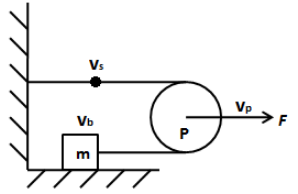
In the above figure, the velocity of the pulley is \[{v_p}\]. We know that the velocity of the pulley is the average of the velocity of block and velocity of the point of the string. Therefore, we can write,
\[{v_p} = \dfrac{{{v_b} + {v_s}}}{2}\]
But we can see that the point of the string does not move and only the block moves by the applied force F. Therefore, the velocity \[{v_s}\] is zero. Thus, we can write the above equation as,
\[{v_p} = \dfrac{{{v_b}}}{2}\] …… (1)
Differentiating the above equation with respect to time, we get,
\[\dfrac{{d{v_p}}}{{dt}} = \dfrac{1}{2}\dfrac{{d{v_b}}}{{dt}}\] …… (2)
But we know that the acceleration is the rate of change of velocity, that is \[a = \dfrac{{dv}}{{dt}}\]. Therefore, we can write the above equation as,
\[{a_P} = \dfrac{{{a_b}}}{2}\]
\[ \therefore \dfrac{{{a_P}}}{{{a_b}}} = 0.5\]
Here, \[{a_P}\] is the acceleration of pulley and \[{a_b}\] is the acceleration of the block. Therefore, the ratio of acceleration of the pulley to the acceleration of the block is 0.5.
So, the correct answer is option A.
Note: Students can directly use the fact that the sum of acceleration of the block and acceleration of the point on the string due to the tension is twice the acceleration of the pulley. Since the string does not move, its acceleration must be zero. Therefore, the acceleration of the block is twice as much as the acceleration of the pulley.
Formula used:
Acceleration, \[a = \dfrac{{dv}}{{dt}}\]
Here, v is the velocity and t is the time.
Complete step by step answer:
We assume the velocity of the block is \[{v_b}\] and velocity of the point of the string as shown in the figure below is \[{v_s}\].
In the above figure, the velocity of the pulley is \[{v_p}\]. We know that the velocity of the pulley is the average of the velocity of block and velocity of the point of the string. Therefore, we can write,
\[{v_p} = \dfrac{{{v_b} + {v_s}}}{2}\]
But we can see that the point of the string does not move and only the block moves by the applied force F. Therefore, the velocity \[{v_s}\] is zero. Thus, we can write the above equation as,
\[{v_p} = \dfrac{{{v_b}}}{2}\] …… (1)
Differentiating the above equation with respect to time, we get,
\[\dfrac{{d{v_p}}}{{dt}} = \dfrac{1}{2}\dfrac{{d{v_b}}}{{dt}}\] …… (2)
But we know that the acceleration is the rate of change of velocity, that is \[a = \dfrac{{dv}}{{dt}}\]. Therefore, we can write the above equation as,
\[{a_P} = \dfrac{{{a_b}}}{2}\]
\[ \therefore \dfrac{{{a_P}}}{{{a_b}}} = 0.5\]
Here, \[{a_P}\] is the acceleration of pulley and \[{a_b}\] is the acceleration of the block. Therefore, the ratio of acceleration of the pulley to the acceleration of the block is 0.5.
So, the correct answer is option A.
Note: Students can directly use the fact that the sum of acceleration of the block and acceleration of the point on the string due to the tension is twice the acceleration of the pulley. Since the string does not move, its acceleration must be zero. Therefore, the acceleration of the block is twice as much as the acceleration of the pulley.
Recently Updated Pages
If x a + bt + ct2 where x is in meters and t is in class 11 physics CBSE

A car covers the first half distance between two places class 11 physics CBSE
The resultant of two vectors overrightarrow P and overrightarrow class 11 physics CBSE
Find the value of cos 135 class 11 maths CBSE
A mass M is held in place by an applied force F and class 11 physics CBSE
A solution of glucose in water is labelled as 10 dfracwv class 11 chemistry CBSE
Trending doubts
One Metric ton is equal to kg A 10000 B 1000 C 100 class 11 physics CBSE
Find the value of the expression given below sin 30circ class 11 maths CBSE
Draw a diagram of nephron and explain its structur class 11 biology CBSE
10 examples of friction in our daily life
Proton was discovered by A Thomson B Rutherford C Chadwick class 11 chemistry CBSE
Bond order ofO2 O2+ O2 and O22 is in order A O2 langle class 11 chemistry CBSE