




The radius of curvature of the convex surface of a Plano-convex lens is 10cm. What is the focal length of the Plano-convex lens? (Here $\mu =1.5$)
A. $10cm$
B. $20cm$
C. $15cm$
D. $5cm$
Answer
 Verified
609.3k+ views
Hint: We need to find the focal length of the lens. For that we have a lens maker’s formula. We can substitute the given values of radius of curvature into the lens maker’s formula. Then we can find the focal length by simplifying and taking the reciprocal.
Formula used:
Lens maker’s formula
\[\dfrac{1}{f}=\left( \mu -1 \right)\left( \dfrac{1}{{{R}_{1}}}-\dfrac{1}{{{R}_{2}}} \right)\]
Complete step by step answer:
In the question we are given the radius of curvature of the convex surface of a Plano-convex lens.
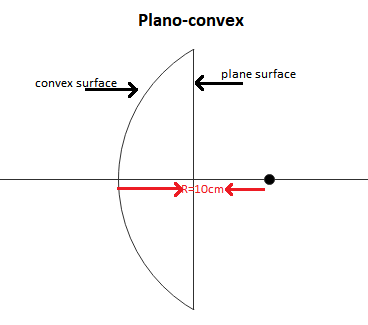
A Plano-convex with radius of curvature of the convex surface = 10cm is given in the above figure.
We need to find the focal length of the lens.
The relation between radius of curvature and focal length of a lens is given by the lens maker’s formula.
It is given as,
\[\dfrac{1}{f}=\left( \mu -1 \right)\left( \dfrac{1}{{{R}_{1}}}-\dfrac{1}{{{R}_{2}}} \right)\], Where f = focal length of the lens, µ = refractive index of the material ${{R}_{1}}$ is the radius of curvature of the ${{1}^{st}}$ surface and ${{R}_{2}}$ is the radius of curvature of the ${{2}^{nd}}$ surface.
We have a Plano-convex lens, which means, one side of the lens is plane and the other side is convex.
Radius of curvature of the convex surface is given as 10 cm and the radius of curvature of the plane surface is infinity.
$\Rightarrow {{R}_{1}}=10cm$ And ${{R}_{2}}=\infty $
We are also given the refractive index $\mu =1.5$.
Applying these in the lens maker’s formula, we get,
\[\dfrac{1}{f}=\left( 1.5-1 \right)\left( \dfrac{1}{10}-\dfrac{1}{\infty } \right)\]
We know that \[\dfrac{1}{\infty }=0\]
\[\therefore \dfrac{1}{f}=\left( 0.5 \right)\left( \dfrac{1}{10} \right)=\dfrac{1}{20}\]
On taking the reciprocal, we get,
\[f=20\]
Therefore, the focal length of the lens is $20cm$.
Hence the correct answer is option B.
Note:
Plano convex lens is a type of convex lens with one spherical surface and a flat surface. The radius of curvature of the plane surface of a Plano-convex lens is infinite. Plano-convex lenses are used to focus parallel rays to a single point.
Formula used:
Lens maker’s formula
\[\dfrac{1}{f}=\left( \mu -1 \right)\left( \dfrac{1}{{{R}_{1}}}-\dfrac{1}{{{R}_{2}}} \right)\]
Complete step by step answer:
In the question we are given the radius of curvature of the convex surface of a Plano-convex lens.
A Plano-convex with radius of curvature of the convex surface = 10cm is given in the above figure.
We need to find the focal length of the lens.
The relation between radius of curvature and focal length of a lens is given by the lens maker’s formula.
It is given as,
\[\dfrac{1}{f}=\left( \mu -1 \right)\left( \dfrac{1}{{{R}_{1}}}-\dfrac{1}{{{R}_{2}}} \right)\], Where f = focal length of the lens, µ = refractive index of the material ${{R}_{1}}$ is the radius of curvature of the ${{1}^{st}}$ surface and ${{R}_{2}}$ is the radius of curvature of the ${{2}^{nd}}$ surface.
We have a Plano-convex lens, which means, one side of the lens is plane and the other side is convex.
Radius of curvature of the convex surface is given as 10 cm and the radius of curvature of the plane surface is infinity.
$\Rightarrow {{R}_{1}}=10cm$ And ${{R}_{2}}=\infty $
We are also given the refractive index $\mu =1.5$.
Applying these in the lens maker’s formula, we get,
\[\dfrac{1}{f}=\left( 1.5-1 \right)\left( \dfrac{1}{10}-\dfrac{1}{\infty } \right)\]
We know that \[\dfrac{1}{\infty }=0\]
\[\therefore \dfrac{1}{f}=\left( 0.5 \right)\left( \dfrac{1}{10} \right)=\dfrac{1}{20}\]
On taking the reciprocal, we get,
\[f=20\]
Therefore, the focal length of the lens is $20cm$.
Hence the correct answer is option B.
Note:
Plano convex lens is a type of convex lens with one spherical surface and a flat surface. The radius of curvature of the plane surface of a Plano-convex lens is infinite. Plano-convex lenses are used to focus parallel rays to a single point.
Recently Updated Pages
Master Class 12 Business Studies: Engaging Questions & Answers for Success

Master Class 12 Biology: Engaging Questions & Answers for Success
Master Class 12 Chemistry: Engaging Questions & Answers for Success
Class 12 Question and Answer - Your Ultimate Solutions Guide
Master Class 11 Social Science: Engaging Questions & Answers for Success
Master Class 11 English: Engaging Questions & Answers for Success
Trending doubts
Which are the Top 10 Largest Countries of the World?
Draw a labelled sketch of the human eye class 12 physics CBSE
Differentiate between homogeneous and heterogeneous class 12 chemistry CBSE
Why is the cell called the structural and functional class 12 biology CBSE
Draw ray diagrams each showing i myopic eye and ii class 12 physics CBSE
Which is the correct genotypic ratio of mendel dihybrid class 12 biology CBSE