




The radial component of centripetal acceleration at poles of earth is?
Where $R$ is the radius of earth, $\omega $ is the angular velocity of earth)
$\begin{align}
& A.zero \\
& B.R{{\omega }^{2}} \\
& C.{{R}^{2}}\omega \\
& D.\infty \\
\end{align}$
Answer
 Verified
652.5k+ views
Hint: The equation of centripetal acceleration should be found first. Then the radial components can be substituted in that equation. As we know the y components will be zero at the poles because the angle being there is zero.
Complete step-by-step answer:
The centripetal acceleration is given by the formula,
${{a}_{c}}=\dfrac{{{v}^{2}}}{r}$
Where $v$ be the velocity of the rotation of earth and $r$be the radius of earth.
When we take radial components into account, the above equation becomes,
\[{{a}_{c}}=\dfrac{-{{v}^{2}}}{r}\times \sin \theta \]
And also we know that, the velocity can be written in the form of angular velocity as,
\[v=r\omega \]
Substituting this in the equation of centripetal acceleration will give,
\[{{a}_{c}}=\dfrac{-{{\left( r\omega \right)}^{2}}}{r}\sin \theta \]
Simplifying this will give,
\[{{a}_{c}}=-r{{\omega }^{2}}\sin \theta \]
As we know that the angle at the poles in the y component is found to be zero.
Substituting this in the equation will give,
\[\begin{align}
& {{a}_{c}}=\dfrac{-{{\left( r\omega \right)}^{2}}}{r}\sin 0 \\
& {{a}_{c}}=0 \\
\end{align}\]
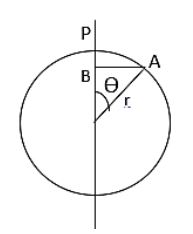
So, the correct answer is “Option A”.
Note: Centripetal acceleration is defined as the characteristics of the motion of a particle which is travelling in a circular path. The acceleration has been directed radially towards the centre of the circular path. Centripetal forces are the reason for the centripetal accelerations. In the circular motion of earth around the Sun or any satellite having circular motion around any celestial body, the centripetal force is there as a result of the gravitational attraction between them. At the equator there is always a subtractive force present because of the gravity opposite to this, towards the centre. At the poles, as there is no distance from the centre of rotation, no centrifugal force is there.
Complete step-by-step answer:
The centripetal acceleration is given by the formula,
${{a}_{c}}=\dfrac{{{v}^{2}}}{r}$
Where $v$ be the velocity of the rotation of earth and $r$be the radius of earth.
When we take radial components into account, the above equation becomes,
\[{{a}_{c}}=\dfrac{-{{v}^{2}}}{r}\times \sin \theta \]
And also we know that, the velocity can be written in the form of angular velocity as,
\[v=r\omega \]
Substituting this in the equation of centripetal acceleration will give,
\[{{a}_{c}}=\dfrac{-{{\left( r\omega \right)}^{2}}}{r}\sin \theta \]
Simplifying this will give,
\[{{a}_{c}}=-r{{\omega }^{2}}\sin \theta \]
As we know that the angle at the poles in the y component is found to be zero.
Substituting this in the equation will give,
\[\begin{align}
& {{a}_{c}}=\dfrac{-{{\left( r\omega \right)}^{2}}}{r}\sin 0 \\
& {{a}_{c}}=0 \\
\end{align}\]
So, the correct answer is “Option A”.
Note: Centripetal acceleration is defined as the characteristics of the motion of a particle which is travelling in a circular path. The acceleration has been directed radially towards the centre of the circular path. Centripetal forces are the reason for the centripetal accelerations. In the circular motion of earth around the Sun or any satellite having circular motion around any celestial body, the centripetal force is there as a result of the gravitational attraction between them. At the equator there is always a subtractive force present because of the gravity opposite to this, towards the centre. At the poles, as there is no distance from the centre of rotation, no centrifugal force is there.
Recently Updated Pages
If x a + bt + ct2 where x is in meters and t is in class 11 physics CBSE

A car covers the first half distance between two places class 11 physics CBSE
The resultant of two vectors overrightarrow P and overrightarrow class 11 physics CBSE
Find the value of cos 135 class 11 maths CBSE
A mass M is held in place by an applied force F and class 11 physics CBSE
A solution of glucose in water is labelled as 10 dfracwv class 11 chemistry CBSE
Trending doubts
Find the value of the expression given below sin 30circ class 11 maths CBSE
One Metric ton is equal to kg A 10000 B 1000 C 100 class 11 physics CBSE
Draw a diagram of nephron and explain its structur class 11 biology CBSE
10 examples of friction in our daily life
Proton was discovered by A Thomson B Rutherford C Chadwick class 11 chemistry CBSE
Bond order ofO2 O2+ O2 and O22 is in order A O2 langle class 11 chemistry CBSE