




The product ‘X’ in the given reaction sequence is:
$ C{H_3}COOC{H_3} + PhMgBr\;({\text{excess)}} \to {\text{Product}}\xrightarrow{{{H^ + }}}X $
A. 1,1-diphenyl ethanol
B. 1,1-diphenyl methanol
C. methylphenyl ethanol
D. methyl phenyl ketone
Answer
 Verified
574.5k+ views
Hint: A Grignard reagent is a chemical compound with general formula $ R - Mg - X $ , where X is a halogen and R is any alkyl or aryl group. It is one of the popular organometallic reagents which is used in organic reactions for creating new carbon-carbon single bonds.
Complete answer:
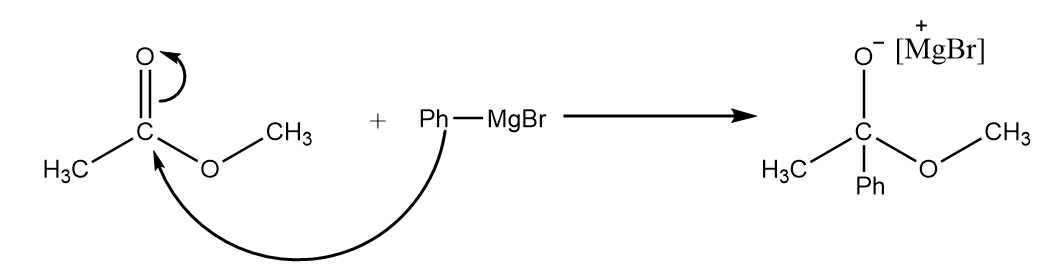
Two most common examples of Grignard reagent are phenylmagnesium bromide and methylmagnesium chloride. When methyl acetate reacts with excess of phenylmagnesium bromide in acidic medium, formation of a tertiary alcohol takes place. The reaction mechanism involved in the process is discussed below:
Step-1: Nucleophilic attack of phenyl group takes place at the carbonyl centre and an intermediate product is formed. The reaction proceeds as follows:
Step-2: When two oxygen atoms are present on a carbon atom, then one of the oxygen atoms has the tendency to form a double bond with the carbon atom, so the formation of ketone will take place by removing the leaving group. The reaction takes place as follows:

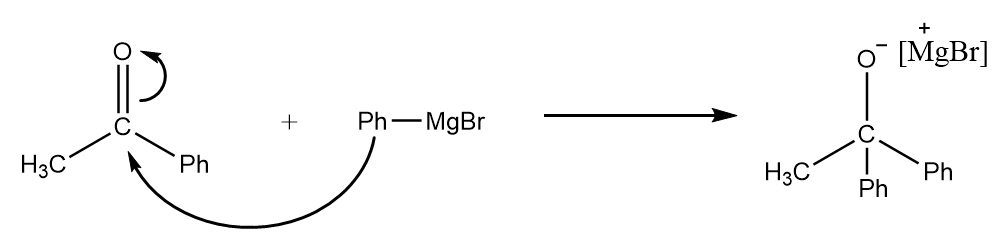
Step-3: As the Grignard reagent is present in excess, it again attacks the carbonyl centre of the compound and the formation of an intermediate compound takes place. The reaction proceeds as follows:
Step-4: The intermediate formed in the previous step will undergo protonation in acidic medium and formation of tertiary alcohol takes place. The reaction takes place as follows:
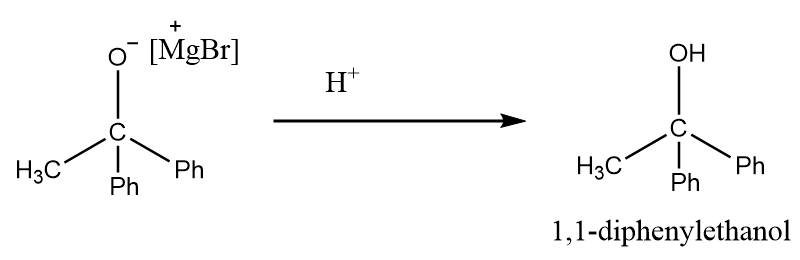
Hence, in the given reaction sequence, the product ‘X’ formed is 1,1-diphenyl ethanol.
Thus, option (A) is the correct answer.
Note:
It is important to note that the Grignard reagent does not react with the protected carbonyl group i.e., acetal and hemiacetal compounds because these compounds are base proof. Except these, the Grignard reagent is most commonly used for alkylation of carbonyl compounds.
Complete answer:
Two most common examples of Grignard reagent are phenylmagnesium bromide and methylmagnesium chloride. When methyl acetate reacts with excess of phenylmagnesium bromide in acidic medium, formation of a tertiary alcohol takes place. The reaction mechanism involved in the process is discussed below:
Step-1: Nucleophilic attack of phenyl group takes place at the carbonyl centre and an intermediate product is formed. The reaction proceeds as follows:
Step-2: When two oxygen atoms are present on a carbon atom, then one of the oxygen atoms has the tendency to form a double bond with the carbon atom, so the formation of ketone will take place by removing the leaving group. The reaction takes place as follows:
Step-3: As the Grignard reagent is present in excess, it again attacks the carbonyl centre of the compound and the formation of an intermediate compound takes place. The reaction proceeds as follows:
Step-4: The intermediate formed in the previous step will undergo protonation in acidic medium and formation of tertiary alcohol takes place. The reaction takes place as follows:
Hence, in the given reaction sequence, the product ‘X’ formed is 1,1-diphenyl ethanol.
Thus, option (A) is the correct answer.
Note:
It is important to note that the Grignard reagent does not react with the protected carbonyl group i.e., acetal and hemiacetal compounds because these compounds are base proof. Except these, the Grignard reagent is most commonly used for alkylation of carbonyl compounds.
Recently Updated Pages
If x a + bt + ct2 where x is in meters and t is in class 11 physics CBSE

A car covers the first half distance between two places class 11 physics CBSE
The resultant of two vectors overrightarrow P and overrightarrow class 11 physics CBSE
Find the value of cos 135 class 11 maths CBSE
A mass M is held in place by an applied force F and class 11 physics CBSE
A solution of glucose in water is labelled as 10 dfracwv class 11 chemistry CBSE
Trending doubts
Find the value of the expression given below sin 30circ class 11 maths CBSE
One Metric ton is equal to kg A 10000 B 1000 C 100 class 11 physics CBSE
Draw a diagram of nephron and explain its structur class 11 biology CBSE
10 examples of friction in our daily life
Proton was discovered by A Thomson B Rutherford C Chadwick class 11 chemistry CBSE
Bond order ofO2 O2+ O2 and O22 is in order A O2 langle class 11 chemistry CBSE