




The process of obtaining food for amoeba is
A. Dialysis
B. Cytokinesis
C. Phagocytosis
D. Endocytosis
Answer
 Verified
660.9k+ views
Hint: Some lower unicellular eukaryotic organisms capture the food particles with the help of the membrane.
Complete step-by-step answer:
The process in which the food particles are brought inside the cell by surrounding the material with the cell membrane is called endocytosis. It occurs mostly in the case of amoeba and paramecium.
Additional information:
-Amoeba is a unicellular organism that can change its shape by the movement of its pseudopodia.
-Amoeba ingests its food typically by the process of phagocytosis by wrapping the food particles with membrane and engulfing it.
-They do not have mouth or anus, but ingestion and excretion occur through pseudopodia.
-The ingested food which is surrounded by the cell membrane will later break off from the cell membrane and form a small round body called vesicles which contain food particles inside it.
-Endocytosis can be classified into two types:
Pinocytosis – the process of cell drinking where the cell membrane will invaginate around the material and buds off to form a vesicle that is taken off to it’s required place.
Phagocytosis – the process of cell eating where a large membrane binds and engulfs food particles.
So, the correct answer is ‘Endocytosis’.
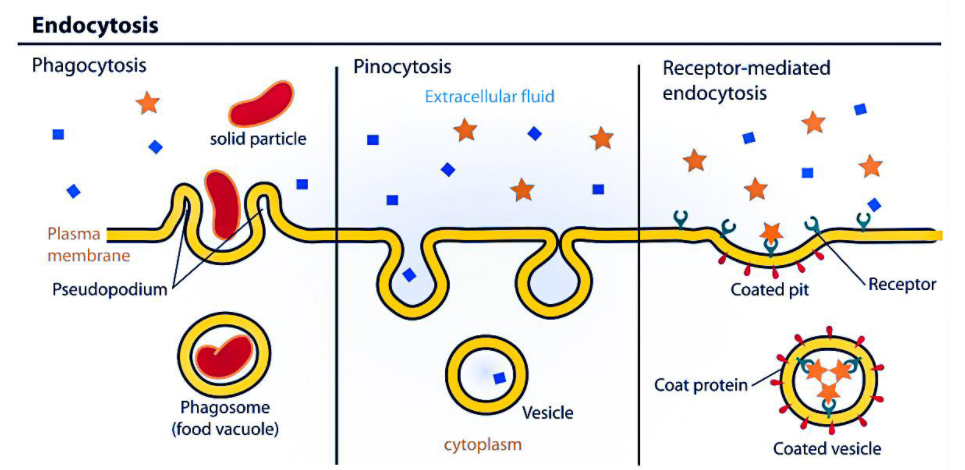
Note: The term Endocytosis was proposed in 1963 by De Duve while the term Phagocytosis was discovered in 1882 by Elie Metchnikoff. The process of removal of excess wastes from the blood of an organism by the means of the kidney is known as dialysis. Dialysis was discovered by Willem Johan Kolff who was named as the inventor of kidney dialysis and it was performed for the first time in 1943.
Complete step-by-step answer:
The process in which the food particles are brought inside the cell by surrounding the material with the cell membrane is called endocytosis. It occurs mostly in the case of amoeba and paramecium.
Additional information:
-Amoeba is a unicellular organism that can change its shape by the movement of its pseudopodia.
-Amoeba ingests its food typically by the process of phagocytosis by wrapping the food particles with membrane and engulfing it.
-They do not have mouth or anus, but ingestion and excretion occur through pseudopodia.
-The ingested food which is surrounded by the cell membrane will later break off from the cell membrane and form a small round body called vesicles which contain food particles inside it.
-Endocytosis can be classified into two types:
Pinocytosis – the process of cell drinking where the cell membrane will invaginate around the material and buds off to form a vesicle that is taken off to it’s required place.
Phagocytosis – the process of cell eating where a large membrane binds and engulfs food particles.
So, the correct answer is ‘Endocytosis’.
Note: The term Endocytosis was proposed in 1963 by De Duve while the term Phagocytosis was discovered in 1882 by Elie Metchnikoff. The process of removal of excess wastes from the blood of an organism by the means of the kidney is known as dialysis. Dialysis was discovered by Willem Johan Kolff who was named as the inventor of kidney dialysis and it was performed for the first time in 1943.
Recently Updated Pages
Differentiate between voluntary action and reflex class 10 biology CBSE

The uses of bleaching powder are A It is used bleaching class 10 chemistry CBSE
Fill in the blanks with abstract nouns of the words class 10 english CBSE
How many threedigit numbers are there class 10 maths CBSE
What is a reflex arc class 10 biology CBSE
Construct a square whose diagonal is 6cm Measure the class 10 maths CBSE
Trending doubts
Explain the Treaty of Vienna of 1815 class 10 social science CBSE
The slogan Jai Hind was given by A Lal Bahadur Shastri class 10 social science CBSE
10 examples of evaporation in daily life with explanations
What is the full form of POSCO class 10 social science CBSE
Identify the feminine form of noun nephew a shenephew class 10 english CBSE
Make a sketch of the human nerve cell What function class 10 biology CBSE