




The principle of controlled chain reaction is used in:
A. atomic energy reactor.
B. atom bomb
C. the core of sun
D. artificial radioactivity
Answer
 Verified
611.1k+ views
Hint: The principle of controlled chain reaction is the process in which the continuous fissions of nuclei take place. Fission is the process of splitting a nucleus into two different nuclei, when it is bombarded with high energy particles.
Complete step-by-step answer:
A nuclear reactor works on the principle of chain of nuclear fission. When a highly energetic particle is bombarded on a nucleus, it splits into two lighter nuclei of comparable mass with liberation of energy. This process is called nuclear fission.
The commonly used nucleus for nuclear fission is the nucleus of uranium ${}_{92}{{U}^{235}}$. In the nuclear fission of this nucleus, three neutrons are produced and a large amount of energy is released. These neutrons can cause further fission of other nuclei, if favourable conditions are provided. This produces a large number of neutrons. In this way a chain of nuclear fissions take place until the uranium is used completely. This is called chain reaction.
The purpose of a nuclear reactor is to carry out a sustained and controlled chain reaction. Thus, it acts as a source of large controlled energy, which is utilised for many useful purposes.
A labelled diagram of a nuclear reactor is given below.
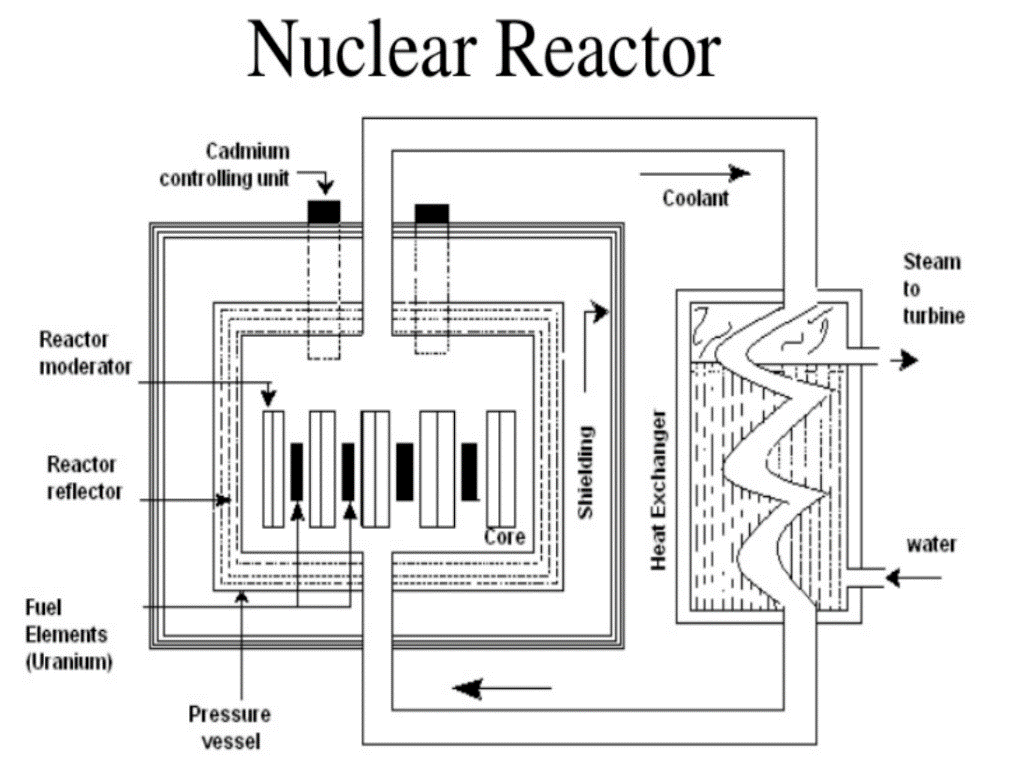
Let us understand the parts of the reactor to understand its working.
The material that undergoes the chain reaction is called the fuel of the reactor.
To slow down the fast moving neutrons a moderator is used. The common moderators are graphite and heavy water (${{D}_{{{2}_{{}}}}}O$).
To control the chain reaction and to maintain a stable rate a control material is used. A control material controls the number of neutrons available for the fission process.
In the chain reaction, a large amount of heat is produced. In order to reduce the heat generated coolants are used. For example, water, nitrogen and carbon dioxide.
To protect the people around the reactor thick concrete walls are used as protective shields.
So, the correct answer is “Option A”.
Note: It may be noted that Plutonium is the best fuel as compared to other fissionable material. It is because fission in Plutonium can be initiated by both slow and fast neutrons. Moreover, it can be obtained from ${}_{92}{{U}^{235}}$.
Complete step-by-step answer:
A nuclear reactor works on the principle of chain of nuclear fission. When a highly energetic particle is bombarded on a nucleus, it splits into two lighter nuclei of comparable mass with liberation of energy. This process is called nuclear fission.
The commonly used nucleus for nuclear fission is the nucleus of uranium ${}_{92}{{U}^{235}}$. In the nuclear fission of this nucleus, three neutrons are produced and a large amount of energy is released. These neutrons can cause further fission of other nuclei, if favourable conditions are provided. This produces a large number of neutrons. In this way a chain of nuclear fissions take place until the uranium is used completely. This is called chain reaction.
The purpose of a nuclear reactor is to carry out a sustained and controlled chain reaction. Thus, it acts as a source of large controlled energy, which is utilised for many useful purposes.
A labelled diagram of a nuclear reactor is given below.
Let us understand the parts of the reactor to understand its working.
The material that undergoes the chain reaction is called the fuel of the reactor.
To slow down the fast moving neutrons a moderator is used. The common moderators are graphite and heavy water (${{D}_{{{2}_{{}}}}}O$).
To control the chain reaction and to maintain a stable rate a control material is used. A control material controls the number of neutrons available for the fission process.
In the chain reaction, a large amount of heat is produced. In order to reduce the heat generated coolants are used. For example, water, nitrogen and carbon dioxide.
To protect the people around the reactor thick concrete walls are used as protective shields.
So, the correct answer is “Option A”.
Note: It may be noted that Plutonium is the best fuel as compared to other fissionable material. It is because fission in Plutonium can be initiated by both slow and fast neutrons. Moreover, it can be obtained from ${}_{92}{{U}^{235}}$.
Recently Updated Pages
Master Class 12 Business Studies: Engaging Questions & Answers for Success

Master Class 12 Biology: Engaging Questions & Answers for Success
Master Class 12 Chemistry: Engaging Questions & Answers for Success
Class 12 Question and Answer - Your Ultimate Solutions Guide
Master Class 11 Social Science: Engaging Questions & Answers for Success
Master Class 11 English: Engaging Questions & Answers for Success
Trending doubts
Which are the Top 10 Largest Countries of the World?
Draw a labelled sketch of the human eye class 12 physics CBSE
Differentiate between homogeneous and heterogeneous class 12 chemistry CBSE
Sulphuric acid is known as the king of acids State class 12 chemistry CBSE
Why is the cell called the structural and functional class 12 biology CBSE
Which is the correct genotypic ratio of mendel dihybrid class 12 biology CBSE