




The principle behind the working of an atom bomb is:
a.) Nuclear fusion
b.) Nuclear fission
c.) Radioactivity
d.) None of these
Answer
 Verified
650.4k+ views
Hint: When a heavier nuclei having high atomic number and mass number disintegrates into lighter nuclei of lower mass number and atomic number, a large amount of energy is produced which can be used as a weapon of mass destruction if implemented in a certain way.
Detailed step by step solution:
An atom bomb is a weapon which can cause a lot of destruction in the area where it is dropped.
The working of an atomic bomb is based on the phenomenon of nuclear fission.
Nuclear fission can be defined as a nuclear phenomenon in which the nucleus of an element having high atomic number and mass number splits into a lighter nuclei of smaller mass number and atomic number.
This phenomena is based on the binding energy per nucleon curve shown below.
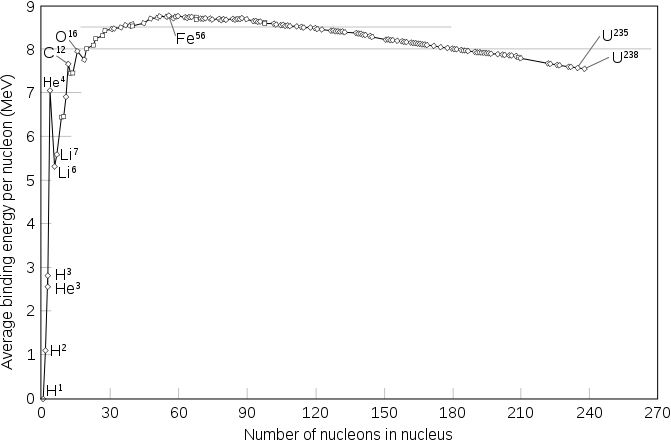
In this plot, the elements beyond iron have big nuclei with large numbers of nucleons and are unstable. They try to achieve stability by undergoing nuclear fission to reduce their number of nucleons.
Hence, the correct answer is option C.
Note:
1. Radioactivity and nuclear fission are two different phenomena in the sense that in radioactivity, the nucleus of a radioactive isotope undergoes decay to emit certain radiation whereas in case of nuclear fission, a heavier unstable nucleus breaks into nuclei of lighter mass giving off a lot of energy.
2. In nuclear fusion, lighter nuclei combine to form a heavier nuclei. This process requires a lot of energy. It is the process by which the sun’s core gets its energy. On earth, we have not yet discovered a method to produce the required amount of energy required for nuclear fusion to occur.
Detailed step by step solution:
An atom bomb is a weapon which can cause a lot of destruction in the area where it is dropped.
The working of an atomic bomb is based on the phenomenon of nuclear fission.
Nuclear fission can be defined as a nuclear phenomenon in which the nucleus of an element having high atomic number and mass number splits into a lighter nuclei of smaller mass number and atomic number.
This phenomena is based on the binding energy per nucleon curve shown below.
In this plot, the elements beyond iron have big nuclei with large numbers of nucleons and are unstable. They try to achieve stability by undergoing nuclear fission to reduce their number of nucleons.
Hence, the correct answer is option C.
Note:
1. Radioactivity and nuclear fission are two different phenomena in the sense that in radioactivity, the nucleus of a radioactive isotope undergoes decay to emit certain radiation whereas in case of nuclear fission, a heavier unstable nucleus breaks into nuclei of lighter mass giving off a lot of energy.
2. In nuclear fusion, lighter nuclei combine to form a heavier nuclei. This process requires a lot of energy. It is the process by which the sun’s core gets its energy. On earth, we have not yet discovered a method to produce the required amount of energy required for nuclear fusion to occur.
Recently Updated Pages
Basicity of sulphurous acid and sulphuric acid are

Master Class 12 Economics: Engaging Questions & Answers for Success
Master Class 12 Biology: Engaging Questions & Answers for Success
Master Class 11 English: Engaging Questions & Answers for Success
Master Class 11 Physics: Engaging Questions & Answers for Success
Master Class 11 Computer Science: Engaging Questions & Answers for Success
Trending doubts
Draw a labelled sketch of the human eye class 12 physics CBSE
Why is the cell called the structural and functional class 12 biology CBSE
Draw ray diagrams each showing i myopic eye and ii class 12 physics CBSE
Which are the Top 10 Largest Countries of the World?
Differentiate between homogeneous and heterogeneous class 12 chemistry CBSE
Which is the correct genotypic ratio of mendel dihybrid class 12 biology CBSE