




The number of tetrahedral voids present in a bcc lattice is:
A.$4$
B.$2$
C.$1$
D.$8$
Answer
 Verified
621k+ views
Hint:We know that a unit cell is the smallest representation of an entire crystal. All crystal lattices are made up of repeating unit cells. In a unit cell, coordination number of an atom is the number of atoms it touches.
Complete step by step answer:
We can say the body centered cubic unit cell has the atoms at each the eight corners of a cube plus one atom in the centre of the cube. Each of the corner atoms is the corner of another cube so the corners atoms are shared by an 8 unit cell.
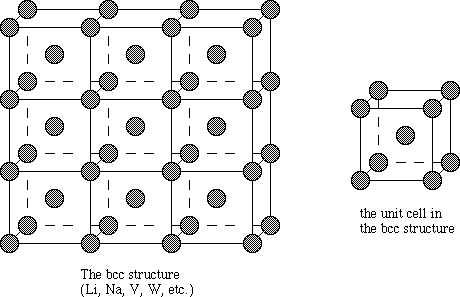
We have a simple way to find the number of tetrahedral Voids in a lattice. Here if the number of spheres that are unit cells is considered to be “n”, then the number of voids would be twice as many.
Therefore, the number of tetrahedral voids would be $2n$.
We have to know that bcc has 2 atoms per unit cell, the number of tetrahedral voids is \[2 \times 2 = 4\].
The number of tetrahedral voids in BCC is $4$.
Therefore, option (A) is correct.
Note:
We also remember that in a body centered cubic unit cell each corner is occupied by an identical particle and in addition to that one atom occupies the body centre. Those atoms that occupy the corners do not touch each other, however they all touch the atom which occupies the body centre. Hence each atom is surrounded by eight nearest neighbors and coordination number is 8.
We can calculate the number of atoms in body centered cubic cell as follows,
No of atom
$ = \left( {\dfrac{{Number\;of\;atom\;shared\;per\;unit\;cell}}{{Number\;of\;corners}}} \right) + \dfrac{{Number\;of\;atom\;per\;unit\;cell}}{{number\;of\;centre\;atom}}$
Example 1: We can calculate the number of tungsten atoms as,
The no of atoms
$ = \left( {\dfrac{{Number\;of\;atom\;shared\;per\;unit\;cell}}{{Number\;of\;corners}}} \right) + \dfrac{{Number\;of\;atom\;per\;unit\;cell}}{{number\;of\;centre\;atom}}$
The number of tungsten atoms$ = \left( {\dfrac{8}{8}} \right) + \dfrac{1}{1} = 2$
The number tungsten atoms present in each unit cell of that metal is two.
Example 2: The structure of the rutile $\left( {Ti{O_2}} \right)$ is Bcc array.
The number of ${O^{2 - }}$ ion has to be calculated as,
No of atoms
$ = \left( {\dfrac{{Number\;of\;atom\;shared\;per\;unit\;cell}}{{Number\;of\;corners}}} \right) + \dfrac{{Number\;of\;atom\;per\;unit\;cell}}{{number\;of\;centre\;atom}}$
No of atoms=$\left( {\dfrac{8}{8}} \right) + \dfrac{1}{1} = 2$
The number of ${O^{2 - }}$ atoms is two.
Complete step by step answer:
We can say the body centered cubic unit cell has the atoms at each the eight corners of a cube plus one atom in the centre of the cube. Each of the corner atoms is the corner of another cube so the corners atoms are shared by an 8 unit cell.
We have a simple way to find the number of tetrahedral Voids in a lattice. Here if the number of spheres that are unit cells is considered to be “n”, then the number of voids would be twice as many.
Therefore, the number of tetrahedral voids would be $2n$.
We have to know that bcc has 2 atoms per unit cell, the number of tetrahedral voids is \[2 \times 2 = 4\].
The number of tetrahedral voids in BCC is $4$.
Therefore, option (A) is correct.
Note:
We also remember that in a body centered cubic unit cell each corner is occupied by an identical particle and in addition to that one atom occupies the body centre. Those atoms that occupy the corners do not touch each other, however they all touch the atom which occupies the body centre. Hence each atom is surrounded by eight nearest neighbors and coordination number is 8.
We can calculate the number of atoms in body centered cubic cell as follows,
No of atom
$ = \left( {\dfrac{{Number\;of\;atom\;shared\;per\;unit\;cell}}{{Number\;of\;corners}}} \right) + \dfrac{{Number\;of\;atom\;per\;unit\;cell}}{{number\;of\;centre\;atom}}$
Example 1: We can calculate the number of tungsten atoms as,
The no of atoms
$ = \left( {\dfrac{{Number\;of\;atom\;shared\;per\;unit\;cell}}{{Number\;of\;corners}}} \right) + \dfrac{{Number\;of\;atom\;per\;unit\;cell}}{{number\;of\;centre\;atom}}$
The number of tungsten atoms$ = \left( {\dfrac{8}{8}} \right) + \dfrac{1}{1} = 2$
The number tungsten atoms present in each unit cell of that metal is two.
Example 2: The structure of the rutile $\left( {Ti{O_2}} \right)$ is Bcc array.
The number of ${O^{2 - }}$ ion has to be calculated as,
No of atoms
$ = \left( {\dfrac{{Number\;of\;atom\;shared\;per\;unit\;cell}}{{Number\;of\;corners}}} \right) + \dfrac{{Number\;of\;atom\;per\;unit\;cell}}{{number\;of\;centre\;atom}}$
No of atoms=$\left( {\dfrac{8}{8}} \right) + \dfrac{1}{1} = 2$
The number of ${O^{2 - }}$ atoms is two.
Recently Updated Pages
Master Class 12 Business Studies: Engaging Questions & Answers for Success

Master Class 12 Chemistry: Engaging Questions & Answers for Success
Master Class 12 Biology: Engaging Questions & Answers for Success
Class 12 Question and Answer - Your Ultimate Solutions Guide
Master Class 11 English: Engaging Questions & Answers for Success
Master Class 11 Social Science: Engaging Questions & Answers for Success
Trending doubts
Which are the Top 10 Largest Countries of the World?
Draw a labelled sketch of the human eye class 12 physics CBSE
Differentiate between homogeneous and heterogeneous class 12 chemistry CBSE
Why is the cell called the structural and functional class 12 biology CBSE
Draw ray diagrams each showing i myopic eye and ii class 12 physics CBSE
Which is the correct genotypic ratio of mendel dihybrid class 12 biology CBSE