




The number of solutions for the equation \[{{\tan }^{-1}}\left( {{e}^{-x}} \right)+{{\cot }^{-1}}\left( \left| \ln x \right| \right)=\dfrac{\pi }{2}\] is:
(a) 0
(b) 1
(c) 3
(d) 2
Answer
 Verified
601.8k+ views
Hint: We solve this problem first by taking the trigonometric equations out by using the standard formulas that is
\[{{\tan }^{-1}}x={{\cot }^{-1}}\left( \dfrac{1}{x} \right)\]
Then we use the composite angle formula of inverse trigonometric equations as
\[{{\cot }^{-1}}x+{{\cot }^{-1}}y={{\cot }^{-1}}\left( \dfrac{xy-1}{x+y} \right)\]
By using the above formulas we find the relation between to functions without trigonometric equations so that we can find the number of solutions using the graphs that is if \[f\left( x \right)=g\left( x \right)\] then the number of solutions to above equations will be number of points of intersections of \[y=f\left( x \right)\] and \[y=g\left( x \right)\]
Complete step-by-step solution
We are given that the equation that is
\[\Rightarrow {{\tan }^{-1}}\left( {{e}^{-x}} \right)+{{\cot }^{-1}}\left( \left| \ln x \right| \right)=\dfrac{\pi }{2}\]
We know that the inverse trigonometric relation that is
\[{{\tan }^{-1}}x={{\cot }^{-1}}\left( \dfrac{1}{x} \right)\]
By using this relation to above equation we get
\[\begin{align}
& \Rightarrow {{\cot }^{-1}}\left( \dfrac{1}{{{e}^{-x}}} \right)+{{\cot }^{-1}}\left( \left| \ln x \right| \right)=\dfrac{\pi }{2} \\
& \Rightarrow {{\cot }^{-1}}\left( {{e}^{x}} \right)+{{\cot }^{-1}}\left( \left| \ln x \right| \right)=\dfrac{\pi }{2} \\
\end{align}\]
We know that the formula of the composite angle formula of inverse trigonometric equations as
\[{{\cot }^{-1}}x+{{\cot }^{-1}}y={{\cot }^{-1}}\left( \dfrac{xy-1}{x+y} \right)\]
By using this formula to above equation we get
\[\begin{align}
& \Rightarrow {{\cot }^{-1}}\left( \dfrac{{{e}^{x}}\left| \ln x \right|-1}{{{e}^{x}}+\left| \ln x \right|} \right)=\dfrac{\pi }{2} \\
& \Rightarrow \dfrac{{{e}^{x}}\left| \ln x \right|-1}{{{e}^{x}}+\left| \ln x \right|}=\cot \dfrac{\pi }{2} \\
\end{align}\]
We know that from the standard table of trigonometric ratios that is
\[\cot \dfrac{\pi }{2}=0\]
By substituting this value in above equation we get
\[\begin{align}
& \Rightarrow \dfrac{{{e}^{x}}\left| \ln x \right|-1}{{{e}^{x}}+\left| \ln x \right|}=0 \\
& \Rightarrow {{e}^{x}}\left| \ln x \right|-1=0 \\
& \Rightarrow \left| \ln x \right|={{e}^{-x}} \\
\end{align}\]
We know that if \[f\left( x \right)=g\left( x \right)\] then the number of solutions to above equations will be number of points of intersections of \[y=f\left( x \right)\] and \[y=g\left( x \right)\]
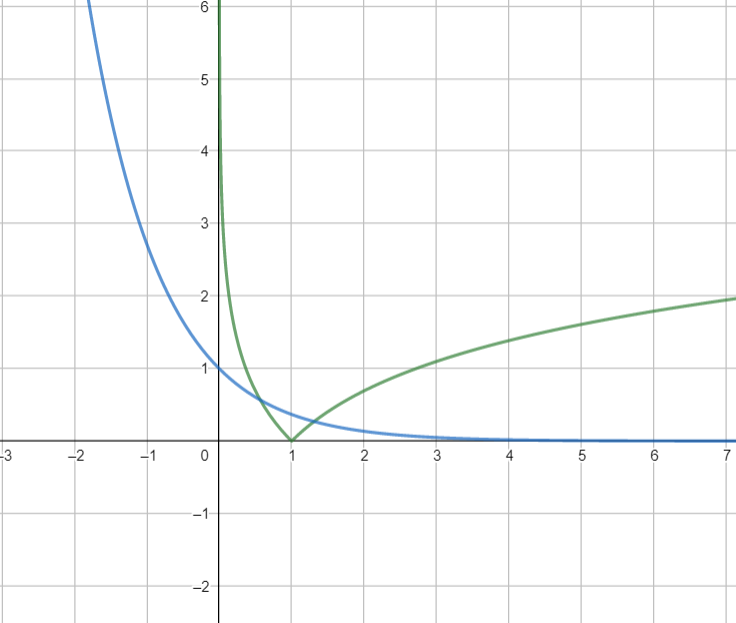
Now, let us draw the graph of \[y=\left| \ln x \right|\] and \[y={{e}^{-x}}\] then we get
Here we can see that the blue line represents \[y={{e}^{-x}}\] and the green line represents \[y=\left| \ln x \right|\]
Here, we can see that both the graphs intersect at 2 points therefore the number of solutions of the given equation is 2.
So, option (d) is the correct answer.
Note: We have a shortcut for solving the problem.
We are given that the equation as
\[\Rightarrow {{\tan }^{-1}}\left( {{e}^{-x}} \right)+{{\cot }^{-1}}\left( \left| \ln x \right| \right)=\dfrac{\pi }{2}\]
We have a standard result of inverse trigonometric ratios that is if \[{{\tan }^{-1}}x+{{\cot }^{-1}}y=\dfrac{\pi }{2}\] happens if and only if \[x=y\]
By using the above result we get
\[\Rightarrow {{e}^{-x}}=\left| \ln x \right|\]
\[{{\tan }^{-1}}x={{\cot }^{-1}}\left( \dfrac{1}{x} \right)\]
Then we use the composite angle formula of inverse trigonometric equations as
\[{{\cot }^{-1}}x+{{\cot }^{-1}}y={{\cot }^{-1}}\left( \dfrac{xy-1}{x+y} \right)\]
By using the above formulas we find the relation between to functions without trigonometric equations so that we can find the number of solutions using the graphs that is if \[f\left( x \right)=g\left( x \right)\] then the number of solutions to above equations will be number of points of intersections of \[y=f\left( x \right)\] and \[y=g\left( x \right)\]
Complete step-by-step solution
We are given that the equation that is
\[\Rightarrow {{\tan }^{-1}}\left( {{e}^{-x}} \right)+{{\cot }^{-1}}\left( \left| \ln x \right| \right)=\dfrac{\pi }{2}\]
We know that the inverse trigonometric relation that is
\[{{\tan }^{-1}}x={{\cot }^{-1}}\left( \dfrac{1}{x} \right)\]
By using this relation to above equation we get
\[\begin{align}
& \Rightarrow {{\cot }^{-1}}\left( \dfrac{1}{{{e}^{-x}}} \right)+{{\cot }^{-1}}\left( \left| \ln x \right| \right)=\dfrac{\pi }{2} \\
& \Rightarrow {{\cot }^{-1}}\left( {{e}^{x}} \right)+{{\cot }^{-1}}\left( \left| \ln x \right| \right)=\dfrac{\pi }{2} \\
\end{align}\]
We know that the formula of the composite angle formula of inverse trigonometric equations as
\[{{\cot }^{-1}}x+{{\cot }^{-1}}y={{\cot }^{-1}}\left( \dfrac{xy-1}{x+y} \right)\]
By using this formula to above equation we get
\[\begin{align}
& \Rightarrow {{\cot }^{-1}}\left( \dfrac{{{e}^{x}}\left| \ln x \right|-1}{{{e}^{x}}+\left| \ln x \right|} \right)=\dfrac{\pi }{2} \\
& \Rightarrow \dfrac{{{e}^{x}}\left| \ln x \right|-1}{{{e}^{x}}+\left| \ln x \right|}=\cot \dfrac{\pi }{2} \\
\end{align}\]
We know that from the standard table of trigonometric ratios that is
\[\cot \dfrac{\pi }{2}=0\]
By substituting this value in above equation we get
\[\begin{align}
& \Rightarrow \dfrac{{{e}^{x}}\left| \ln x \right|-1}{{{e}^{x}}+\left| \ln x \right|}=0 \\
& \Rightarrow {{e}^{x}}\left| \ln x \right|-1=0 \\
& \Rightarrow \left| \ln x \right|={{e}^{-x}} \\
\end{align}\]
We know that if \[f\left( x \right)=g\left( x \right)\] then the number of solutions to above equations will be number of points of intersections of \[y=f\left( x \right)\] and \[y=g\left( x \right)\]
Now, let us draw the graph of \[y=\left| \ln x \right|\] and \[y={{e}^{-x}}\] then we get
Here we can see that the blue line represents \[y={{e}^{-x}}\] and the green line represents \[y=\left| \ln x \right|\]
Here, we can see that both the graphs intersect at 2 points therefore the number of solutions of the given equation is 2.
So, option (d) is the correct answer.
Note: We have a shortcut for solving the problem.
We are given that the equation as
\[\Rightarrow {{\tan }^{-1}}\left( {{e}^{-x}} \right)+{{\cot }^{-1}}\left( \left| \ln x \right| \right)=\dfrac{\pi }{2}\]
We have a standard result of inverse trigonometric ratios that is if \[{{\tan }^{-1}}x+{{\cot }^{-1}}y=\dfrac{\pi }{2}\] happens if and only if \[x=y\]
By using the above result we get
\[\Rightarrow {{e}^{-x}}=\left| \ln x \right|\]
Recently Updated Pages
Master Class 12 Business Studies: Engaging Questions & Answers for Success

Master Class 12 Biology: Engaging Questions & Answers for Success
Master Class 12 Chemistry: Engaging Questions & Answers for Success
Class 12 Question and Answer - Your Ultimate Solutions Guide
Master Class 11 Social Science: Engaging Questions & Answers for Success
Master Class 11 English: Engaging Questions & Answers for Success
Trending doubts
Which are the Top 10 Largest Countries of the World?
Draw a labelled sketch of the human eye class 12 physics CBSE
Name the crygenes that control cotton bollworm and class 12 biology CBSE
Differentiate between homogeneous and heterogeneous class 12 chemistry CBSE
Ribosomal RNA is actively synthesised in A Nucleoplasm class 12 biology CBSE
How many molecules of ATP and NADPH are required information class 12 biology CBSE