




The number of integers n for which $3{x^3} - 25x + n = 0$ has three real roots is?
$\left( a \right)$ 1
$\left( b \right)$ 25
$\left( c \right)$ 55
$\left( d \right)$ Infinite
Answer
 Verified
662.1k+ views
Hint: In this particular question use the concept that between two roots of derivative, a function has at least 1 root, so differentiate the given function and equate to zero and solve for x, then on these value of x calculate the value of function f (x), so use these concepts to reach the solution of the question.
Complete step-by-step solution:
Given equation:
$3{x^3} - 25x + n = 0$
As we see that the highest power of x is 3, so it is a cubic equation.
Let, $f\left( x \right) = 3{x^3} - 25x + n$
Now as we all know that between two roots of derivative, a function has at least 1 root.
To differentiate the given function and equate it to zero and solve for x, then on these values of x calculate the value of function f (x).
Now differentiate f (x) we have,
$ \Rightarrow \dfrac{d}{{dx}}f\left( x \right) = \dfrac{d}{{dx}}\left( {3{x^3} - 25x + n} \right)$
Now as we know that, \[\dfrac{d}{{dx}}{x^n} = n{x^{n - 1}}\] so use this property in the above equation we have,
$ \Rightarrow \dfrac{d}{{dx}}f\left( x \right) = f'\left( x \right) = 3\left( 3 \right){x^{3 - 1}} - 25 + 0$
$ \Rightarrow f'\left( x \right) = 9{x^2} - 25$
Now equate this to zero we have,
$ \Rightarrow 9{x^2} - 25 = 0$
$ \Rightarrow 9{x^2} = 25$
$ \Rightarrow {x^2} = \dfrac{{25}}{9}$
Now take square root on both sides we have,
$ \Rightarrow x = \sqrt {\dfrac{{25}}{9}} = \pm \dfrac{5}{3}$
Now double differentiate the function to check at which value function attains maxima or minima.
$ \Rightarrow \dfrac{{{d^2}}}{{d{x^2}}}f\left( x \right) = f''\left( x \right) = \dfrac{d}{{dx}}f'\left( x \right) = \dfrac{d}{{dx}}\left( {9{x^2} - 25} \right) = 18x$
So when, $x = \dfrac{5}{3}$
\[ \Rightarrow f''\left( {\dfrac{5}{3}} \right) = 18\left( {\dfrac{5}{3}} \right) = + 30\] (Positive so it is minima)
And when, $x = - \dfrac{5}{3}$
\[ \Rightarrow f''\left( { - \dfrac{5}{3}} \right) = 18\left( { - \dfrac{5}{3}} \right) = - 30\] (Negative so it is maxima)
So the value of f (x) at these roots we have,
So when, $x = \dfrac{5}{3}$
$ \Rightarrow f\left( {\dfrac{5}{3}} \right) = 3{\left( {\dfrac{5}{3}} \right)^3} - 25\left( {\dfrac{5}{3}} \right) + n$
$ \Rightarrow f\left( {\dfrac{5}{3}} \right) = \dfrac{{125}}{9} - \dfrac{{125}}{3} + n$
$ \Rightarrow f\left( {\dfrac{5}{3}} \right) = - \dfrac{{250}}{9} + n$ (Minimum value)
And when, $x = - \dfrac{5}{3}$
$ \Rightarrow f\left( { - \dfrac{5}{3}} \right) = 3{\left( { - \dfrac{5}{3}} \right)^3} - 25\left( { - \dfrac{5}{3}} \right) + n$
$ \Rightarrow f\left( { - \dfrac{5}{3}} \right) = - \dfrac{{125}}{9} + \dfrac{{125}}{3} + n$
$ \Rightarrow f\left( { - \dfrac{5}{3}} \right) = \dfrac{{250}}{9} + n$ (Maximum value)
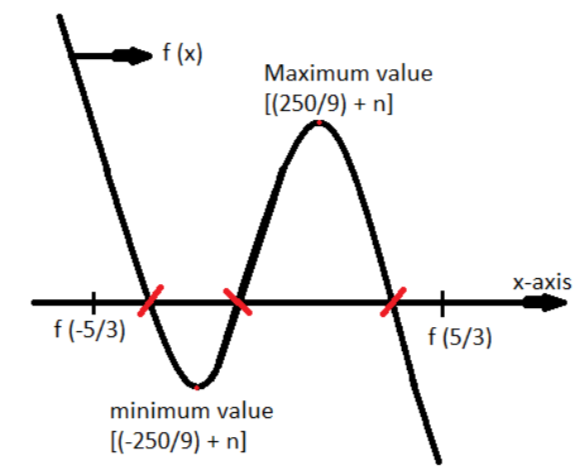
Now for the cubic equation to have three real roots $f\left( {\dfrac{{ - 5}}{3}} \right) > 0$ and $f\left( {\dfrac{5}{3}} \right) < 0$ as shown in the above figure.
Therefore, $f\left( { - \dfrac{5}{3}} \right) > 0 \Rightarrow \dfrac{{250}}{9} + n > 0$
$ \Rightarrow n > \dfrac{{ - 250}}{9}$
And
$f\left( {\dfrac{5}{3}} \right) < 0 \Rightarrow - \dfrac{{250}}{9} + n < 0$
$ \Rightarrow n < \dfrac{{250}}{9}$
Therefore,
$ - \dfrac{{250}}{9} < n < \dfrac{{250}}{9}$
$ \Rightarrow - 27.77 < n < 27.77$
Now we have to find out the integers value of n.
$ \Rightarrow n \in \left[ { - 27,27} \right]$ (I.e. closed interval from -27 to 27).
And the number of integer values from -27 to 27 is 55.
So there are 55 integers’ values of n for which the given cubic equation has 3 real roots.
So this is the required answer.
Hence option (C) is the correct answer.
Note: Whenever we face such types of questions the key concept we have to remember is that always recall that if a function crosses the x-axis then there is the real root of the function, so if a function crosses n times the x-axis then there are n real roots of the function, and always recall the basic differentiation property which is stated above.
Complete step-by-step solution:
Given equation:
$3{x^3} - 25x + n = 0$
As we see that the highest power of x is 3, so it is a cubic equation.
Let, $f\left( x \right) = 3{x^3} - 25x + n$
Now as we all know that between two roots of derivative, a function has at least 1 root.
To differentiate the given function and equate it to zero and solve for x, then on these values of x calculate the value of function f (x).
Now differentiate f (x) we have,
$ \Rightarrow \dfrac{d}{{dx}}f\left( x \right) = \dfrac{d}{{dx}}\left( {3{x^3} - 25x + n} \right)$
Now as we know that, \[\dfrac{d}{{dx}}{x^n} = n{x^{n - 1}}\] so use this property in the above equation we have,
$ \Rightarrow \dfrac{d}{{dx}}f\left( x \right) = f'\left( x \right) = 3\left( 3 \right){x^{3 - 1}} - 25 + 0$
$ \Rightarrow f'\left( x \right) = 9{x^2} - 25$
Now equate this to zero we have,
$ \Rightarrow 9{x^2} - 25 = 0$
$ \Rightarrow 9{x^2} = 25$
$ \Rightarrow {x^2} = \dfrac{{25}}{9}$
Now take square root on both sides we have,
$ \Rightarrow x = \sqrt {\dfrac{{25}}{9}} = \pm \dfrac{5}{3}$
Now double differentiate the function to check at which value function attains maxima or minima.
$ \Rightarrow \dfrac{{{d^2}}}{{d{x^2}}}f\left( x \right) = f''\left( x \right) = \dfrac{d}{{dx}}f'\left( x \right) = \dfrac{d}{{dx}}\left( {9{x^2} - 25} \right) = 18x$
So when, $x = \dfrac{5}{3}$
\[ \Rightarrow f''\left( {\dfrac{5}{3}} \right) = 18\left( {\dfrac{5}{3}} \right) = + 30\] (Positive so it is minima)
And when, $x = - \dfrac{5}{3}$
\[ \Rightarrow f''\left( { - \dfrac{5}{3}} \right) = 18\left( { - \dfrac{5}{3}} \right) = - 30\] (Negative so it is maxima)
So the value of f (x) at these roots we have,
So when, $x = \dfrac{5}{3}$
$ \Rightarrow f\left( {\dfrac{5}{3}} \right) = 3{\left( {\dfrac{5}{3}} \right)^3} - 25\left( {\dfrac{5}{3}} \right) + n$
$ \Rightarrow f\left( {\dfrac{5}{3}} \right) = \dfrac{{125}}{9} - \dfrac{{125}}{3} + n$
$ \Rightarrow f\left( {\dfrac{5}{3}} \right) = - \dfrac{{250}}{9} + n$ (Minimum value)
And when, $x = - \dfrac{5}{3}$
$ \Rightarrow f\left( { - \dfrac{5}{3}} \right) = 3{\left( { - \dfrac{5}{3}} \right)^3} - 25\left( { - \dfrac{5}{3}} \right) + n$
$ \Rightarrow f\left( { - \dfrac{5}{3}} \right) = - \dfrac{{125}}{9} + \dfrac{{125}}{3} + n$
$ \Rightarrow f\left( { - \dfrac{5}{3}} \right) = \dfrac{{250}}{9} + n$ (Maximum value)
Now for the cubic equation to have three real roots $f\left( {\dfrac{{ - 5}}{3}} \right) > 0$ and $f\left( {\dfrac{5}{3}} \right) < 0$ as shown in the above figure.
Therefore, $f\left( { - \dfrac{5}{3}} \right) > 0 \Rightarrow \dfrac{{250}}{9} + n > 0$
$ \Rightarrow n > \dfrac{{ - 250}}{9}$
And
$f\left( {\dfrac{5}{3}} \right) < 0 \Rightarrow - \dfrac{{250}}{9} + n < 0$
$ \Rightarrow n < \dfrac{{250}}{9}$
Therefore,
$ - \dfrac{{250}}{9} < n < \dfrac{{250}}{9}$
$ \Rightarrow - 27.77 < n < 27.77$
Now we have to find out the integers value of n.
$ \Rightarrow n \in \left[ { - 27,27} \right]$ (I.e. closed interval from -27 to 27).
And the number of integer values from -27 to 27 is 55.
So there are 55 integers’ values of n for which the given cubic equation has 3 real roots.
So this is the required answer.
Hence option (C) is the correct answer.
Note: Whenever we face such types of questions the key concept we have to remember is that always recall that if a function crosses the x-axis then there is the real root of the function, so if a function crosses n times the x-axis then there are n real roots of the function, and always recall the basic differentiation property which is stated above.
Recently Updated Pages
Which of the following graphs shows the variation of class 12 physics CBSE

Draw a labelled diagram of the human male reproductive class 12 biology CBSE
Describe the experiment to compare the emf of two cells class 12 physics CBSE
What is standard hydrogen electrode
What is conventional current and electric current class 12 physics CBSE
2Bromopentane is treated with an alcoholic KOH solution class 12 chemistry CBSE
Trending doubts
Draw a labelled sketch of the human eye class 12 physics CBSE
Which are the Top 10 Largest Countries of the World?
Differentiate between homogeneous and heterogeneous class 12 chemistry CBSE
Draw ray diagrams each showing i myopic eye and ii class 12 physics CBSE
Which is the correct genotypic ratio of mendel dihybrid class 12 biology CBSE
What is the Full Form of PVC, PET, HDPE, LDPE, PP and PS ?