




The motion of a particle is given by y=a sin$\omega t$ . What would be the time period of motion for this particle?
A) T=$\dfrac{\pi }{{2\omega }}$
B) T=$\dfrac{\pi }{\omega }$
C) T=$\dfrac{{2\pi }}{\omega }$
D) T=$\dfrac{{4\pi }}{\omega }$
Answer
 Verified
604.5k+ views
Hint:SHM Simple Harmonic Motion. The solution lies in the equation of the SHM. In SHM the particle moves from mean position to +A then again to mean position and after that toward –A and come back to its original point. It keeps oscillating but covers in $2\pi $ time.
Step by step solution:
Step 1:
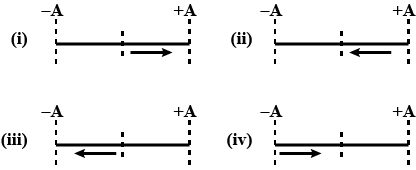
Before considering the SHM, have a look on the image and it will clear the vision on how particle oscillate
Step 2:
In (i) situation it is clearly visible that particle is at mean position and just started its oscillation, whenever a particle just starts its oscillation then it has no phase difference that means $\phi $ is zero
In the first case the particle starts from the rest and goes to the extreme position +A . In part II it is returning from the extreme position, we can infer from this that the particle has a phase difference this time now.
The phase difference this time will be equal to $\pi $ because whenever a particle comes from the extreme position it has a phase difference equal to $\pi $ . Positive and negative signs depend on where it is coming from.
In (iii) this time from the origin to +A particle has covered A distance and then returned back to the mean position that means again a distance of A and now it is going to –A which is again at a distance of A from the mean position.
This time the phase distance will be equal to 3A and for this the phase difference will be equal to $\dfrac{{3\pi }}{2}$
In (iv) the particle returning from the extreme position of –A and phase will be $2\pi $
From above statements we can rewrite it as, $\omega T$ =$2\pi $ or T =$\dfrac{{2\pi }}{\omega }$
That means Time period will be equal to $\dfrac{{2\pi }}{\omega }$ . So, Option C. is correct.
Note: In simple harmonic motion the curve travels a sine graph. It starts from the rest at zero position and then continues its oscillation until it has energy.
All the oscillations are simple harmonic motion but all the simple harmonic motion can’t be said as oscillatory motion.
Step by step solution:
Step 1:
Before considering the SHM, have a look on the image and it will clear the vision on how particle oscillate
Step 2:
In (i) situation it is clearly visible that particle is at mean position and just started its oscillation, whenever a particle just starts its oscillation then it has no phase difference that means $\phi $ is zero
In the first case the particle starts from the rest and goes to the extreme position +A . In part II it is returning from the extreme position, we can infer from this that the particle has a phase difference this time now.
The phase difference this time will be equal to $\pi $ because whenever a particle comes from the extreme position it has a phase difference equal to $\pi $ . Positive and negative signs depend on where it is coming from.
In (iii) this time from the origin to +A particle has covered A distance and then returned back to the mean position that means again a distance of A and now it is going to –A which is again at a distance of A from the mean position.
This time the phase distance will be equal to 3A and for this the phase difference will be equal to $\dfrac{{3\pi }}{2}$
In (iv) the particle returning from the extreme position of –A and phase will be $2\pi $
From above statements we can rewrite it as, $\omega T$ =$2\pi $ or T =$\dfrac{{2\pi }}{\omega }$
That means Time period will be equal to $\dfrac{{2\pi }}{\omega }$ . So, Option C. is correct.
Note: In simple harmonic motion the curve travels a sine graph. It starts from the rest at zero position and then continues its oscillation until it has energy.
All the oscillations are simple harmonic motion but all the simple harmonic motion can’t be said as oscillatory motion.
Recently Updated Pages
Master Class 11 Social Science: Engaging Questions & Answers for Success

Master Class 11 Physics: Engaging Questions & Answers for Success
Master Class 11 Maths: Engaging Questions & Answers for Success
Master Class 11 Economics: Engaging Questions & Answers for Success
Master Class 11 Computer Science: Engaging Questions & Answers for Success
Master Class 11 Chemistry: Engaging Questions & Answers for Success
Trending doubts
One Metric ton is equal to kg A 10000 B 1000 C 100 class 11 physics CBSE
There are 720 permutations of the digits 1 2 3 4 5 class 11 maths CBSE
1 Quintal is equal to a 110 kg b 10 kg c 100kg d 1000 class 11 physics CBSE
State and prove Bernoullis theorem class 11 physics CBSE
Difference Between Prokaryotic Cells and Eukaryotic Cells
Discuss the various forms of bacteria class 11 biology CBSE